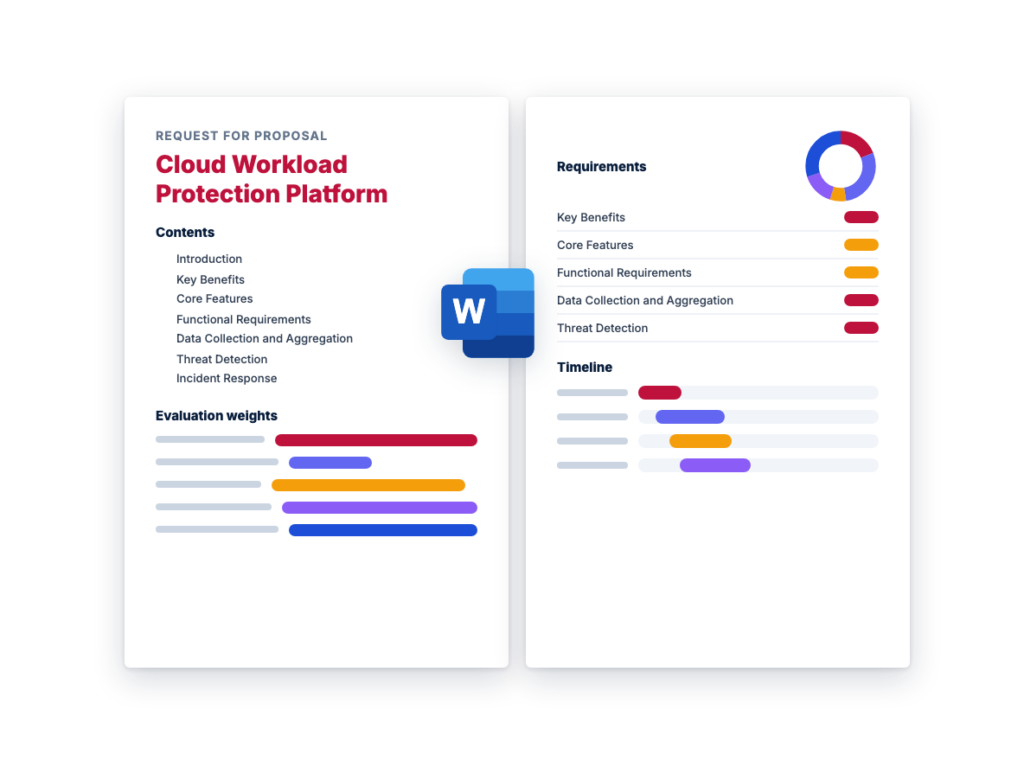
Request for Proposal: Cloud Workload Protection Platform
Table of Contents
- Introduction
- Key Benefits
- Core Features
- Functional Requirements
- Integration Requirements
- Emerging Trends
- Implementation and Support
- Compliance and Certifications
- Pricing and Licensing Model
- Case Studies and References
- Evaluation Criteria
- Timeline
1. Introduction
This Request for Proposal (RFP) seeks a Cloud Workload Protection Platform (CWPP). CWPPs are specialized security solutions designed to safeguard workloads—such as applications, databases, and services—across diverse cloud environments, including public, private, and hybrid clouds. These platforms offer comprehensive visibility, threat detection, and automated responses to ensure the integrity and security of cloud-based operations.
2. Key Benefits
The proposed solution must deliver the following key benefits:
- Enhanced Security Posture
- Comprehensive threat protection
- Proactive security measures
- Advanced threat intelligence
- Operational Efficiency
- Streamlined security operations
- Automated security processes
- Reduced manual intervention
- Scalability
- Support for growing cloud environments
- Performance optimization
- Resource management
- Compliance Assurance
- Regulatory compliance management
- Automated compliance monitoring
- Compliance reporting
- Cross-Cloud Management
- Unified security across cloud platforms
- Consistent policy enforcement
- Centralized management
3. Core Features
Vendors must demonstrate capabilities in the following core areas:
- Automated Discovery and Visibility
- Real-time asset discovery
- Comprehensive visibility across environments
- Resource mapping
- Threat Detection and Response
- Advanced threat detection
- Automated response capabilities
- Incident management
- Workload Hardening
- Security configuration management
- Vulnerability management
- System hardening
- Asset Discovery
- Continuous asset monitoring
- Asset classification
- Inventory management
- Anomaly Detection
- Behavioral analysis
- Pattern recognition
- Alert generation
- Data Security
- Data protection
- Encryption management
- Access control
- Governance
- Policy management
- Compliance monitoring
- Risk assessment
- Logging and Reporting
- Comprehensive logging
- Custom reporting
- Analytics dashboards
4. Functional Requirements
4.1 Data Collection and Aggregation
Tip: Effective data collection and aggregation forms the foundation of your CWPP solution. Focus on comprehensive data gathering capabilities across all cloud environments while considering performance impact and storage requirements. Look for solutions that can handle high-volume data processing in real-time.
| Requirement |
Sub-Requirement |
Y/N |
Notes |
| Data Collection and Aggregation |
Collection from multiple cloud providers (AWS, Azure, GCP) |
|
|
|
Real-time data gathering from cloud workloads |
|
|
|
Log collection and aggregation |
|
|
|
Performance metrics collection |
|
|
|
Configuration data gathering |
|
|
|
Network traffic monitoring |
|
|
|
API-level data collection |
|
|
4.2 Threat Detection
Tip: Advanced threat detection capabilities should combine multiple detection methods to provide comprehensive protection. Consider solutions that leverage both traditional signature-based detection and modern ML-powered analysis to minimize false positives while maintaining high detection rates.
| Requirement |
Sub-Requirement |
Y/N |
Notes |
| Threat Detection |
Signature-based detection |
|
|
|
Machine learning analysis |
|
|
|
Behavioral analytics |
|
|
|
Vulnerability scanning |
|
|
|
Malware detection |
|
|
|
Zero-day threat detection |
|
|
|
Advanced persistent threat (APT) detection |
|
|
4.3 Incident Response
Tip: Automated incident response capabilities are crucial for maintaining security in cloud environments where threats can spread rapidly. Ensure the solution provides both automated and manual response options with clear workflows and audit trails.
| Requirement |
Sub-Requirement |
Y/N |
Notes |
| Incident Response |
Automated threat containment |
|
|
|
System isolation capabilities |
|
|
|
Traffic blocking mechanisms |
|
|
|
Automated remediation workflows |
|
|
|
Incident playbook execution |
|
|
|
Manual response options |
|
|
|
Post-incident analysis tools |
|
|
4.4 Alert Prioritization
Tip: Effective alert prioritization is essential for managing security operations at scale. Look for solutions that use intelligent algorithms to reduce alert fatigue while ensuring critical threats don’t go unnoticed.
| Requirement |
Sub-Requirement |
Y/N |
Notes |
| Alert Prioritization |
Risk-based alert ranking |
|
|
|
Alert correlation capabilities |
|
|
|
Custom alert rules |
|
|
|
Alert suppression options |
|
|
|
Automated alert triage |
|
|
|
Alert context enrichment |
|
|
|
Historical alert analysis |
|
|
4.5 Compliance Management
Tip: Comprehensive compliance management features should support both standard regulatory frameworks and custom compliance policies. Consider solutions that automate compliance monitoring and reporting to reduce manual oversight requirements.
| Requirement |
Sub-Requirement |
Y/N |
Notes |
| Compliance Management |
Industry regulation enforcement |
|
|
|
Policy monitoring capabilities |
|
|
|
Compliance reporting tools |
|
|
|
Custom policy creation |
|
|
|
Automated compliance checks |
|
|
|
Compliance violation alerts |
|
|
|
Audit trail maintenance |
|
|
4.6 Scalability
Tip: Scalability is critical for growing cloud environments. Evaluate solutions based on their ability to scale both horizontally and vertically while maintaining performance and effectiveness across all protected workloads.
| Requirement |
Sub-Requirement |
Y/N |
Notes |
| Scalability |
Support for growing workload volume |
|
|
|
Cross-cloud scaling capabilities |
|
|
|
Performance optimization features |
|
|
|
Resource usage efficiency |
|
|
|
Automatic scaling mechanisms |
|
|
|
Load balancing capabilities |
|
|
|
Multi-region support |
|
|
4.7 Integration with Existing Systems
Tip: Strong integration capabilities ensure your CWPP solution works seamlessly with your existing security infrastructure. Focus on standard API support and pre-built integrations with common security tools.
| Requirement |
Sub-Requirement |
Y/N |
Notes |
| Integration Capabilities |
Security tool API integration |
|
|
|
SIEM integration |
|
|
|
SOAR platform integration |
|
|
|
Identity management integration |
|
|
|
Custom API development options |
|
|
|
Webhook support |
|
|
|
Third-party plugin support |
|
|
4.8 Data Privacy Management
Tip: Data privacy features should address both regulatory requirements and internal security policies. Consider solutions that provide granular control over sensitive data handling and strong encryption capabilities.
| Requirement |
Sub-Requirement |
Y/N |
Notes |
| Data Privacy Management |
Sensitive data handling |
|
|
|
Encryption implementation |
|
|
|
Access control features |
|
|
|
Data masking capabilities |
|
|
|
Privacy policy enforcement |
|
|
|
Data classification tools |
|
|
|
Privacy compliance reporting |
|
|
4.9 AI-Driven Capabilities
Tip: AI capabilities should enhance both security operations and threat detection. Look for solutions that demonstrate practical applications of AI/ML beyond marketing buzzwords, with clear benefits to security outcomes.
| Requirement |
Sub-Requirement |
Y/N |
Notes |
| AI-Driven Capabilities |
AI workload security monitoring |
|
|
|
AI-generated remediation steps |
|
|
|
IAM policy optimization |
|
|
|
AI-generated alert descriptions |
|
|
|
Intelligent anomaly detection |
|
|
|
AI model/package detection |
|
|
|
AI-enhanced attack path analysis |
|
|
|
AI inventory management |
|
|
|
AI-specific runtime policies |
|
|
5. Integration Requirements
The CWPP solution must integrate with:
- Endpoint Detection and Response (EDR) systems
- Data Center Security Software
- Cloud Management Platforms
- Cloud Compliance Software
6. Emerging Trends
Vendors must address their approach to:
- AI and Machine Learning Integration for enhanced threat detection and response
- Shift-Left Security practices
- Integration with Cloud Security Posture Management (CSPM)
7. Implementation and Support
Vendors must provide detailed information on:
- Implementation process and timeline
- Training and onboarding support
- Ongoing technical support and SLAs
- Regular updates and patch management
8. Compliance and Certifications
Vendors must specify:
- Relevant industry certifications (e.g., ISO 27001, SOC 2)
- Compliance with data protection regulations (e.g., GDPR, CCPA)
9. Pricing and Licensing Model
Vendors must provide:
- Detailed pricing structure
- Licensing models (per user, per workload, or enterprise-wide)
- Additional costs for premium features or support
10. Case Studies and References
Vendors must include:
- Relevant case studies demonstrating CWPP implementation success
- References from clients in similar industries or with comparable cloud environments
11. Evaluation Criteria
Proposals will be evaluated based on:
- Feature completeness
- Ease of use and management
- Scalability and performance
- Integration capabilities
- AI and machine learning capabilities
- Pricing and total cost of ownership
- Vendor reputation and support quality
Contact Information:
- Timeline
- RFP Release Date: [Date]
- Questions Deadline: [Date]
- Proposal Due Date: [Date]
- Vendor Presentations: [Date Range]
- Selection Date: [Date]
- Project Start Date: [Date]
Download Template