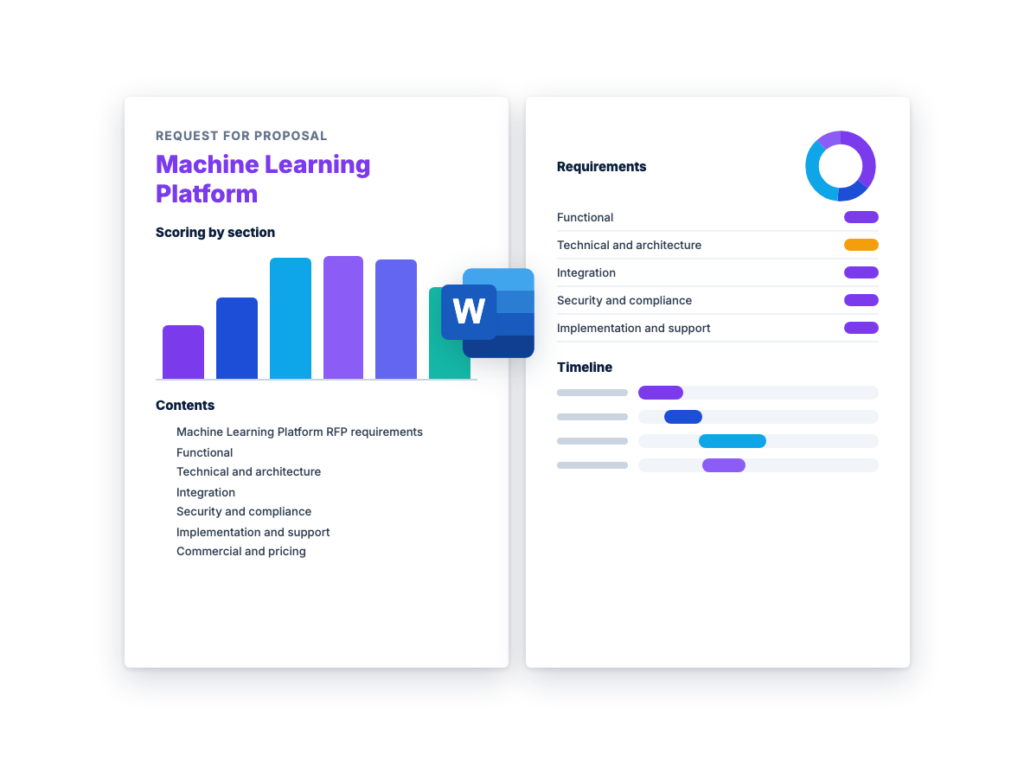
How to run a Machine Learning Platform RFP
A machine learning platform is used every day by data scientists and engineers, and it reaches into your data platform, cloud accounts and security controls, so most of the work is agreeing on scope and testing with the people who will use it. The example schedule below runs about 13 weeks from kickoff to contract award; stretch it if you are comparing several deployment models or if a model risk team must approve the platform.
- Agree on use cases and scope (weeks 1-2). List the models you build today and the ones you plan: forecasting, classification, recommendations, computer vision, document processing or LLM applications. Record the numbers vendors will price against: data scientists, ML engineers and analysts by team, models in production, data volumes, expected GPU needs, and where your data lives (data warehouse, lakehouse, object storage).
- Assemble the buying team. Include data science leads and the practitioners who will use the platform daily, ML engineers, data engineering, cloud infrastructure, security, model risk or AI governance, legal and privacy, procurement and finance. Bring finance in early: compute charges, especially for GPUs, may be billed separately from the license fee, so decide how they will be budgeted and charged back to teams.
- Settle the architecture, and decide whether you need an RFI (weeks 2-4). Decide where the platform will run (vendor-hosted SaaS, your own cloud account, on-premises or a mix) and whether it must work on top of your existing data platform instead of copying data into its own storage. If you're unsure whether you need a full machine learning platform or only an MLOps platform, or your long list has more than five vendors, issue a short RFI first (see the questions below) and use the answers to build a shortlist.
- Tailor and issue the RFP (weeks 4-7). Delete requirements that don't apply, adjust priorities, and add your environment details to Section 1. Prepare a representative dataset (masked if needed) and a sample use case now, so the proof of concept can start on time. Give vendors three weeks to respond, with a written question-and-answer window in the first week.
- Score the responses (weeks 7-8). Have each evaluator score independently against the rubric before comparing notes, and set aside any vendor that misses a Must-have. Check every 'yes' for whether the feature is generally available today or still in preview, especially for generative AI features, and whether it needs an extra module or license.
- Run a proof of concept with two or three vendors (weeks 8-12). Give each vendor the same dataset and use case. Have your own data scientists take a model from a notebook to a monitored endpoint: training on GPUs, registering and approving the model, deploying it, triggering a drift alert and rolling back. Track the compute each vendor's platform uses so you can test its cost estimate, and call references of a similar size.
- Negotiate and award (weeks 12-13). Use the pricing table to compare like for like, including compute for your real workloads, not just license fees. Settle renewal caps, unit rates for compute and exit terms, including export of models, code and experiment history, before you sign, not after.
Machine learning platform vs MLOps platform: which RFP do you need?
A machine learning platform, often called a data science and machine learning (DSML) platform, covers the whole model lifecycle in one product: data access and preparation, notebooks and IDEs, experiment tracking, AutoML, training, deployment and monitoring. Choose this RFP when you need one shared environment where data scientists and analysts build models, and you want deployment and monitoring included.
An MLOps platform focuses on the second half of that lifecycle: pipelines, model registry, deployment, monitoring and governance for models that may be built elsewhere. Choose an MLOps RFP when your teams are happy with their development tools and the gap is getting models into production and keeping them healthy. If you can't tell which gap matters more, run a short RFI before you commit to either.
Questions worth asking in a machine learning platform RFI:
- Which parts of the lifecycle (data preparation, notebooks, experiment tracking, AutoML, training, registry, serving, monitoring) do you build and support yourself, and which rely on partners or open-source components?
- Do you offer vendor-hosted SaaS, deployment in our cloud account, on-premises, or all three? Which features differ between them?
- Which clouds, data warehouses and lakehouses do you run on or connect to without copying data?
- How do you provide GPU capacity, and can we use our own cloud commitments?
- What is your pricing model (per user, per compute unit, per endpoint, platform fee), and is compute billed by you or by our cloud provider?
- Which generative AI capabilities (fine-tuning, LLM evaluation, RAG, access to hosted models) are generally available today?
- What does a deployment for an organization of our size involve, and who delivers it?
Machine Learning Platform RFP requirements
Each line is written to paste straight into your RFP. Must-have means a vendor that cannot meet it is out; Nice-to-have earns extra points. Change the priorities to fit your situation, and delete what doesn't apply.
Functional
| ID |
Requirement |
Priority |
| F1 |
Managed notebooks compatible with the Jupyter format, plus browser-based and desktop IDE access, for Python, R and SQL. Each project has a reproducible environment (container image and pinned packages from our approved repositories) that users can adjust within limits set by administrators. |
Must-have |
| F2 |
Data exploration and preparation on large datasets, including profiling, cleaning, joins and transformations, using distributed processing (for example Apache Spark or a comparable engine), with a record of the dataset and version used to train each model. |
Must-have |
| F3 |
Visual, low-code tools for analysts to prepare data and build models, producing work that data scientists can open and extend in code. |
Nice-to-have |
| F4 |
Feature engineering tools and a feature store (built in or integrated) where teams define, document, share and reuse features, with point-in-time correct joins when building training sets. State whether low-latency online serving of the same features is included. |
Must-have |
| F5 |
Automatic experiment tracking that records code version, parameters, metrics, datasets, environment and output artifacts for every run, with side-by-side comparison. Hyperparameter tuning (for example random or Bayesian search with early stopping) runs trials in parallel and is tracked the same way. |
Must-have |
| F6 |
AutoML for classification, regression and time-series forecasting, with a leaderboard of candidate models and full visibility of the preprocessing, algorithm and settings behind each one. |
Must-have |
| F7 |
Pipelines that chain data preparation, training, evaluation and deployment steps, run on a schedule or triggered by events such as new data, with a human approval step before a retrained model is promoted. |
Must-have |
| F8 |
A model registry with versioning, stages or aliases (for example staging and production), approval workflows, and links from each version to the experiment, code and data that produced it. |
Must-have |
| F9 |
Deployment of registered models as real-time API endpoints and as batch scoring jobs, directly from the registry, without rewriting the model. |
Must-have |
| F10 |
Controlled rollout of new model versions, such as traffic splitting between versions or shadow deployment, and rollback to the previous version in one step. |
Must-have |
| F11 |
Monitoring of deployed models for data drift, prediction drift and accuracy (once actual outcomes are available), plus latency, errors and throughput, with alert thresholds we can set per model. |
Must-have |
| F12 |
Explainability for whole models and for individual predictions (for example feature-attribution methods), with results stored alongside the model version so reviewers can see them. |
Must-have |
| F13 |
Fine-tuning of open-weight foundation models on our data, including parameter-efficient methods such as LoRA, with fine-tuned models tracked, registered and deployed like any other model. |
Nice-to-have |
| F14 |
Evaluation of LLM and other generative AI output before release: test datasets, automated metrics, LLM-as-a-judge scoring and human review, compared across prompts, models and versions. Make this Must-have if generative AI is in scope. |
Nice-to-have |
| F15 |
Tools for building retrieval-augmented generation (RAG) applications: document ingestion and chunking, embedding generation, connection to a vector index or vector database, prompt versioning, and tracing of each request in production. |
Nice-to-have |
| F16 |
A governed gateway to hosted foundation models, where administrators control which models teams may use and set usage limits, with usage and cost reported by project. |
Nice-to-have |
| F17 |
An AI assistant in notebooks and IDEs that helps write, explain and debug code, with administrator control over which model it uses and what data it can see. |
Nice-to-have |
Technical and architecture
| ID |
Requirement |
Priority |
| T1 |
Clearly stated deployment options: vendor-hosted SaaS, deployment in our own cloud account on [cloud provider], on-premises, or hybrid. Identify any feature that is not available in the option you propose. |
Must-have |
| T2 |
Elastic CPU and GPU compute for notebooks, jobs and endpoints that starts on demand and shuts down automatically when idle, with idle timeouts set by administrators. |
Must-have |
| T3 |
Distributed training across multiple GPUs and nodes for common open-source frameworks (for example PyTorch, TensorFlow and XGBoost), with checkpointing so a failed or interrupted job can resume. |
Must-have |
| T4 |
Access to the GPU types we need [list], with a statement of how capacity is provided (reserved, on-demand or through our own cloud commitments) and what happens to queued work when capacity is not available. |
Must-have |
| T5 |
Model endpoints with autoscaling, high availability (for example across availability zones), and documented limits for latency, throughput and model size. |
Must-have |
| T6 |
Export of trained models in standard formats (framework-native files, ONNX or container images) that run outside the platform, and export of experiment and registry metadata through an API. |
Must-have |
| T7 |
Optimization of models for edge or on-premises inference, such as quantization and compilation for target hardware, and management of models deployed to edge devices. |
Nice-to-have |
| T8 |
Compute quotas and budgets by user, project and team, with usage and cost reports and alerts before limits are reached. |
Must-have |
Integration
| ID |
Requirement |
Priority |
| I1 |
Single sign-on with our identity provider via SAML 2.0 or OIDC, with user and group provisioning via SCIM. |
Must-have |
| I2 |
Native connectors to our data sources [list: data warehouse, lakehouse, relational databases, object storage, streaming], processing data in place where possible rather than copying it. State whether users' own permissions in the source are enforced or a shared service account is used. |
Must-have |
| I3 |
Integration with our Git provider [cloud or self-hosted], so notebooks, code and pipeline definitions are versioned with branches and pull requests. |
Must-have |
| I4 |
A documented REST API, Python SDK and command-line interface covering the main platform functions, so training, testing and deployment can run from our existing CI/CD pipelines. |
Must-have |
| I5 |
Infrastructure-as-code support (for example a Terraform provider) for workspaces, permissions, compute settings and endpoints. |
Nice-to-have |
| I6 |
Export of audit logs to our SIEM, and of model, endpoint and pipeline metrics to our monitoring tools, in documented formats. |
Must-have |
| I7 |
Integration with our data catalog or governance tool, so datasets, features and models appear there with owners and lineage. |
Nice-to-have |
Security and compliance
| ID |
Requirement |
Priority |
| S1 |
A current SOC 2 Type II report and ISO/IEC 27001 certification covering the proposed services, available under NDA. State whether you hold ISO/IEC 42001 (AI management system) certification. |
Must-have |
| S2 |
Encryption in transit and at rest. State whether customer-managed encryption keys are supported, and for which data and artifacts. |
Must-have |
| S3 |
Private network connectivity for notebooks, data access and model endpoints, so traffic does not need to cross the public internet, plus control over outbound internet access from workloads. |
Must-have |
| S4 |
Role-based access control by workspace, project, dataset, model and endpoint, managed through groups from our identity provider with MFA enforced, plus an audit log of user and administrator actions, including data access, approvals and deployments. |
Must-have |
| S5 |
Lineage from source data through features, experiments and model versions to deployed endpoints, viewable in the platform and exportable for audit. |
Must-have |
| S6 |
AI governance workflows: a model inventory, risk classification, documentation such as model cards, bias and fairness testing, and approval sign-offs, to support obligations such as the EU AI Act or model risk management rules. Make this Must-have if you are in a regulated industry. |
Nice-to-have |
| S7 |
Integration with our secrets manager, so credentials for data sources and APIs are not stored in notebooks or code. |
Must-have |
| S8 |
A data processing agreement, a current list of sub-processors, a choice of region for storing and processing our data, models and logs, and a contractual commitment to notify us of security incidents within a defined time. State the time. |
Must-have |
| S9 |
A contractual commitment that our data, code, prompts and models are not used to train the vendor's or any third party's models, including through built-in AI assistants and hosted model services. |
Must-have |
Implementation and support
| ID |
Requirement |
Priority |
| M1 |
An implementation plan covering platform setup, integration with our identity, data, Git and CI/CD systems, and migration of priority projects and models from current tools, with named roles and the effort expected from both sides. |
Must-have |
| M2 |
Identification of who delivers the implementation (vendor, partner or both) and the relevant experience of the named team. |
Must-have |
| M3 |
A service-level agreement for platform availability and for model-serving endpoints, with service credits. State how availability is measured and what the SLA covers when the platform runs in our cloud account. |
Must-have |
| M4 |
24×7 support for issues that affect production models, with response-time targets by severity. State your targets. |
Must-have |
| M5 |
A published support policy for runtimes, framework versions and APIs, with advance notice before upgrades or deprecations affect running jobs or endpoints. |
Must-have |
| M6 |
Role-based training and documentation for data scientists, ML engineers, analysts and administrators, including example projects. |
Must-have |
| M7 |
Hands-on help from the vendor's specialists on our first production use cases, a named customer success contact, and periodic reviews of usage and cost. |
Nice-to-have |
Commercial and pricing
| ID |
Requirement |
Priority |
| C1 |
Pricing broken down by component (user licenses by role, platform fees, compute by instance or GPU type, model serving, storage and optional modules) and by term, showing list price, discount and net price, plus prices for adding users or modules mid-term. |
Must-have |
| C2 |
A worked cost estimate for the workloads described in Section 1 (interactive development, training and serving), stating every assumption and which charges are billed by you and which by our cloud provider. |
Must-have |
| C3 |
A cap on price increases at renewal, including unit rates for compute. State the cap. |
Must-have |
| C4 |
Terms that apply if we exceed committed usage or user counts, and whether unused committed spend carries over. |
Must-have |
| C5 |
Pricing that ramps with adoption, so we don't pay for full capacity before teams are onboarded. |
Nice-to-have |
| C6 |
A proof of concept at no charge, including the compute it needs and the vendor's engineering support. |
Nice-to-have |
| C7 |
Exit terms covering export of code, notebooks, models, features, experiment history and metadata in usable formats, plus transition assistance at the end of the contract. |
Must-have |
Questions to ask Machine Learning Platform vendors
These questions are designed to separate vendors, not to collect brochure answers. Ask for evidence: a demo, a document or a reference.
- Demonstrate, live, one model going from a notebook to a monitored production endpoint: tracking, registration, approval, deployment, a drift alert and rollback. Which steps need a separate product, module or license?
- Which capabilities in your proposal do you build and support yourself, and which depend on open-source components or partners? Who fixes a defect in each, and how quickly?
- How does the platform work with our data warehouse or lakehouse without copying data? Where is the data processed, and whose permissions apply when a notebook reads it?
- Show how one feature is defined once and used for both training and real-time serving. How do you prevent training-serving skew and leakage of future values into training data?
- How does your drift monitoring work when actual outcomes arrive weeks after a prediction? Show the alert, the investigation view and the link to retraining.
- What happens to a queued training job when the GPU type it needs is not available? How is GPU capacity guaranteed for us, and at what cost?
- How is compute billed: by you, by our cloud provider, or both? Give an itemized monthly estimate for the workloads in Section 1, and show the controls that stop idle notebooks and unused endpoints from running up costs.
- Which generative AI capabilities (fine-tuning, LLM evaluation, RAG building, tracing, a model gateway) are generally available in the proposed edition, which are in preview, and which cost extra?
- Show how we would evaluate an LLM application before release: the test dataset, the metrics, LLM-as-a-judge scoring, human review, and the comparison between two versions.
- What does your AI coding assistant send to which model? Can we restrict it to a model and region we approve, or switch it off?
- Show the lineage and documentation a model risk reviewer or auditor would see for one production model, and how we would export it.
- How long do you support each runtime and framework version, and how much notice do you give before an upgrade affects a running job or endpoint?
- If we leave, what can we take with us in usable form: code, notebooks, models, features, experiment history, lineage and registry metadata? Show us the export.
- Which features in your proposal are generally available today, and which are in preview or on the roadmap? Give dates for the roadmap items.
- Provide a reference customer of similar size and industry that runs production models on your platform, ideally one that moved to you from another platform.
Scoring rubric
Score each criterion from 1 to 5, multiply by its weight, and add the results. The weights below are a starting point; agree on your own before any proposals arrive so the scoring can't be bent around a favorite.
| Criterion |
Weight |
What a strong response shows |
| Model development and data science productivity |
20% |
Your data scientists worked productively in the proof of concept: familiar notebooks and IDEs, reproducible environments, and experiment tracking that works by default. |
| Deployment, monitoring and model lifecycle |
20% |
A model moved from notebook to a monitored endpoint and was rolled back during the proof of concept, without custom glue code. |
| Compute, scale and GPU access |
10% |
Distributed GPU training that worked on your data, a clear capacity commitment, and automatic shutdown of idle resources. |
| Generative AI support |
5% |
Fine-tuning, LLM evaluation and RAG features that are generally available and were demonstrated, not described. Raise this weight if generative AI is a main driver. |
| Integration, architecture and portability |
10% |
Works on top of your data platform, identity provider, Git and CI/CD; a deployment model that fits your cloud strategy; models and metadata you can export. |
| Security, governance and compliance |
10% |
Private networking, fine-grained access control, end-to-end lineage, audit logs, and a contractual commitment not to train on your data. |
| Implementation and support |
10% |
A credible plan with a named, experienced team, clear SLAs for serving endpoints, and a published runtime support policy. |
| Commercials and total cost |
15% |
Transparent license and compute pricing, a cost estimate that held up in the proof of concept, a renewal cap and fair exit terms over a three-year view. |
| Total |
100% |
|
Scoring scale
- 5 Exceeds: meets every Must-have and most Nice-to-haves, shown in a demo or proof of concept, with a matching reference customer.
- 4 Strong: meets every Must-have and some Nice-to-haves, with clear evidence.
- 3 Adequate: meets most Must-haves; gaps have a credible workaround or a dated roadmap commitment.
- 2 Weak: misses one or more Must-haves, or the answer is vague.
- 1 Poor: does not meet the requirement, or no answer.
Frequently asked questions
What should a machine learning RFP include?
Your use cases, users and data platform; requirements for notebooks and IDEs, data preparation, feature store, experiment tracking, AutoML, GPU training, model registry, deployment and drift monitoring, each marked Must-have or Nice-to-have; architecture, integration, security and governance requirements; any generative AI needs; support terms; a pricing table that separates licenses from compute; and the rubric you'll score with. This template includes all of them.
What is a DSML platform?
DSML stands for data science and machine learning. A DSML platform brings together the tools to access and prepare data, build and train models in code or with low-code tools, and deploy, monitor and govern those models in production. The terms machine learning platform and DSML platform describe the same category, and this template covers both.
Should a machine learning platform RFP cover generative AI?
Include it if you plan to fine-tune open-weight models, evaluate large language model (LLM) output or build retrieval-augmented generation (RAG) applications on the same platform. Support for this work varies between platforms and changes quickly, so this template marks those requirements Nice-to-have. Raise them to Must-have if generative AI is a main driver, and ask vendors to demonstrate each one rather than describe it.
How long does a machine learning platform RFP take?
The example schedule in this template runs about 13 weeks from kickoff to contract award, including three weeks for vendor responses and four weeks for a proof of concept. Allow more time if security review of a deployment in your own cloud account is new to your organization, or if a model risk team must approve the platform.
How do you evaluate machine learning platform vendors?
Score the written responses against a weighted rubric agreed before proposals arrive, then run a proof of concept with two or three vendors using the same dataset and use case. Have your own data scientists take a model from a notebook to a monitored endpoint, and track the compute it uses, so you test both the day-to-day experience and the cost estimate. Treat any feature you can't see working as a roadmap item.
Related RFP templates
Download Template