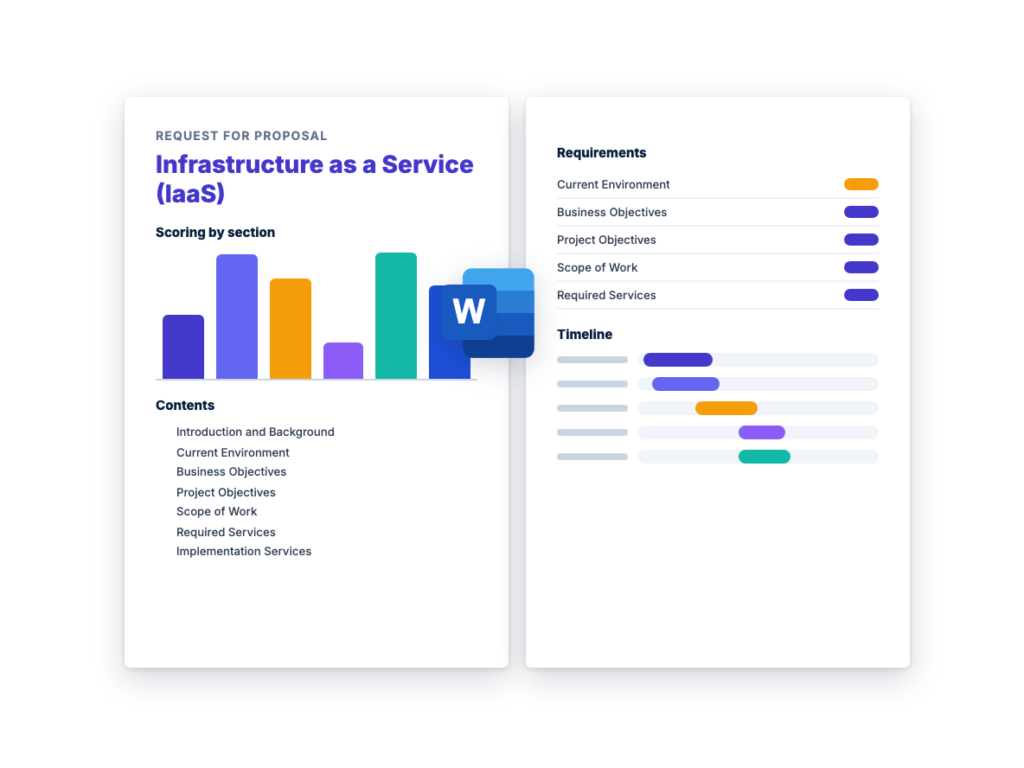
Request for Proposal (RFP): Infrastructure as a Service (IaaS) Solution
Table of Contents
- Introduction and Background
- Project Objectives
- Scope of Work
- Technical Requirements
- Functional Requirements
- AI and Advanced Features
- Vendor Qualifications
- Evaluation Criteria
- Submission Guidelines
- Timeline
1. Introduction and Background
[Company Name] is seeking proposals for a comprehensive Infrastructure as a Service (IaaS) solution to support our organization’s cloud computing needs. This RFP outlines our requirements for a scalable, flexible, and cost-effective cloud infrastructure that will enable our digital transformation initiatives.
Current Environment
[Describe your current infrastructure setup, including:]
- Number of physical servers
- Current virtualization platform (if any)
- Storage capacity requirements
- Network configuration
- Number of users/applications to be supported
Business Objectives
[Outline your organization’s key business goals for moving to IaaS]
2. Project Objectives
The primary objectives of this IaaS implementation project are to:
- Establish a scalable and flexible cloud infrastructure
- Optimize IT infrastructure costs through pay-per-use model
- Enhance operational efficiency and agility
- Improve disaster recovery and business continuity capabilities
- Enable faster deployment of new services and applications
- Strengthen security and compliance posture
3. Scope of Work
Required Services
- Virtualization Services
- Virtual machine provisioning and management
- Multiple operating system support
- Resource allocation and scaling capabilities
- Storage Solutions
- Scalable cloud storage options
- Support for block, object, and file storage
- Database management capabilities
- Network Services
- Network provisioning and management
- Load balancing
- Content delivery network options
- Traffic management tools
- Security Services
- Access control and authentication
- Data encryption
- Network security
- Compliance management
Implementation Services
- Migration planning and execution
- Integration with existing systems
- Training and knowledge transfer
- Ongoing support and maintenance
4. Technical Requirements
4.1 Infrastructure Types
- Support for public, private, and hybrid cloud deployments
- Bare metal servers and high-performance computing (HPC) options
- Customizable virtual machines with flexible resource allocation
4.2 Performance Requirements
- Guaranteed high availability and uptime (specify SLA requirements)
- Low-latency network connections
- High-throughput data processing capabilities
- Performance monitoring and optimization tools
4.3 Compatibility Requirements
- Support for major operating systems and containerization platforms
- Integration capabilities with common development tools and frameworks
- Cross-platform compatibility
4.4 Security and Compliance
- Industry-standard compliance certifications (ISO 27001, SOC 2)
- Region-specific data residency options
- Advanced encryption standards
- Security monitoring and threat detection
- Access control and authentication mechanisms
4.5 Disaster Recovery and Backup
- Robust disaster recovery solutions
- Automated backup and restore capabilities
- Geographic redundancy options
- Recovery time and point objectives (RTO/RPO)
- Business continuity features
5. Functional Requirements
5.1 Virtualization Capabilities
Tip: Virtualization infrastructure must balance performance, flexibility, and resource utilization while ensuring seamless scalability. Consider solutions that offer comprehensive VM management, diverse OS support, efficient resource allocation, and robust monitoring capabilities.
| Requirement |
Sub-Requirement |
Y/N |
Notes |
| VM Customization |
Custom CPU allocation |
|
|
|
Custom memory allocation |
|
|
|
Storage configuration options |
|
|
|
Network interface customization |
|
|
| OS Support |
Windows Server support |
|
|
|
Linux distribution support |
|
|
|
Custom image support |
|
|
|
Container platform support |
|
|
| Scaling Features |
Automatic vertical scaling |
|
|
|
Automatic horizontal scaling |
|
|
|
Resource pool management |
|
|
|
Load-based scaling rules |
|
|
| Management Tools |
VM lifecycle management |
|
|
|
Template management |
|
|
|
Snapshot capabilities |
|
|
|
Migration tools |
|
|
5.2 Storage Management
Tip: Storage solutions should provide flexible capacity scaling, diverse storage types, and robust data management features while ensuring data durability and accessibility. Focus on performance metrics, backup capabilities, and compliance requirements for data governance.
| Requirement |
Sub-Requirement |
Y/N |
Notes |
| Cloud Storage |
Block storage support |
|
|
|
Object storage support |
|
|
|
File storage support |
|
|
|
Archive storage options |
|
|
| Database Management |
Managed database services |
|
|
|
Database backup tools |
|
|
|
Database scaling options |
|
|
|
Performance monitoring |
|
|
| Storage Performance |
IOPS guarantees |
|
|
|
Throughput specifications |
|
|
|
Latency requirements |
|
|
|
SSD/HDD options |
|
|
| Data Lifecycle |
Automated tiering |
|
|
|
Retention policies |
|
|
|
Data archival |
|
|
|
Deletion policies |
|
|
5.3 Network Features
Tip: Network infrastructure requires careful consideration of performance, security, and scalability aspects. Evaluate solutions based on their ability to provide robust connectivity, efficient load balancing, content delivery capabilities, and comprehensive traffic management tools.
| Requirement |
Sub-Requirement |
Y/N |
Notes |
| Network Provisioning |
Virtual network creation |
|
|
|
Subnet management |
|
|
|
IP address management |
|
|
|
Network isolation |
|
|
| Load Balancing |
Application load balancing |
|
|
|
Network load balancing |
|
|
|
Global load balancing |
|
|
|
SSL offloading |
|
|
| Content Delivery |
CDN integration |
|
|
|
Edge caching |
|
|
|
Content optimization |
|
|
|
Media streaming support |
|
|
|
Global content distribution |
|
|
|
Cache management |
|
|
|
Performance analytics |
|
|
|
Security features |
|
|
| Traffic Management |
Traffic routing |
|
|
|
Bandwidth management |
|
|
|
QoS controls |
|
|
|
Traffic analytics |
|
|
5.4 Resource Management
Tip: Resource management systems must provide comprehensive tools for allocation, monitoring, and optimization while ensuring cost efficiency. Focus on automation capabilities, usage analytics, and integration with existing management frameworks.
| Requirement |
Sub-Requirement |
Y/N |
Notes |
| Resource Allocation |
Resource pool management |
|
|
|
Dynamic resource allocation |
|
|
|
Resource quota management |
|
|
|
Capacity planning tools |
|
|
| Usage Monitoring |
Real-time monitoring |
|
|
|
Historical usage analysis |
|
|
|
Resource utilization metrics |
|
|
|
Performance analytics |
|
|
| Cost Optimization |
Cost tracking tools |
|
|
|
Budget management |
|
|
|
Usage optimization |
|
|
|
Cost allocation features |
|
|
| Dashboard & Reports |
Custom dashboard creation |
|
|
|
Usage reporting |
|
|
|
Cost reporting |
|
|
|
Trend analysis |
|
|
5.5 Cloud Migration Tools
Tip: Migration tools must support comprehensive workload assessment, efficient data transfer, and minimal business disruption during transitions. Look for solutions offering detailed planning tools, automated migration processes, and thorough validation capabilities.
| Requirement |
Sub-Requirement |
Y/N |
Notes |
| Assessment Tools |
Workload analysis |
|
|
|
Dependency mapping |
|
|
|
Cost estimation |
|
|
|
Migration readiness evaluation |
|
|
| Data Migration |
Bulk data transfer support |
|
|
|
Incremental synchronization |
|
|
|
Database migration tools |
|
|
|
Data validation tools |
|
|
| Progress Monitoring |
Migration status tracking |
|
|
|
Performance monitoring |
|
|
|
Error reporting |
|
|
|
Success validation |
|
|
| Rollback Capabilities |
Rollback planning |
|
|
|
Data consistency checks |
|
|
|
System state restoration |
|
|
|
Recovery procedures |
|
|
5.6 Security Controls
Tip: Security infrastructure must provide comprehensive protection across network, data, and application layers while ensuring compliance with regulatory requirements. Evaluate solutions based on access control granularity and threat prevention capabilities.
| Requirement |
Sub-Requirement |
Y/N |
Notes |
| Access Control |
Identity management |
|
|
|
Role-based access control |
|
|
|
Multi-factor authentication |
|
|
|
Single sign-on support |
|
|
| Data Protection |
At-rest encryption |
|
|
|
In-transit encryption |
|
|
|
Key management |
|
|
|
Data masking |
|
|
| Compliance Tools |
Regulatory compliance |
|
|
|
Audit logging |
|
|
|
Compliance reporting |
|
|
|
Policy enforcement |
|
|
| Threat Prevention |
Firewall management |
|
|
|
DDoS protection |
|
|
|
Intrusion detection |
|
|
|
Vulnerability scanning |
|
|
5.7 Maintenance and Management
Tip: System maintenance and management capabilities are critical for ensuring continuous operation and optimal performance. Look for solutions offering comprehensive automation tools, robust monitoring systems, and efficient administrative controls.
| Requirement |
Sub-Requirement |
Y/N |
Notes |
| VM Maintenance |
Automated patching |
|
|
|
System updates |
|
|
|
Health monitoring |
|
|
|
Backup management |
|
|
| System Administration |
User management |
|
|
|
Role management |
|
|
|
Policy administration |
|
|
|
Configuration management |
|
|
| Task Automation |
Scheduled tasks |
|
|
|
Workflow automation |
|
|
|
Script execution |
|
|
|
Job scheduling |
|
|
| Monitoring |
Performance monitoring |
|
|
|
Resource monitoring |
|
|
|
Alert management |
|
|
|
Reporting tools |
|
|
5.8 Scalability and Flexibility
Tip: Scalability solutions must provide automatic resource adjustment capabilities while maintaining performance and cost efficiency. Consider both immediate scaling needs and long-term growth requirements when evaluating these features.
| Requirement |
Sub-Requirement |
Y/N |
Notes |
| Auto-Scaling |
Demand-based scaling |
|
|
|
Schedule-based scaling |
|
|
|
Custom scaling rules |
|
|
|
Performance-based scaling |
|
|
| Resource Management |
Resource addition |
|
|
|
Resource removal |
|
|
|
Resource reallocation |
|
|
|
Resource optimization |
|
|
| Pricing Flexibility |
Pay-per-use model |
|
|
|
Reserved capacity options |
|
|
|
Spot instance support |
|
|
|
Custom pricing plans |
|
|
| Performance Scaling |
Load balancing integration |
|
|
|
Performance monitoring |
|
|
|
Automatic failover |
|
|
|
Geographic distribution |
|
|
6. AI and Advanced Features
6.1 AI and Machine Learning Capabilities
Tip: Artificial Intelligence and Machine Learning platforms require robust computational resources, scalable infrastructure, and comprehensive development tools. Evaluate solutions based on model development support, deployment options, and integration capabilities.
| Requirement |
Sub-Requirement |
Y/N |
Notes |
| AI Platform Services |
AutoML capabilities |
|
|
|
Model training infrastructure |
|
|
|
Model deployment tools |
|
|
|
Model monitoring services |
|
|
| ML Infrastructure |
GPU-enabled instances |
|
|
|
TPU support |
|
|
|
Distributed training support |
|
|
|
Memory-optimized instances |
|
|
| Development Tools |
Jupyter notebook support |
|
|
|
ML framework integration |
|
|
|
Version control integration |
|
|
|
CI/CD pipeline support |
|
|
| Model Management |
Model versioning |
|
|
|
Model registry |
|
|
|
Model performance tracking |
|
|
|
A/B testing support |
|
|
6.2 AI-Optimized Infrastructure
Tip: AI infrastructure must support diverse workloads while providing specialized hardware acceleration and security features. Evaluate solutions based on their ability to handle various AI/ML workflows and integration capabilities with existing systems.
| Requirement |
Sub-Requirement |
Y/N |
Notes |
| Hardware Optimization |
Custom AI processors |
|
|
|
GPU/TPU clusters |
|
|
|
Memory optimization |
|
|
|
Network optimization |
|
|
| Confidential Computing |
Secure enclaves |
|
|
|
Data encryption |
|
|
|
Secure model training |
|
|
|
Privacy preservation |
|
|
| Development Support |
Pre-built AI models |
|
|
|
Industry-specific solutions |
|
|
|
Custom model support |
|
|
|
Use case templates |
|
|
| Integration Features |
API management |
|
|
|
Service integration |
|
|
|
Data pipeline support |
|
|
|
Workflow automation |
|
|
6.3 Quantum Computing Services
Tip: Quantum computing capabilities should facilitate experimentation and development with quantum algorithms while providing integration with classical computing resources. Consider both current quantum processing needs and future scalability requirements.
| Requirement |
Sub-Requirement |
Y/N |
Notes |
| QaaS Platform |
Quantum processor access |
|
|
|
Quantum circuit design |
|
|
|
Quantum-classical hybrid support |
|
|
|
Error correction capabilities |
|
|
| Development Tools |
Quantum SDK support |
|
|
|
Algorithm libraries |
|
|
|
Simulation capabilities |
|
|
|
Debug tools |
|
|
| Integration Features |
Classical compute integration |
|
|
|
API access |
|
|
|
Results visualization |
|
|
|
Resource management |
|
|
| Performance Features |
Quantum volume metrics |
|
|
|
Qubit coherence times |
|
|
|
Gate fidelity measures |
|
|
|
Runtime optimization |
|
|
6.4 Edge Computing Integration
Tip: Edge computing solutions should enable distributed processing while maintaining centralized management and security. Focus on local processing capabilities, efficient data synchronization, and reliable connectivity between edge locations and cloud resources.
| Requirement |
Sub-Requirement |
Y/N |
Notes |
| Edge Processing |
Local compute capabilities |
|
|
|
Edge device management |
|
|
|
Edge data processing |
|
|
|
Local storage support |
|
|
| Connectivity |
Edge-to-cloud communication |
|
|
|
Bandwidth optimization |
|
|
|
Offline operation support |
|
|
|
Protocol support |
|
|
| Security |
Edge security controls |
|
|
|
Device authentication |
|
|
|
Data encryption |
|
|
|
Access control |
|
|
| Management |
Device provisioning |
|
|
|
Remote management |
|
|
|
Updates and patches |
|
|
|
Performance monitoring |
|
|
7. Vendor Qualifications
Vendors must provide detailed information about:
- Company History and Experience
- Years in IaaS business
- Market presence
- Industry recognition
- Key achievements
- Financial stability
- Client Base and References
- Similar implementations
- Industry-specific experience
- Client testimonials
- Case studies
- Reference contacts
- Technical Support Capabilities
- Support levels offered
- Response time guarantees
- Support channels
- Escalation procedures
- 24/7 availability
- Product Roadmap
- Development plans
- Future features
- Innovation focus
- Technology partnerships
- Industry commitments
- Partnership Ecosystem
- Technology partners
- Integration partners
- Service providers
- Industry alliances
- Certification programs
8. Evaluation Criteria
Proposals will be evaluated based on the following weighted criteria:
- Technical Solution Completeness (30%)
- Feature completeness
- Technical capabilities
- Architecture design
- Performance metrics
- Security measures
- Implementation Approach (20%)
- Migration methodology
- Project management
- Risk mitigation
- Timeline feasibility
- Resource allocation
- Support and Service Levels (20%)
- Support structure
- SLA terms
- Training programs
- Documentation
- Ongoing maintenance
- Total Cost of Ownership (30%)
- Initial costs
- Ongoing fees
- Training costs
- Support costs
- Additional services
9. Submission Guidelines
Proposals must include the following components:
- Executive Summary
- Company overview
- Solution highlights
- Key differentiators
- Value proposition
- Technical Solution Details
- Architecture overview
- Technical specifications
- Feature descriptions
- Integration approach
- Security measures
- Implementation Plan
- Project phases
- Timeline
- Resource requirements
- Risk management
- Quality assurance
- Support and Maintenance Plan
- Support structure
- SLA details
- Maintenance procedures
- Escalation process
- Training plan
- Pricing Structure
- Component pricing
- Service pricing
- Volume discounts
- Payment terms
- Optional services
- Company Qualifications
- Corporate overview
- Experience
- Certifications
- Key personnel
- Financial information
- Client References
- Similar projects
- Contact information
- Project scope
- Results achieved
- Sample SLA
- Performance metrics
- Support levels
- Response times
- Resolution times
- Compensation terms
10. Timeline
- RFP Release Date: [Date]
- Questions Deadline: [Date]
- Responses to Questions: [Date]
- Proposal Due Date: [Date]
- Vendor Presentations: [Dates]
- Vendor Selection: [Date]
- Project Kickoff: [Date]
Contact Information
For questions regarding this RFP, contact: [Name] [Title] [Email] [Phone]
Submit proposals to: [Email Address/Portal] [Physical Address if applicable]
All proposals must be received by [Time] on [Date]. Late submissions may not be considered.
Download Template