Embedded Business Intelligence Software RFP Template
Seeks a comprehensive embedded business intelligence software solution that integrates seamlessly with existing applications.
Word · FreeDownload Template →
Outlines comprehensive requirements for integrating location-based data analysis, visualization, and AI capabilities to optimize business operations, improve customer service, and support strategic planning initiatives.
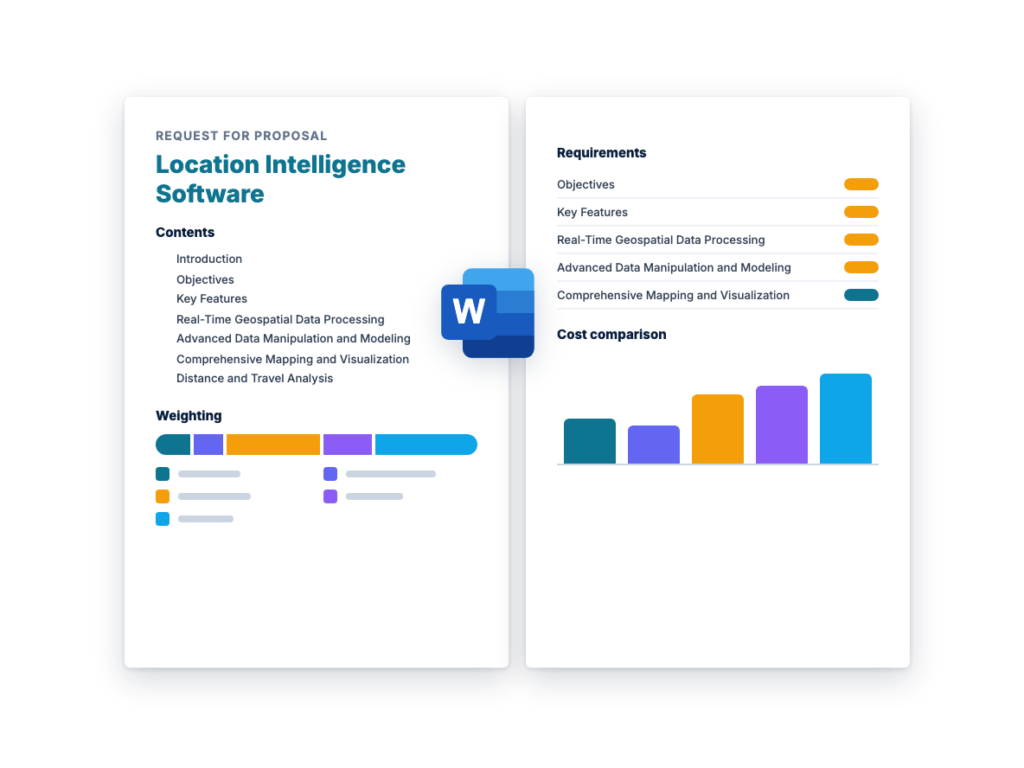
See the structure before you download. The Word file has every section listed below, ready to fill in.
The sections in the document, in order.
This RFP template is designed to help organizations evaluate and select location intelligence software solutions that enable data-driven decision-making through geospatial analytics.
The document outlines comprehensive requirements for integrating location-based data analysis, visualization, and AI capabilities to optimize business operations, improve customer service, and support strategic planning initiatives.
Location intelligence software, also known as spatial intelligence software, is a business intelligence solution that provides location analytics to identify relationships between objects based on their physical locations. This software enables users to visualize trends, patterns, and relationships on maps and graphics to optimize business opportunities and make data-driven decisions.
The primary objectives of implementing location intelligence software are:
Tip: Robust data integration is fundamental to location intelligence. Consider both real-time and batch processing needs, as well as the variety of data sources your organization uses. Ensure the solution can handle your current data volumes and anticipated growth while maintaining performance.
| Requirement | Sub-Requirement | Y/N | Notes |
|---|---|---|---|
| Data Integration | Ability to ingest data from IoT sensors | ||
| Integration with GIS systems | |||
| API data ingestion capabilities | |||
| Integration with existing business intelligence systems | |||
| Support for structured data handling | |||
| Support for unstructured data handling |
Tip: Future-proof your investment by ensuring the solution can adapt to changing business needs. Consider both horizontal scaling (more users/locations) and vertical scaling (more complex analyses/larger datasets) requirements.
| Requirement | Sub-Requirement | Y/N | Notes |
|---|---|---|---|
| Customization & Scalability | Custom map building tools | ||
| Visualization customization options | |||
| Scalable data processing capability | |||
| Support for growing data volumes | |||
| User-defined data model creation | |||
| Custom analysis workflow creation |
Tip: Effective collaboration tools can significantly improve team productivity and decision-making. Consider how different teams will need to share and collaborate on spatial analyses and ensure the solution supports your organization’s workflow.
| Requirement | Sub-Requirement | Y/N | Notes |
|---|---|---|---|
| Collaboration | Sharing visualization capabilities | ||
| Team report sharing | |||
| Collaborative analysis tools | |||
| Decision-making support features | |||
| Version control system | |||
| Change tracking functionality |
Tip: Cloud deployment offers flexibility and accessibility but requires careful consideration of security and compliance requirements. Evaluate both public and private cloud options, as well as hybrid deployments if needed.
| Requirement | Sub-Requirement | Y/N | Notes |
|---|---|---|---|
| Cloud Access | Secure remote accessibility | ||
| Cloud platform security measures | |||
| Industry compliance standards | |||
| Hybrid cloud deployment support |
Tip: Mobile capabilities are crucial for field operations and remote work. Consider both online and offline requirements, and ensure the mobile experience matches your users’ needs while maintaining security.
| Requirement | Sub-Requirement | Y/N | Notes |
|---|---|---|---|
| Mobile Features | Mobile-friendly interface | ||
| Mobile dashboard access | |||
| Location-based services | |||
| Offline capabilities | |||
| Field work support |
Tip: Data quality directly impacts analysis accuracy and decision-making reliability. Ensure the solution provides robust tools for maintaining data integrity throughout the data lifecycle.
| Requirement | Sub-Requirement | Y/N | Notes |
|---|---|---|---|
| Data Quality | Data cleansing tools | ||
| Validation capabilities | |||
| Data enrichment features | |||
| Inconsistency detection | |||
| Resolution tools | |||
| Governance support | |||
| Compliance requirement tools |
Tip: NLP capabilities can make your location intelligence solution more accessible to non-technical users while improving efficiency for all users. Consider the languages and query types most important to your organization.
| Requirement | Sub-Requirement | Y/N | Notes |
|---|---|---|---|
| NLP Features | Location-based query interpretation | ||
| Natural language query support | |||
| Voice-activated commands | |||
| Multi-language support |
Tip: Predictive capabilities can provide crucial insights for strategic planning. Consider both short-term and long-term forecasting needs, and ensure the models can incorporate your organization’s unique factors.
| Requirement | Sub-Requirement | Y/N | Notes |
|---|---|---|---|
| Predictive Analytics | Advanced forecasting models | ||
| “What-if” scenario generation | |||
| Strategic planning tools | |||
| Pattern detection | |||
| Temporal analysis | |||
| Anomaly detection |
Tip: Automated insights can significantly reduce analysis time and highlight patterns that might be missed manually. Ensure the automation capabilities align with your analytical priorities and can be customized to your business context.
| Requirement | Sub-Requirement | Y/N | Notes |
|---|---|---|---|
| Automated Insights | Pattern identification algorithms | ||
| Anomaly detection | |||
| Trend analysis | |||
| Automated pattern recognition | |||
| Insight recommendation engine | |||
| Custom insight rules configuration |
Tip: Computer vision capabilities can transform raw imagery into actionable insights. Consider the types of imagery your organization uses and the specific features you need to identify or analyze.
| Requirement | Sub-Requirement | Y/N | Notes |
|---|---|---|---|
| Computer Vision | AI-powered image recognition | ||
| Satellite imagery analysis | |||
| Aerial imagery processing | |||
| Object detection capabilities | |||
| Geospatial object classification | |||
| Change detection in imagery |
Tip: Data enrichment can add significant value to your existing data. Consider what additional attributes would be most valuable for your analysis and ensure the enrichment sources are reliable and regularly updated.
| Requirement | Sub-Requirement | Y/N | Notes |
|---|---|---|---|
| Data Enrichment | Automatic data enrichment | ||
| Multiple source integration | |||
| Spatial relationship inference | |||
| Attribute enhancement | |||
| Data source validation | |||
| Enrichment customization |
Tip: Self-improving models can provide increasingly accurate insights over time. Consider how the models will learn from your specific data and use cases, and ensure they can be monitored and adjusted as needed.
| Requirement | Sub-Requirement | Y/N | Notes |
|---|---|---|---|
| Machine Learning | Self-improving algorithms | ||
| Accuracy enhancement over time | |||
| Transfer learning support | |||
| Federated learning capabilities | |||
| Model performance monitoring | |||
| Custom model training options |
Tip: Automated data cleaning can significantly improve data quality while reducing manual effort. Consider the types of data quality issues you commonly face and ensure the solution can address them effectively.
| Requirement | Sub-Requirement | Y/N | Notes |
|---|---|---|---|
| Data Cleaning | Automated error detection | ||
| Error correction processes | |||
| Data imputation capabilities | |||
| Outlier detection | |||
| Validation rule creation | |||
| Quality metric tracking |
Tip: Advanced routing capabilities can significantly improve operational efficiency. Consider both regular routing needs and special cases that require custom optimization criteria.
| Requirement | Sub-Requirement | Y/N | Notes |
|---|---|---|---|
| Routing & Logistics | Real-time route optimization | ||
| Traffic pattern integration | |||
| Weather impact analysis | |||
| Delivery priority handling | |||
| Multi-stop route planning | |||
| Alternative route generation |
Tip: Social media sentiment analysis can provide valuable insights into location-specific customer experience. Consider the social platforms most relevant to your business and the types of insights you need to extract.
| Requirement | Sub-Requirement | Y/N | Notes |
|---|---|---|---|
| Sentiment Analysis | Geotagged post analysis | ||
| Social media integration | |||
| Sentiment classification | |||
| Trend analysis | |||
| Geographic sentiment mapping | |||
| Custom sentiment rules |
Tip: Automated reporting can save significant time and ensure consistency. Consider the various stakeholders who will receive reports and their specific information needs.
| Requirement | Sub-Requirement | Y/N | Notes |
|---|---|---|---|
| Report Generation | Comprehensive report creation | ||
| Complex data handling | |||
| Natural language summaries | |||
| Custom report templates | |||
| Scheduled report generation | |||
| Multiple format support |
Seeks a comprehensive embedded business intelligence software solution that integrates seamlessly with existing applications.
Outlines technical, functional, and AI requirements for modern data visualization tools, helping evaluate vendor capabilities across critical features while ensuring scalability, security,…
Please provide your feedback below.
"*" indicates required fields