How to run an EAM RFP
An EAM evaluation involves maintenance, operations, engineering, finance, stores and IT at once, and the result depends heavily on the quality of your asset data. Most of the early work is agreeing on scope and looking hard at your asset register. The example schedule below runs about 16 weeks from kickoff to contract award; stretch it if your asset data needs cleaning first or several business units must agree on one process.
- Agree on drivers and scope (weeks 1-3). Write down what the system must replace (a CMMS, spreadsheets, inspection apps, a homegrown asset register) and which lifecycle stages are in scope: planning, acquisition, operation, maintenance, renewal and disposal. Record the numbers vendors will price against: assets by class, sites, storerooms, length of any linear networks, and users by type (planners, technicians, storeroom staff, requesters, contractors). If you only need work orders and preventive maintenance, a CMMS RFP may be enough.
- Assemble the buying team. Include maintenance and reliability, operations, engineering or asset management, capital planning, stores, finance (fixed assets), IT and OT, GIS, and health and safety, plus procurement and legal. Put at least one planner and one field technician on the team: they will use the system every day, and they should test the mobile app.
- Review your asset data, and decide whether you need an RFI (weeks 2-5). Pull a sample of your asset register, hierarchy and maintenance history. Vendors will use it in demonstrations, and the review shows how much cleansing the migration will need. If you're unsure whether you need linear assets, capital planning or asset performance management, or your long list has more than five vendors, issue a short RFI first: ask which modules are core and which are add-ons, which asset types they serve, how they integrate with your ERP and GIS, and how they price.
- Tailor and issue the RFP (weeks 5-8). Delete requirements that don't apply, adjust priorities, and add your environment details to Section 1. Attach three or four demonstration scripts based on your own work, such as a breakdown handled from request to close on a mobile device with no signal. Give vendors three weeks to respond, with a written question-and-answer window in the first week.
- Score the responses (weeks 8-9). Have each evaluator score independently against the rubric before comparing notes, and set aside any vendor that misses a Must-have. Check every 'yes' for whether the feature is in the proposed edition today, needs a separate module, or depends on a partner product.
- Run scripted demonstrations and a sandbox trial with two or three vendors (weeks 9-14). Have each vendor run your scripts with your sample data: a preventive maintenance plan triggered by meter readings, a condition alert that creates a work order, a defect on a linear asset, a capital renewal scenario under a fixed budget, and a cost posting to your ERP. Give planners and technicians a sandbox for a week. Call references with similar asset types and scale.
- Negotiate and award (weeks 14-16). Use the pricing table to compare like for like across user types and modules. Settle renewal caps, prices for adding sites, users and modules, and data export at exit before you sign, not after.
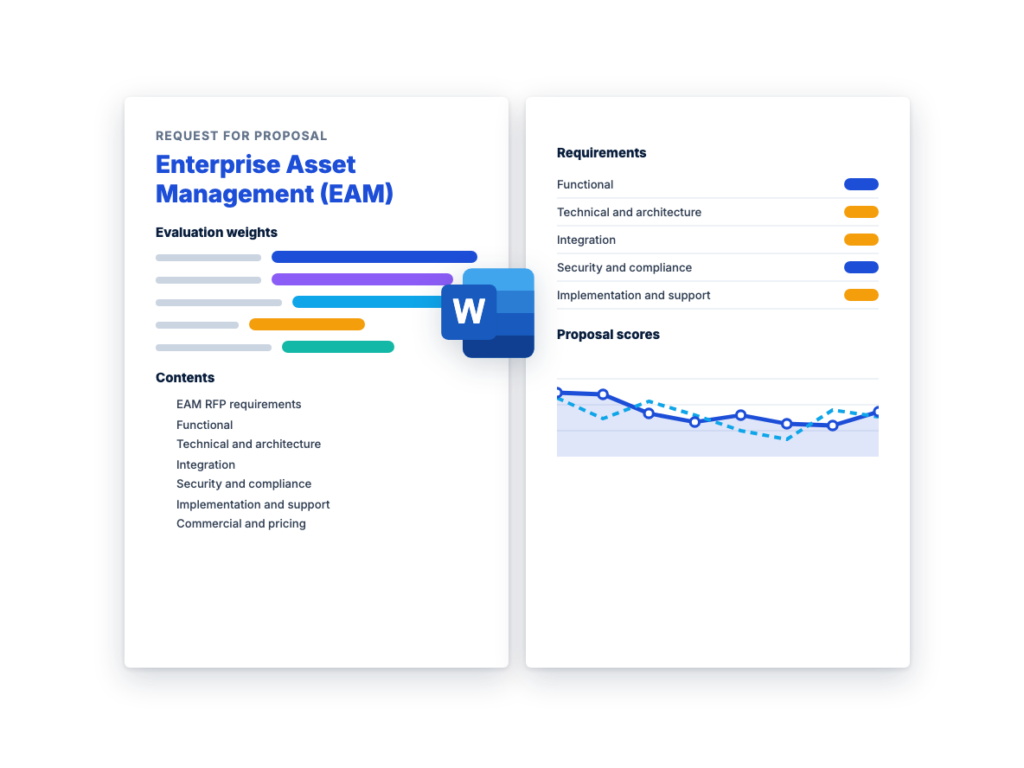
EAM RFP requirements
Each line is written to paste straight into your RFP. Must-have means a vendor that cannot meet it is out; Nice-to-have earns extra points. Change the priorities to fit your situation, and delete what doesn't apply.
Functional
| ID |
Requirement |
Priority |
| F1 |
An asset register with configurable multi-level hierarchies of locations, systems and assets, and asset classes with their own attribute templates. Rotable and repairable assets that move between locations or go out for repair keep their history by both asset and location. |
Must-have |
| F2 |
Linear asset management for [pipelines, roads, rail, water mains or power lines]: assets, attributes, condition, defects and work recorded by start and end measure along a linear reference, with dynamic segmentation. Delete if you don't manage linear networks. |
Must-have |
| F3 |
Lifecycle records from planning to disposal: planned assets, acquisition and commissioning data, warranties, status changes, decommissioning, and disposal with the date, method and reason. Disposed assets keep their full history. |
Must-have |
| F4 |
Work management from request to close: work requests from any employee, triage and approval, work orders built from job plans (tasks, crafts, parts, tools and estimated hours), and failure reporting with problem, cause and remedy codes at closure. |
Must-have |
| F5 |
Safety information on work orders, including hazards, precautions, required protective equipment and lockout/tagout isolation steps. State whether permit-to-work is included or sold separately. |
Must-have |
| F6 |
Planning and scheduling: backlog management, scheduling by craft, crew and shift against labor availability, and reporting of schedule compliance. |
Must-have |
| F7 |
Preventive maintenance triggered by calendar, by meter readings (such as run hours, cycles or distance) or both, with a forecast of future PM work and the labor and parts it needs. |
Must-have |
| F8 |
Condition-based maintenance: inspection results and condition readings captured on mobile or from sensors, with thresholds and rules that create work orders or notifications automatically. |
Must-have |
| F9 |
Asset criticality ranking based on the consequence and likelihood of failure, used to prioritize work orders, preventive maintenance and spare parts stocking. |
Must-have |
| F10 |
Reliability-centered maintenance (RCM) and failure mode and effects analysis (FMEA) in the product, with maintenance strategies linked to failure modes and turned into PM plans. |
Nice-to-have |
| F11 |
Asset performance management (APM) features: asset health scores, anomaly detection and failure prediction from condition, sensor and maintenance-history data. State which are in the core product and which are separate modules. |
Nice-to-have |
| F12 |
Capital planning: multi-year renewal forecasts for assets and asset groups based on condition, remaining useful life, risk and lifecycle cost, comparing repair, refurbish and replace options. |
Must-have |
| F13 |
Risk-based investment scenarios that rank or select projects under budget and resource limits, showing the risk reduced for the money spent and the effect of deferring work. |
Nice-to-have |
| F14 |
MRO inventory across multiple storerooms and bins: an item master with interchangeable parts, reordering by minimum/maximum or reorder point, parts reserved or kitted for planned work, cycle counts, and spare parts lists that link parts to the assets they fit. |
Must-have |
| F15 |
Purchase requisitions raised from work orders and stock reorders, with approval workflows, and tracking of contractor and service-contract work against assets. State whether purchasing runs in the EAM product, in our ERP, or either. |
Must-have |
| F16 |
Cost capture on every work order (labor, parts, contractors and other costs), rolled up the asset hierarchy, with budget versus actual by cost center and lifecycle cost per asset. |
Must-have |
| F17 |
A mobile app for iOS and Android that works offline: view and complete work orders, record readings and inspections, issue parts, scan barcodes or QR codes, attach photos and capture signatures, then sync with clear handling of conflicts. |
Must-have |
| F18 |
Dashboards and reports for maintenance and asset KPIs (such as backlog, PM compliance, mean time between failures, mean time to repair, maintenance cost by asset class and asset condition) that business users can configure. |
Must-have |
| F19 |
Our asset management system follows ISO 55000-series practice. Support for it through traceability from our asset management objectives and plans to individual assets, work and capital decisions. |
Must-have |
| F20 |
Generative AI assistance grounded in our own records, such as suggested failure codes, draft job plans, work order summaries and plain-language search of asset history and manuals, with administrator controls to turn each feature off. |
Nice-to-have |
Technical and architecture
| ID |
Requirement |
Priority |
| T1 |
Delivery as software as a service (SaaS). State whether the service is multi-tenant or single-tenant, where it is hosted, and whether a customer-hosted option exists. |
Must-have |
| T2 |
Support for multiple organizations, sites, currencies, languages and time zones in one instance, with data and processes separable by site where needed. |
Must-have |
| T3 |
Configuration of fields, screens, forms, workflows and business rules without custom code, preserved through upgrades. |
Must-have |
| T4 |
Performance at our scale: [number] assets, [number] work orders a year, [number] concurrent users and [number] mobile devices. Describe the largest comparable deployment in production. |
Must-have |
| T5 |
Backup and disaster recovery with stated recovery point and recovery time objectives (RPO and RTO), tested at least once a year. |
Must-have |
| T6 |
Web and mobile interfaces that conform to WCAG 2.1 level AA or later. Make this Must-have if you are a public-sector buyer. |
Nice-to-have |
Integration
| ID |
Requirement |
Priority |
| I1 |
Integration with our ERP finance system: work order labor, parts and contractor costs posted to the general ledger, cost centers and projects; shared asset identifiers with the ERP fixed-asset register, which calculates depreciation; capitalization of qualifying work; and retirement when an asset is disposed of. State which data each system owns. |
Must-have |
| I2 |
Integration with ERP purchasing and inventory: purchase orders, receipts, invoices, suppliers and the item master, flowing in the direction we choose. |
Must-have |
| I3 |
Two-way integration with our GIS so asset locations, geometry and attributes stay consistent, with map views of assets and work on desktop and mobile, including offline. Change to Nice-to-have if you don't manage infrastructure or utility networks. |
Must-have |
| I4 |
Ingestion of meter readings, sensor data and alarms from our IoT platform, historian or SCADA systems, directly or through an edge connector, using standard protocols such as OPC UA or MQTT or a documented API. |
Must-have |
| I5 |
Single sign-on with our identity provider via SAML 2.0 or OIDC. State support for SCIM user provisioning. |
Must-have |
| I6 |
Documented REST APIs for the main records (assets, locations, work orders, inventory and meter readings), event notifications or webhooks, and bulk export to our data warehouse or analytics platform. |
Must-have |
| I7 |
Links from assets to documents and engineering data (drawings, manuals, CAD or BIM models) in our document management system, and import of handover data from capital projects, for example in COBie format. |
Nice-to-have |
Security and compliance
| ID |
Requirement |
Priority |
| S1 |
A current SOC 2 Type II report and ISO/IEC 27001 certification covering the proposed services, available under NDA. |
Must-have |
| S2 |
FedRAMP authorization at the required impact level, or equivalent regional certifications for public-sector use. Make this Must-have if you are a public-sector buyer. |
Nice-to-have |
| S3 |
Isolation of our tenant's data, encryption in transit and at rest, and a documented key-management approach. |
Must-have |
| S4 |
Role-based permissions that can be limited by organization, site, craft and storeroom; administrator access through SSO with MFA; and an audit trail of changes to assets, work orders and configuration. |
Must-have |
| S5 |
Connections to operational technology (OT) networks that do not require inbound connections into those networks. Describe how your IoT and historian connectors fit an IEC 62443 zones-and-conduits design. Delete if no OT data is in scope. |
Must-have |
| S6 |
Electronic records and signatures that meet 21 CFR Part 11 for regulated maintenance, calibration and validation records. Make this Must-have in life sciences. |
Nice-to-have |
| S7 |
A data processing agreement, a current list of sub-processors, a choice of hosting region for data residency, and support for our privacy obligations (for example, GDPR). |
Must-have |
| S8 |
A contractual commitment to notify us of security incidents affecting our data within a defined time. State the time. |
Must-have |
Implementation and support
| ID |
Requirement |
Priority |
| M1 |
A phased implementation plan by site or asset class, with named roles, the effort expected from both sides, and a list of anything that needs custom development rather than configuration. |
Must-have |
| M2 |
Migration of asset registers, hierarchies, maintenance history, PM schedules, inventory and open work orders from [current systems], including data cleansing, validation reports and a reconciliation sign-off. State who does each task. |
Must-have |
| M3 |
Identification of who delivers the implementation (vendor, partner or both) and the named team's experience with similar asset types and industries. |
Must-have |
| M4 |
A service-level agreement for availability, with service credits, and 24×7 support for critical issues such as a failure of mobile work order sync. State response-time targets by severity. |
Must-have |
| M5 |
A published release schedule with advance notice of changes, and a non-production environment where we can test each release against our configuration and integrations before it reaches production. |
Must-have |
| M6 |
Role-based training for administrators, planners, schedulers, technicians and storeroom staff, plus documentation we can adapt for our own training. |
Must-have |
Commercial and pricing
| ID |
Requirement |
Priority |
| C1 |
Pricing broken down by module, user type and term, showing list price, discount and net price. |
Must-have |
| C2 |
A definition of each user type (for example full, limited, mobile-only, requester and read-only) and what it can do, with prices for work requesters, occasional users and contractors. |
Must-have |
| C3 |
Any charges based on asset counts, sites, sensor data volume, storage or API calls, with the metric, included allowance and overage price for each. |
Must-have |
| C4 |
Prices for adding users, sites and modules mid-term, co-terminated with the main agreement, and a cap on price increases at renewal. State the cap. |
Must-have |
| C5 |
Pricing that ramps with the rollout by site, so we don't pay for every user before they go live. |
Nice-to-have |
| C6 |
A sandbox trial at no charge during the evaluation, loaded with our sample asset data. |
Nice-to-have |
| C7 |
Exit terms covering export of all our data (asset register, hierarchies, history, documents and attachments) in a usable format, and transition assistance at the end of the contract. |
Must-have |
Questions to ask EAM vendors
These questions are designed to separate vendors, not to collect brochure answers. Ask for evidence: a demo, a document or a reference.
- Using our sample asset data, show how you model our location hierarchy, an asset class with its attributes, and a rotable pump that is removed, repaired and installed somewhere else. Where does its history appear afterwards?
- For our [pipeline / road / rail / water] network, show a defect recorded on a segment by start and end measure. What happens to attributes and work history when the network is re-measured or realigned in GIS?
- Show a meter reading and a sensor alert each creating a work order with no manual step. How do you stop a noisy signal from creating duplicate work orders?
- Walk a technician through a corrective work order on a phone with no signal: parts issued, labor, failure codes, photos and sign-off. What happens when two people edit the same record offline?
- Which asset performance management features (health scores, anomaly detection, failure prediction, RCM and FMEA) are in the core product, which are separate modules, and which come from partners? What data, and how much history, do the models need before they give useful results?
- Show how criticality and risk scores are calculated and who can change the method. Then run a ten-year renewal scenario for one asset class under a fixed budget, comparing repair, refurbish and replace.
- Which data does your product exchange with our ERP for costs, purchasing, inventory and the fixed-asset register? Which integrations are standard connectors, which are built during the project, and who maintains them after upgrades?
- Is our GIS or your product the system of record for asset location and geometry? How do edits flow in each direction, how quickly, and how are conflicts resolved?
- Which generative AI features are generally available today? What data do they use, does any of our data leave our tenant or train shared models, and can we turn each feature off?
- How often do you release updates, how much notice do we get, and can we defer one? How do you make sure our configuration, reports and integrations still work afterwards?
- How will you migrate and clean our asset register and maintenance history from [current systems]? Which tools do you use, what do you need from our team, and how do we confirm the migrated data is complete?
- Our asset management practice follows the ISO 55000 series. Show the link in your product from one of our asset management objectives to the plans, work orders and capital projects that serve it.
- Which features in your proposal are generally available today, and which are in preview or on the roadmap? Give dates for the roadmap items.
- What are the most common causes of delay in EAM implementations like ours, and how does your plan address them?
- Provide a reference customer with similar asset types and scale that has been live for at least a year, ideally one that moved from a CMMS or spreadsheets.
Scoring rubric
Score each criterion from 1 to 5, multiply by its weight, and add the results. The weights below are a starting point; agree on your own before any proposals arrive so the scoring can't be bent around a favorite.
| Criterion |
Weight |
What a strong response shows |
| Asset register, hierarchies and linear assets |
15% |
Your sample hierarchy modeled cleanly in the demo, rotable history kept, and linear referencing that holds up when the network changes. |
| Work and maintenance management, including mobile |
20% |
Request-to-close work, planning and scheduling, time- and meter-based PM and condition-triggered work, shown with your data on an offline mobile device. |
| Reliability, condition monitoring and APM |
10% |
Criticality used to drive real decisions, a clear split between core features and add-on modules, and stated data needs for any predictive feature. |
| Capital planning and lifecycle cost |
10% |
Risk-based renewal scenarios under a budget, lifecycle cost per asset, and a scoring method you can explain to finance. |
| MRO inventory and procurement |
10% |
Multi-storeroom control, parts kitted to planned work, and a clean handoff to ERP purchasing. |
| Integration with ERP, GIS and IoT |
15% |
Maintained standard connectors, clear data ownership with the ERP fixed-asset register, two-way GIS sync, and a working sensor-to-work-order flow. |
| Implementation, data migration and support |
10% |
A credible phased plan, an experienced named team, a realistic data cleansing approach, and clear SLAs and release management. |
| Commercials and total cost |
10% |
Clear user-type definitions, transparent module and data charges, a renewal cap, and fair exit terms over a five-year view. |
| Total |
100% |
|
Scoring scale
- 5 Exceeds: meets every Must-have and most Nice-to-haves, shown in a demo or proof of concept, with a matching reference customer.
- 4 Strong: meets every Must-have and some Nice-to-haves, with clear evidence.
- 3 Adequate: meets most Must-haves; gaps have a credible workaround or a dated roadmap commitment.
- 2 Weak: misses one or more Must-haves, or the answer is vague.
- 1 Poor: does not meet the requirement, or no answer.
Frequently asked questions
What should an EAM RFP include?
Your asset base and scope (asset classes, sites, linear networks and user types); requirements for the asset register, work management, preventive and condition-based maintenance, reliability, capital planning, MRO inventory and mobile, each marked Must-have or Nice-to-have; integration requirements for ERP, GIS and IoT; security, implementation and support terms; a pricing table; and the rubric you'll score with. Add demonstration scripts that use your own asset data. This template includes all of them.
What is the difference between EAM and CMMS?
A CMMS (computerized maintenance management system) focuses on maintenance: work orders, preventive maintenance, spare parts and technician scheduling, often for one site or a few. EAM covers the whole asset lifecycle across the organization, adding capital planning, lifecycle cost, risk and criticality, linear assets, and deeper links to finance and GIS. The products overlap, so judge by your requirements rather than the label: if you mainly need to organize maintenance work, start with the CMMS RFP template; if you also need to decide where to invest across a large asset base, use this one.
How long does an EAM RFP take?
The example schedule in this template runs about 16 weeks from kickoff to contract award, including three weeks for vendor responses and five weeks for scripted demonstrations and a sandbox trial. Allow more time if your asset data needs cleaning first, if you manage linear networks, or if several business units must agree on one process.
Is asset performance management (APM) part of EAM?
Sometimes. APM uses condition data, sensor feeds and maintenance history to score asset health and predict failures; some EAM products include it, while others sell it as a separate module or rely on partners. This template lists APM features as Nice-to-have and asks vendors which are in the core product, which cost extra, and what data their models need. Make them Must-have only if you already collect reliable condition data.
Does EAM software calculate depreciation?
In a typical setup, the ERP's fixed-asset register calculates depreciation and holds book value, while the EAM system holds the operational record: hierarchy, condition, work history and maintenance cost. Your RFP should ask how the two stay linked, including shared asset IDs, cost postings to the general ledger, capitalization of qualifying work and retirement at disposal. If a vendor also tracks asset values for capital planning, ask which system is the book of record.
Related RFP templates
Download Template