How to run a penetration testing RFP
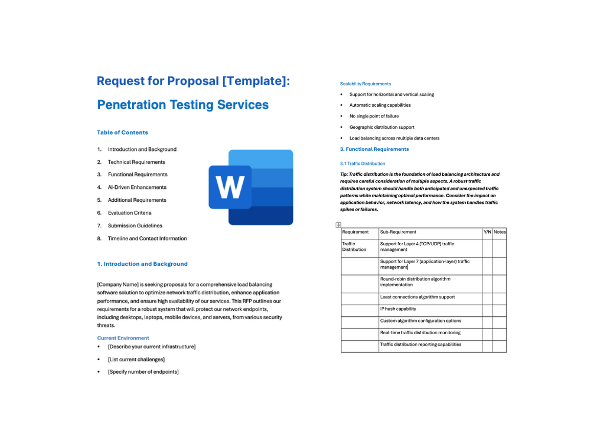
A penetration test gives a team of outside testers permission to attack your systems, so the RFP has to settle who tests, what they may touch, how they keep your data safe and what you receive, not only the price. NIST Special Publication 800-115, Technical Guide to Information Security Testing and Assessment (csrc.nist.gov/pubs/sp/800/115/final), describes penetration testing and vulnerability scanning as parts of a security testing program, so decide where this test fits in yours before you write the scope. The timeline table in the Word document has a row for each milestone, ready for your own dates.
- Write down why you're testing, and what's in scope. List what's driving the test, such as a customer or contract requirement, a new application or major release, a cloud migration, an acquisition, a cyber insurance questionnaire or your regular testing program. Then list the targets for each test type: external IP ranges and domains, internal networks and sites, web applications and their user roles, APIs, mobile apps, cloud accounts, wireless networks and offices. Mark what is off limits, and note which findings from earlier tests are still open. Providers will scope and price against this, so put it in the background section of the RFP.
- Assemble the buying team. Include the security or IT lead who owns the test, the owners of the applications and infrastructure in scope, whoever runs your cloud accounts, and the team or provider that monitors your alerts. Add legal for the authorization letter and the contract, and procurement or finance. Decide early whether your monitoring team will be told about the test: telling them avoids false alarms, while keeping it from them tests whether they notice, and the rules of engagement must say which you chose.
- Settle authorization and third-party systems early. List every system in scope that a hosting, cloud or SaaS provider or your MSP runs for you, and check each provider's terms for a testing policy or approval process you must follow. Ask your counsel what the written authorization should cover and who in your organization should sign it. Settle both before you schedule any testing.
- Choose the test types and approach, and decide whether you need an RFI. Decide which test types you need, and whether you want optional social engineering, physical testing or red team work. For each target, decide whether testers get credentials, documentation or source code, which lets them spend their time on testing rather than discovery. If the scope is still open, or your long list is too long to interview, issue a short RFI asking each provider for the named test lead's background, the test types it offers, a redacted sample report and its use of subcontractors, and use the answers to build a shortlist.
- Tailor and issue the RFP. Delete requirements that don't apply, adjust the priorities, and describe the same scope to every provider so the proposals can be compared. Ask for a separate fee for each test type and clear retest terms. Set a response deadline with a written question-and-answer window, and share every answer with all the providers you invited.
- Score the proposals, read the sample reports and interview the test leads. Have each evaluator score independently against the rubric before comparing notes, and set aside any provider that misses a Must-have. Read each sample report as both your executives and your developers would. Interview each shortlisted provider's named test lead, not only the sales team, give each the same scenario, such as a critical finding discovered late at night, and call references the test lead served directly.
- Agree the rules of engagement and award. Write the named test lead and testers, the test plan, the rules of engagement, the emergency stop contacts, the data handling and destruction terms and the retest terms into the contract or statement of work. Ask your counsel to review the authorization letter, the insurance requirements and the limitation of liability and indemnity terms, and sign the authorization letter before any testing starts.
Penetration testing RFP requirements
Each line is written to paste straight into your RFP. Must-have means a provider that cannot meet it is out; Nice-to-have earns extra points. Change the priorities to fit your situation, and delete what doesn't apply.
Scope of services
| ID |
Requirement |
Priority |
| S1 |
External network penetration testing of our internet-facing systems, including the IP ranges, domains and services listed in the background section: finding exposed services and weaknesses, attempting to exploit them within the rules of engagement, and showing what an attacker could reach from the internet. |
Must-have |
| S2 |
Internal network penetration testing that starts from a position an attacker could gain inside our network, such as a compromised workstation or a network port, delivered on site or through a remote testing device we approve, and covering movement between systems, privilege escalation, and attacks on our directory, identity and file services. |
Must-have |
| S3 |
Web application penetration testing of the applications we list, using test accounts for each user role we name, and covering authentication, session management, access control between users, roles and customers, input handling, file uploads and business logic. |
Must-have |
| S4 |
API penetration testing of the APIs behind our web and mobile applications and any APIs we expose to partners, using our API documentation where we provide it, and covering authentication, authorization for each object and function, input handling and rate limiting. |
Must-have |
| S5 |
Mobile application testing of the apps we list on each platform we name, covering data stored on the device, how the app handles credentials and sessions, its communication with back-end services, and the APIs it calls. |
Nice-to-have |
| S6 |
A review and test of the configuration of our cloud accounts and services: identity and access permissions, exposed storage and services, network controls, logging, and the paths an attacker could use to move from a compromised account or workload to wider access. |
Must-have |
| S7 |
Wireless network testing at the locations we list, covering the security of our corporate and guest networks, the separation between them, and the detection of unauthorized access points. |
Nice-to-have |
| S8 |
Social engineering testing, such as phishing emails and phone pretexting, only in the form we approve in writing: we approve each campaign, pretext and target list in advance, and no employee's personal accounts or devices are targeted. |
Nice-to-have |
| S9 |
Physical security testing at the sites we list, such as attempts to enter buildings or restricted areas, carried out only with a signed authorization letter that each tester carries, and with a contact on site who can confirm the test is approved. |
Nice-to-have |
| S10 |
Red team or adversary simulation: a goal-based exercise against objectives we set, testing how well our people, processes and monitoring detect and respond, scoped and priced separately, with a named contact on our side who knows the exercise is under way. |
Nice-to-have |
| S11 |
Retesting of the findings we fix, within a retest period we agree, confirming for each finding whether it is closed, partly fixed or still open, with an updated report showing the result. |
Must-have |
| S12 |
A written description of your methodology for each test type: how you plan, find targets, identify and confirm weaknesses, attempt exploitation within the rules of engagement and decide when to stop; how manual testing and automated scanning are combined; and how your approach changes when we provide credentials, documentation or source code. |
Must-have |
Named lead and team
| ID |
Requirement |
Priority |
| L1 |
The name of the test lead for our engagement, with a CV showing the tests they have led, the types of systems and environments they have tested, and the professional certifications they hold. The test lead is the person we interview and the person who signs off the report. |
Must-have |
| L2 |
The names of the testers for each test type in scope, with each person's role and experience in that type of testing, such as web applications, APIs, mobile apps, cloud, internal networks, wireless or social engineering. |
Must-have |
| L3 |
No substitution of the named test lead or testers without our written approval. If a named person becomes unavailable, the provider proposes a replacement with comparable experience for us to approve before testing starts. |
Must-have |
| L4 |
No subcontractors, freelance testers or testers working from outside the countries we approve, unless we approve each person in writing in advance. State who employs each named tester, and confirm that any approved subcontractor is bound by the same confidentiality, data handling and rules of engagement terms. |
Must-have |
| L5 |
Background checks on every person who will test our systems or see our findings, in line with our hiring standards. State what checks you run and how often you repeat them. |
Must-have |
Deliverables and reporting
| ID |
Requirement |
Priority |
| D1 |
A test plan agreed before testing starts, covering the targets and test types, the testing approach for each target, the testers, the testing windows, the test accounts, data and access you need from us, and the contacts on both sides. |
Must-have |
| D2 |
A report with an executive summary written for non-technical leaders: the scope tested, the overall result, the most serious findings and their business impact, recurring themes, and what to fix first. |
Must-have |
| D3 |
Technical findings that give, for each finding, the affected system, a description, the evidence (such as screenshots, requests and responses, and command output), step-by-step reproduction instructions, the severity rating and the recommended fix, and, where findings combine, the attack path they create. |
Must-have |
| D4 |
A defined severity rating scale: how each rating is assigned, which factors it weighs (such as how easily the weakness can be exploited and the impact if it is), whether you use a published scoring system, and how our own context, such as the sensitivity of the data involved, changes the rating. |
Must-have |
| D5 |
Remediation guidance specific to our systems for each finding, with short-term steps to reduce the risk where a full fix will take time, and a note of any finding that depends on a third party to fix. |
Must-have |
| D6 |
A record of what was tested: each target, the dates and times of testing, the source IP addresses your testers used, and any target that could not be tested, with the reason. |
Must-have |
| D7 |
A draft report for our review, then read-out meetings: a technical session with our IT and development teams to walk through the findings and fixes, and a briefing for our leadership. |
Must-have |
| D8 |
Findings also delivered in a structured, machine-readable format, such as CSV or JSON, that we can import into our ticketing or vulnerability management system. |
Nice-to-have |
Security, confidentiality and independence
| ID |
Requirement |
Priority |
| N1 |
No testing before we sign a written authorization naming the provider, the testers, the targets and IP ranges, the test types and the testing windows. Testers keep a copy during the engagement and carry it during any on-site or physical testing. |
Must-have |
| N2 |
For each target hosted or run by a third party, such as a hosting, cloud or SaaS provider or our MSP, identification of that party in the test plan, and testing only after we confirm that its testing policy has been followed or its approval obtained. The provider follows any testing rules those parties set. |
Must-have |
| N3 |
Access to our data only as far as needed to prove a finding: no bulk copying of personal, payment, health or other sensitive data, no changes to production data unless we approve them, and an immediate call to our named contact if testers reach sensitive data. |
Must-have |
| N4 |
Protection of the test accounts and credentials we provide and any credentials found during testing: stored encrypted, used only for this engagement, not kept afterward, and listed in the report so we can reset them. |
Must-have |
| N5 |
Encrypted storage and transfer of all evidence, notes and reports, access limited to the named testers and their managers, and delivery of reports only through a secure method we agree, never as an unencrypted email attachment. |
Must-have |
| N6 |
A statement of what the provider keeps after the engagement (such as the report and its working papers), for how long and why, with everything else destroyed at the end of the engagement or the retest period and written confirmation of destruction sent to us. |
Must-have |
| N7 |
A description of the provider's own security program, including how it secures testing devices and the systems that hold client data, plus any independent attestation or certification it holds, and a commitment to notify us within a defined time of any security incident at the provider that affects our data. State the time. Disclose any cloud-hosted tool or AI service that would receive our data, and use none without our approval. |
Must-have |
| N8 |
Disclosure of any relationship with the makers or resellers of the systems in scope or of security products the provider may recommend, including resale margins or referral fees, and of any work the provider or an affiliate has done to build, configure or manage the systems it would test. |
Must-have |
| N9 |
Professional liability (errors and omissions), cyber liability and general liability insurance at the limits we set in the contract, with certificates of insurance provided before testing starts. |
Must-have |
Engagement and transition
| ID |
Requirement |
Priority |
| E1 |
Rules of engagement agreed and signed before testing starts, setting out the systems in scope and off limits, the testing windows, the techniques allowed, the actions not allowed without our approval (such as denial-of-service tests, actions that could change or delete data, and keeping access after the test ends), and the contacts on both sides. |
Must-have |
| E2 |
No testing of any system we list as off limits. If testers find a system whose ownership is unclear, or reach a system outside the scope, they stop testing that system and ask us before going further. |
Must-have |
| E3 |
An emergency stop: named contacts on both sides reachable throughout every testing window, testers who stop all activity as soon as we call a stop, and testing that resumes only when we approve it. |
Must-have |
| E4 |
Immediate notice by phone to our named contact, followed in writing, when testers find a critical finding or signs that someone other than the testers has already compromised a system, without waiting for the report. State how quickly you notify us and how you preserve evidence of an earlier compromise. |
Must-have |
| E5 |
Testing only within the windows we set, with notice before any test you rate as a higher risk to availability, and coordination with our monitoring team or provider on whether alerts should be investigated or recognized as the test. |
Must-have |
| E6 |
A proposed schedule from kickoff to final report, with the earliest start date you can offer, a list of what you need from us (such as test accounts, documentation, network access, allowlisting and a testing device on site), and rescheduling and cancellation terms for both sides. |
Must-have |
| E7 |
Removal at the end of testing of every account, file, tool, configuration change or other artifact the testers placed on our systems, with a list of each item and confirmation that it has been removed. |
Must-have |
Commercial and pricing
| ID |
Requirement |
Priority |
| C1 |
A fixed fee for each test type in scope, based on the scope described in this RFP, stating the targets, user roles and testing effort it assumes and what would change the fee. |
Must-have |
| C2 |
A statement of whether retesting is included in the fees, how many retests are included, the period in which we can request them, and the price of any extra retest. |
Must-have |
| C3 |
Daily rates for each role for extra testing we approve beyond the agreed scope, with no extra time billed unless we approve it in writing first. |
Must-have |
| C4 |
Separate prices for optional services, such as social engineering, physical testing, and red team or adversary simulation, so we can buy the core testing without them. |
Must-have |
| C5 |
A travel and expenses policy for on-site work, and a payment schedule tied to milestones such as the agreed test plan, the final report and the completed retest. |
Must-have |
| C6 |
Limitation of liability and indemnity terms as set out in our contract. State any terms you would ask to change, and confirm that either side can end the engagement with written notice, with fees limited to work done. |
Must-have |
Questions to ask penetration testing providers
These questions are designed to separate providers, not to collect brochure answers. Ask for evidence: a sample deliverable, an interview with the named lead or a reference.
- We'd like to interview the person you propose as our test lead, without the sales team present. How would they approach our scope, what would they test first and why, and what would they need from us?
- Send a redacted sample report from a web application and internal network test the named test lead delivered. Point us to a finding with its evidence, reproduction steps and severity reasoning. Which parts would look different for us?
- Lay out your test plan for our scope: the test types, the approach for each target, which work is manual and which is automated, and the time you would spend on each target. What do you need from our team, and by when?
- Late one evening during the external test, a tester finds an exposed administration page that gives access to customer data. Walk us through what happens next: when testing stops, who on our side is called, how you prove the finding without reaching more data, and what you send us in writing.
- Your testers find signs that someone else has already compromised one of our systems, such as an unfamiliar account or a file they did not place. What do they do, who do they tell, and how do they avoid disturbing the evidence?
- A test slows or interrupts a production service. How would your testers notice, how quickly would they stop, and how would you report it? Which tests do you treat as higher risk to availability, and how do you get our approval before running them?
- Our main web application runs with a cloud provider and uses a third-party login service and payment page. How do you work out what is ours to test, what approvals we need first, and what you would leave out?
- How do you assign severity? Take a finding from your sample report and show how its rating would change for us, given the data involved, how exposed the system is and the controls around it.
- Which findings in your sample report came from manual testing that automated scanning would not have found? How do you make sure our report is more than scanner output?
- Who will test our systems? Tell us who is an employee and who is not, whether any subcontractor would take part, what background checks each person has passed, and what happens if the named test lead is unavailable the week testing is due to start.
- Describe how you handle our data: where test evidence, credentials found during testing, screenshots and reports are stored, who can see them, what you keep afterward and for how long, how you destroy the rest and how you confirm it. Would any cloud-hosted tool or AI service receive our data?
- What does retesting include? Explain the period in which we can request it, how the retest report shows the status of each finding, and what you charge if a fix needs more than the retests included.
- If social engineering is in scope, how do you design the pretexts and target lists with us, what will you not do, how do you treat employees who fall for a test, and how do you report results without singling out individuals?
- Provide a reference from a client of similar size and environment that the named test lead tested directly, and that has completed a retest with you.
Scoring rubric
Score each criterion from 1 to 5, multiply by its weight, and add the results. The weights below are a starting point; agree on your own before any proposals arrive so the scoring can't be bent around a favorite.
| Criterion |
Weight |
What a strong response shows |
| Named test lead's fit and experience |
25% |
Hands-on experience testing systems like yours, a strong interview without the sales team, clear answers on who tests what, and references from clients the named test lead tested directly. |
| Quality of the test plan and methodology |
20% |
A specific plan for your targets and test types, a described methodology that combines manual testing with scanning, a clear list of what's needed from your team, and sensible answers on systems run by third parties. |
| Sample report quality |
15% |
An executive summary your leadership would understand, findings with evidence and reproduction steps your teams could act on, a defined severity scale, and findings that clearly came from manual testing. |
| Rules of engagement and safe testing |
10% |
Clear handling of off-limits systems, a working emergency stop, immediate notice of critical findings and signs of an earlier compromise, approval before higher-risk tests, and full cleanup afterward. |
| Data handling and confidentiality |
10% |
Minimal access to sensitive data, protected credentials and evidence, secure report delivery, background-checked testers, no unapproved subcontractors, and a stated retention and destruction policy with written confirmation. |
| Retesting and remediation support |
10% |
Clear retest terms, a retest report that shows the status of each finding, practical remediation guidance, and read-out meetings that help your teams fix what was found. |
| Commercials and value |
10% |
A fixed fee for each test type on the same scope, clear retest pricing, fair daily rates for approved extra work, separately priced optional services, and insurance and liability terms you can accept. |
| Total |
100% |
|
Scoring scale
- 5 Exceeds: meets every Must-have and most Nice-to-haves, shown through an interview with the named lead, sample deliverables and a matching reference client.
- 4 Strong: meets every Must-have and some Nice-to-haves, with clear evidence.
- 3 Adequate: meets most Must-haves; gaps have a credible plan.
- 2 Weak: misses one or more Must-haves, or the answer is vague.
- 1 Poor: does not meet the requirement, or no answer.
Frequently asked questions
What should a penetration testing RFP include?
Your background and the reasons for the test; the scope by test type, from external and internal networks to web applications, APIs, mobile apps, cloud configuration and wireless, plus any social engineering, physical testing or red team work you approve; requirements for the named test lead and team, the methodology, authorization and rules of engagement, the report and retest, and the handling of your data and credentials, each marked Must-have or Nice-to-have; questions and scenarios that show how each provider works; insurance, liability and pricing terms; and the rubric you'll score with. This template includes all of them.
How much does a penetration test cost?
Price depends on scope, so the only useful comparison is between proposals for the same scope. The main cost drivers are the number and type of targets (IP ranges, applications, user roles, APIs, mobile apps, cloud accounts and sites), how complex each application is, whether testers get credentials and documentation, whether testing must happen out of hours or on site, any social engineering, physical or red team work, how many retests are included, and travel. Compare the fee for each test type, the retest terms and the daily rates for extra work separately.
Penetration test or vulnerability scan?
They answer different questions, and a security testing program can use both. NIST Special Publication 800-115, Technical Guide to Information Security Testing and Assessment, describes penetration testing and vulnerability scanning as parts of a security testing program. A vulnerability scan uses automated tools to look for known weaknesses across many systems; a penetration test uses skilled testers who try to exploit weaknesses, chain them together and show what an attacker could reach, including flaws in access control and business logic that automated tools tend to miss. Ask each provider which findings in its sample report came from manual testing.
How often should we run a penetration test?
Set the schedule by your risk, by how much your systems change (such as a new application, a major release, a cloud migration or an acquisition), and by any contract, customer agreement, cyber insurance policy or standard you're bound by. Check those documents for what they say about testing, then write the schedule into your security program, and plan a retest after you fix significant findings.
Related RFP templates
Download Template
 BD Emerson
 Bishop Fox
 Black Hills Information Security
 CBTS
 CISO Global
 Coalfire
 HALOCK
 IBM
 Kudelski Security
 LevelBlue
 Netrix Global
 Optiv
 Praetorian
 Rapid7
 Tevora
 TrustedSec
 UnderDefense