How to run a SOC 2 audit RFQ
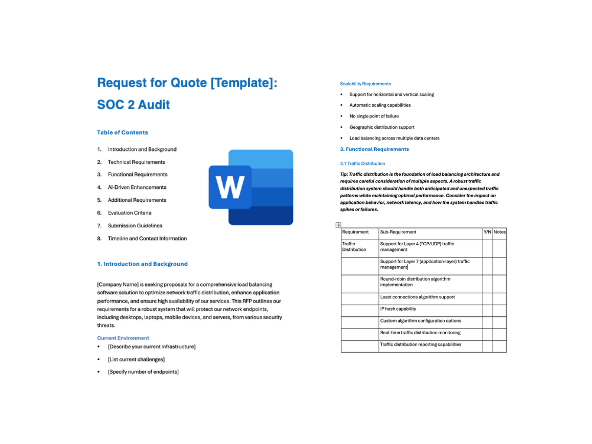
A SOC 2 audit (formally, a SOC 2 examination) covers the system and scope you define, so this template is a request for quote (RFQ) rather than a full RFP: you choose the report type, the review period and the Trust Services Criteria categories, describe that scope once, send the same RFQ to several CPA firms, and compare what each would do, who would do it, when, and at what price. The timeline table in the Word document has a row for each milestone, ready for your own dates.
- Write down why you need a SOC 2 report, and what it should cover. List what's driving the decision, such as requests from customers or prospects, a contract clause, or an existing report that needs renewing. Ask the customers who asked what they expect to see, since that shapes the report type and the categories. Then describe the system to be examined: the services, applications, infrastructure, locations and people in scope, and the outside providers your system relies on, such as cloud hosting. Firms will quote against this, so put it in the background section of the RFQ.
- Choose the report type, review period and categories. A Type 1 report covers the description of your system and the design of your controls as of a specific date. A Type 2 report adds whether the controls operated effectively throughout a review period, so choose the period's start and end dates. Security is the category every SOC 2 covers; decide whether to add availability, processing integrity, confidentiality or privacy based on your services and what your customers ask for. These are your choices, so state them in the RFQ rather than leaving them to each firm.
- Assemble the buying team. Include the executive who owns the decision, the security or compliance lead who will run the audit, the engineering or IT owners of the systems in scope, and finance. Add legal for the engagement letter and the report use terms, and whoever in sales or customer success handles customer requests for the report. If a consultant or your compliance software provider is helping you prepare, keep them informed, but keep the choice of audit firm with your own team.
- Decide on readiness work, and whether you need an RFI. If your controls are new or untested, you may want a readiness assessment before the examination. Decide whether you would buy it from the same firm, and ask each firm to explain in writing how it evaluates its independence if it does both. If the scope is still open, or you want to narrow a long list of firms, send a short RFI asking each one for its license status, its most recent peer review, its experience with services like yours and any business arrangement with your compliance software provider.
- Tailor and issue the RFQ. Delete requirements that don't apply, adjust the priorities, and describe the same scope to every firm so the quotes can be compared. Ask for separate prices for readiness work, the examination and each optional category, and ask which version of the Trust Services Criteria the firm will use, since the AICPA has published proposed updates for comment. Set a response deadline with a written question-and-answer window, and share every answer with all the firms you invited.
- Score the quotes and talk to the signing partners. Have each evaluator score independently against the rubric before comparing notes, and set aside any quote that misses a Must-have. Hold a call with each shortlisted firm's signing partner and fieldwork lead, give each the same scenario, such as a key control that didn't operate for part of the review period, and compare the answers.
- Verify the firm and award. For the firm you choose, confirm its standing before you sign: verify with the state board of accountancy and ask for the firm's most recent peer review report, if the quote didn't include it. Ask your counsel which state's board applies if you're unsure. Then write the signing partner, the team, the schedule, the evidence handling rules, the disclosures, the fees and the report use terms into the engagement letter, and have your counsel review it.
SOC 2 audit RFQ requirements
Each line is written to paste straight into your RFQ. Must-have means an audit firm that cannot meet it is out; Nice-to-have earns extra points. Change the priorities to fit your situation, and delete what doesn't apply.
Scope of services
| ID |
Requirement |
Priority |
| S1 |
A SOC 2 examination of the system described in the background section of this RFQ, for the report type, the review period or report date, and the Trust Services Criteria categories set out there. |
Must-have |
| S2 |
The report type we choose: a Type 1 report on the description of our system and the design of our controls as of a specific date, or a Type 2 report that also covers whether the controls operated effectively throughout the review period we specify. |
Must-have |
| S3 |
Coverage of the security category and of each other Trust Services Criteria category we have chosen (availability, processing integrity, confidentiality or privacy), with a separate price for each optional category so we can see the effect of adding or dropping one. |
Must-have |
| S4 |
A scoping review before fieldwork is scheduled, confirming in writing the services, systems, locations and outside providers in scope, with any questions or concerns about our scope raised in writing before examination work begins. |
Must-have |
| S5 |
A statement of which version of the Trust Services Criteria and Description Criteria you will use for our examination, and how you would handle the proposed updates the AICPA has published as exposure drafts if they take effect before or during our engagement. |
Must-have |
| S6 |
A plan for the outside providers our system relies on, such as our cloud hosting provider: how their part in our system would be treated in the report, and what you would need from us about them, such as their own SOC reports. |
Must-have |
| S7 |
An optional readiness assessment before the examination, priced and contracted separately from it, that identifies controls or evidence that may not be ready. State who would deliver it (your firm, an affiliate or another firm) and how you evaluate your independence if you deliver both the readiness assessment and the examination. |
Nice-to-have |
| S8 |
A statement of whether you offer, or help with, a bridge letter (sometimes called a gap letter) covering the time between the end of one report's period and the next report, what it would cover, who signs it and whether there is a fee. |
Nice-to-have |
Named lead and team
| ID |
Requirement |
Priority |
| L1 |
The name of the partner who will sign our SOC 2 report, and of the engagement manager and each fieldwork team member, with each person's role, credentials and experience examining service organizations like ours. |
Must-have |
| L2 |
A statement of who performs the fieldwork: your firm's own staff, or others such as an affiliate, a contractor or another firm, with where each person is based. No part of the work goes to people not named in your quote without our written approval. |
Must-have |
| L3 |
Experience examining service organizations similar to ours in services, size and technology (for example cloud-hosted software), supported by references where clients agree to be contacted. |
Must-have |
| L4 |
Team members with technical knowledge of the technologies in our scope, such as cloud infrastructure, identity and access management, and software development and change management, with the person named for each. |
Must-have |
| L5 |
Written notice before any change to the signing partner, the engagement manager or the fieldwork lead, with the replacement's experience, and time for us to raise concerns before the change takes effect. |
Must-have |
| L6 |
A single named contact for scheduling, evidence requests and status, from planning until the final report is issued. |
Must-have |
| L7 |
A call with the proposed signing partner and fieldwork lead before we award the work, so we can discuss our scope and how the examination would run. |
Nice-to-have |
Deliverables and reporting
| ID |
Requirement |
Priority |
| D1 |
An examination plan agreed before fieldwork begins, setting out the scope, the people you need to interview, the evidence and system access you need, the schedule, and which work happens remotely and which on site. |
Must-have |
| D2 |
An evidence request list issued early enough for us to prepare, with each item tied to the control it supports, and a shared way to track what has been provided and what is still open. |
Must-have |
| D3 |
Regular status updates during fieldwork on progress, open evidence requests and any potential exceptions, so we hear about issues before we see the draft report. |
Must-have |
| D4 |
Prompt written notice of any control exception or other issue found during fieldwork, with the evidence behind it, and the chance for us to respond before the report is final. |
Must-have |
| D5 |
A draft report for our review before the final report is issued, with time for us to correct factual errors in our system description. |
Must-have |
| D6 |
The final SOC 2 report, in the format we agree, issued by the date in your proposed schedule. |
Must-have |
| D7 |
If we buy a readiness assessment: a written report listing each control or evidence gap you found, written for our engineering, IT and compliance staff, and delivered separately from the examination. |
Nice-to-have |
Security, confidentiality and independence
| ID |
Requirement |
Priority |
| N1 |
Your firm's license status as a CPA firm in the relevant state, with the state and the license number. We will verify it with the state board of accountancy before award. |
Must-have |
| N2 |
Your firm's peer review status, with a copy of the firm's most recent peer review report and the date of that review. |
Must-have |
| N3 |
Written disclosure, before award, of any business arrangement between your firm or an affiliate and any compliance automation or SOC 2 tool provider we use or are considering, including referral fees, revenue sharing, partner or reseller programs, bundled pricing and joint marketing, with prompt notice of any new arrangement during the engagement. |
Must-have |
| N4 |
Disclosure of any readiness, consulting, implementation or other services your firm or an affiliate has provided to us, is providing to us, or has proposed to us, with the dates and a description of each. |
Must-have |
| N5 |
An explanation of how your firm evaluates its independence and objectivity for our engagement under the AICPA Code of Professional Conduct, covering any arrangement disclosed under N3 and any services disclosed under N4, and the safeguards you would apply. |
Must-have |
| N6 |
Fees that do not depend on the result of the examination or on whether the report contains exceptions. |
Must-have |
| N7 |
Evidence handling rules agreed before fieldwork: how evidence is collected, where copies are stored, who can access them, how they are protected in transit and at rest, how long they are kept, and how they are destroyed, apart from records your firm must keep. |
Must-have |
| N8 |
Confidentiality terms covering everything your team learns about our systems, security, customers and people, signed before we share details of our environment. |
Must-have |
| N9 |
Access to our systems and tools only through accounts we issue to named team members, with multifactor authentication, read-only access where possible and the least privilege needed, all removed when fieldwork ends. |
Must-have |
| N10 |
A description of how your firm protects client data on its own systems, portals and staff devices, a commitment to notify us of any security incident affecting our data within a defined time (state the time), and professional liability and cyber liability insurance with the coverage limits stated. |
Must-have |
Engagement and transition
| ID |
Requirement |
Priority |
| E1 |
A proposed schedule for each stage (the readiness assessment if we buy one, planning, fieldwork, the draft report and the final report), tied to the report date or review period we have set, with the earliest start date you can offer. |
Must-have |
| E2 |
A description of how you collect and test evidence, such as through our compliance automation tool, your own portal, direct requests, walkthroughs or observation, and how your team confirms that evidence taken from a tool is complete and accurate. |
Must-have |
| E3 |
A statement of the access you need to our compliance automation tool, cloud consoles and other systems, at what permission level and for how long, with all access set up and removed by us. |
Must-have |
| E4 |
A list of what you need from us before and during fieldwork: documents, our draft system description, the people to interview and when, system access, and a single point of contact on our side. |
Must-have |
| E5 |
Rescheduling and cancellation terms for both sides, including what happens to the schedule and the fees if we are not ready on the agreed date or fieldwork has to pause. |
Must-have |
| E6 |
Your process for handling a disagreement about an exception, a finding or the wording of the report, and who in your firm makes the final decision. |
Must-have |
| E7 |
Report use and distribution terms: who we may share the report with (for example customers and prospects under a nondisclosure agreement), any restrictions stated in the report or the engagement letter, and any consent or fee needed to share it. We will ask our counsel to review these terms. |
Must-have |
| E8 |
A statement of whether you would quote for our next examination after this one, such as a Type 2 after a Type 1, and how a change to our scope would be priced. |
Nice-to-have |
| E9 |
Termination by either side with written notice, with fees limited to work done up to that point, and our evidence returned or destroyed under the rules agreed in N7. |
Must-have |
Commercial and pricing
| ID |
Requirement |
Priority |
| C1 |
A fixed fee for the SOC 2 examination of the scope described in this RFQ, stating what is included and what would change the fee. |
Must-have |
| C2 |
A separate fixed fee for the optional readiness assessment, contracted separately, so we can buy the examination without it. |
Must-have |
| C3 |
Separate prices for each optional Trust Services Criteria category, and for both a Type 1 and a Type 2 if we have asked you to quote both. |
Must-have |
| C4 |
Hourly or daily rates for each role for extra work caused by a scope change we approve, with no extra time billed unless we approve it in writing first. |
Must-have |
| C5 |
A statement of any fee, discount or bundle tied to a compliance automation or SOC 2 tool provider, so we can compare quotes on the same basis. |
Must-have |
| C6 |
A travel and expenses policy for any on-site work, with an estimate for each visit agreed with us before travel is booked. |
Must-have |
| C7 |
A payment schedule tied to milestones, such as the agreed examination plan, the end of fieldwork and the final report. |
Must-have |
Questions to ask SOC 2 audit firms
These questions are designed to separate audit firms, not to collect brochure answers. Ask for evidence: a sample deliverable, an interview with the named lead or a reference.
- Give your firm's name exactly as licensed, the state or states where it holds a CPA firm license, and the license number for each. We will verify them with the state board of accountancy before award.
- Send the firm's most recent peer review report. Tell us the date of the review, and explain any findings and what you changed in response.
- List any business arrangement your firm or an affiliate has with our compliance automation or SOC 2 tool provider, or with any other such provider: referral fees, revenue sharing, partner or reseller programs, bundled pricing or joint marketing. How do you evaluate these arrangements under the AICPA Code of Professional Conduct, and what safeguards would apply to our engagement?
- Who will do our fieldwork? Name the signing partner, the engagement manager and each team member, tell us which are your firm's own staff and which are not, and where each person is based.
- How does your team collect and test evidence? If much of our evidence comes from our compliance automation tool, how do you confirm it is complete and accurate, and what do you test directly in our systems?
- Review the summary of our system, report type, review period and categories in the background section. What questions or concerns would you raise before scheduling fieldwork, and what more would you need from us?
- During fieldwork for a Type 2 report, your team finds that a key control didn't operate for part of the review period. What would you do, how and when would you tell us, and how could it affect the report?
- Which version of the Trust Services Criteria and Description Criteria would you use for our examination, and how are you preparing for the proposed updates the AICPA has published for comment?
- If we buy a readiness assessment from you, who would do it, how is it kept separate from the examination, and how do you evaluate your independence if you do both?
- Walk us through the engagement from kickoff to the final report: each stage, who from your team is involved, what you need from us, and which work happens remotely and which on site.
- Do you offer or help with a bridge letter for the time between reports? If so, what does it cover, who signs it, and is there a fee?
- What may we do with the report once it's issued: who may we share it with, under what conditions, and is anything restricted by the report itself or by your engagement letter?
- Send a redacted sample or a blank template of the examination plan, evidence request list and status update you would use with us.
- Provide a reference from a service organization of similar size and services that you have examined and that has agreed to be contacted.
Scoring rubric
Score each criterion from 1 to 5, multiply by its weight, and add the results. The weights below are a starting point; agree on your own before any quotes arrive so the scoring can't be bent around a favorite.
| Criterion |
Weight |
What a strong response shows |
| Signing partner and audit team |
20% |
A named signing partner, engagement manager and fieldwork team with relevant credentials, experience examining service organizations like yours, technical knowledge of your environment, and a clear statement of who does the fieldwork. |
| Examination plan and approach to your scope |
20% |
A specific plan for your system, report type, review period and categories, useful questions about your scope and outside providers, a clear list of what's needed from your team, and sensible answers to the control failure scenario. |
| License, peer review and independence |
20% |
License details you can verify with the state board of accountancy, the firm's most recent peer review report, full written disclosure of any tool provider arrangements and past work for you, a clear explanation of how the firm evaluates its independence, and fees that do not depend on the result. |
| Evidence testing and confidentiality |
15% |
A clear method for collecting and testing evidence, including evidence taken from a compliance tool, limited and named access to your systems, protected storage, and stated rules for keeping and destroying your evidence. |
| Schedule, criteria version and report terms |
10% |
A workable schedule with an earliest start date, a direct answer on which criteria version applies, a fair process for disputes and rescheduling, clear report use terms and a clear answer on bridge letters. |
| Commercials and value |
15% |
Separate fixed fees for the readiness assessment, the examination and each optional category, any tool-linked pricing disclosed, a stated expenses policy, fair rates for approved extra work, and milestone payments. |
| Total |
100% |
|
Scoring scale
- 5 Exceeds: meets every Must-have and most Nice-to-haves, shown through an interview with the named lead, sample deliverables and a matching reference client.
- 4 Strong: meets every Must-have and some Nice-to-haves, with clear evidence.
- 3 Adequate: meets most Must-haves; gaps have a credible plan.
- 2 Weak: misses one or more Must-haves, or the answer is vague.
- 1 Poor: does not meet the requirement, or no answer.
Frequently asked questions
What is a SOC 2 audit?
A SOC 2 audit, formally a SOC 2 examination, is one of the System and Organization Controls (SOC) services, which the AICPA describes as a suite of services CPAs may provide on system-level controls at a service organization or entity-level controls at other organizations. The AICPA's SOC 2 guide covers examinations of controls at a service organization relevant to security, availability, processing integrity, confidentiality or privacy, the categories of the Trust Services Criteria. Security is covered in every SOC 2, and the other categories are added if you choose them. The result is a Type 1 or a Type 2 report, shared on the terms you agree with the firm.
How do you choose a SOC 2 audit firm?
Start with each firm's standing: verify with the state board of accountancy and ask for the firm's most recent peer review report. The AICPA has publicly said it is looking into allegations about a compliance vendor's SOC services, that auditors who didn't follow professional standards, weren't enrolled in peer review or were unlicensed face AICPA action and referrals to state boards of accountancy, and that "SOC services should be thoroughly evaluated by service organizations and CPA firms." Then compare the signing partner and team, who does the fieldwork, how they test evidence, any business arrangement with your compliance software provider, and quotes for the same scope. This template's requirements, questions and rubric cover each of these.
SOC 2 Type 1 or Type 2?
A Type 1 report covers the description of your system and the design of your controls as of a specific date. A Type 2 report adds whether those controls operated effectively throughout a review period. The choice is yours: ask the customers who requested your report which type they expect, and set the review period yourself. If you are weighing a Type 1 now and a Type 2 later, ask each firm to quote both.
How much does a SOC 2 audit cost?
Price depends on scope, so the useful comparison is between quotes for the same scope. The main cost drivers are the report type, the length of the review period for a Type 2, the categories you add beyond security, the size and complexity of the system in scope, the locations and outside providers involved, how ready your controls and evidence are, how evidence is collected, whether you add a readiness assessment, and any on-site work. Compare the readiness, examination and optional category fees separately, along with travel and expenses, and ask whether any price depends on a tool provider.
Can a compliance software vendor's partner auditor be independent?
Ask the firm to explain in writing. AICPA ethics staff published guidance in April 2026 saying that business arrangements between CPA firms and SOC 2 tool providers can raise significant threats to compliance with the Code of Professional Conduct, including potential threats to independence and objectivity. This template asks each firm to disclose any business arrangement with the tool provider you use, including referral fees, and to explain how it evaluates its independence and objectivity for your engagement and what safeguards it applies. If the answer leaves you unsure, ask your counsel before you sign.
Related RFP templates
Download Template
 A-LIGN
 BARR Advisory
 BPM
 Coalfire
 Elliott Davis
 Forvis Mazars
 Grant Thornton
 Johanson Group
 KirkpatrickPrice
 LBMC
 Linford & Company
 PKF O'Connor Davies
 RSM US
 Sikich
 Withum