How to run an IR retainer RFP
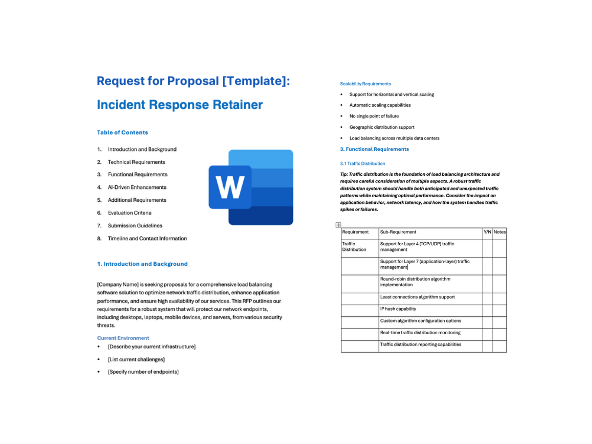
An incident response retainer is bought before you need it and judged on the worst day you have, so the selection should test how each firm would actually respond, not only what it promises. Check your cyber insurance policy and talk to your counsel before you issue the RFP, since both can shape which firms you invite and how the engagement is set up. The timeline table in the Word document has a row for each milestone, ready for your own dates.
- Write down what you have and what you need. Record your incident response plan and when it was last tested, who leads incidents today, your IT team, your MSP, MDR provider or MSSP, your backup and cloud providers, and the environment a responder would work in: users, endpoints, servers, locations, and cloud and SaaS services. List the proactive work you want the retainer to fund. Providers will scope and price against this, so put it in the background section of the RFP.
- Check your insurance policy and talk to your counsel. Read your cyber insurance policy, or ask your broker, to find out whether it requires or recommends particular response firms and whether the insurer must approve a firm before work starts. Ask your counsel whether they want to engage the response firm directly during an incident, and how they want that set up. This template asks providers to support that arrangement but doesn't say what it protects, so take your counsel's advice.
- Assemble the buying team. Include your security lead, IT lead, legal or outside counsel, whoever owns cyber insurance or risk, finance, and the executive who would make decisions during an incident. Keep your MDR provider or MSP informed. If it offers incident response itself, it can bid, but it shouldn't help choose.
- Choose the retainer model, and decide whether you need an RFI. Decide whether you want prepaid hours, a response commitment with hours billed when used, or a mix, and which proactive services you want included. If that's still open, or your long list is too long to interview, issue a short RFI asking each provider for its retainer models, how clients reach it during an incident, its experience with environments like yours and any referral relationships, and build a shortlist from the answers.
- Tailor and issue the RFP. Delete requirements that don't apply and adjust the priorities. Sign a confidentiality agreement with each provider before you share details of your environment, describe the same environment and the same proactive services to every provider so the proposals can be compared, and set a written question-and-answer window with every answer shared with all of them.
- Score, interview and test with a scenario. Have each evaluator score independently against the rubric before comparing notes, and set aside any provider that misses a Must-have. Interview each shortlisted provider's engagement lead and an incident lead who could take your call, give each the same scenario, such as ransomware found late on a Friday night, and call references who used the retainer in a real incident.
- Negotiate, award and onboard. Write the response commitments, the rules for unused hours, surge support, rates, evidence ownership, the arrangement with your counsel and the disclosure of referral fees into the contract. Then complete onboarding and test the activation process, so the retainer is ready before you need it.
IR retainer RFP requirements
Each line is written to paste straight into your RFP. Must-have means an incident response firm that cannot meet it is out; Nice-to-have earns extra points. Change the priorities to fit your situation, and delete what doesn't apply.
Scope of services
| ID |
Requirement |
Priority |
| S1 |
Emergency response to security incidents affecting our organization, covering triage, containment, investigation, eradication and recovery support, for the incident types we may face, such as ransomware, business email compromise, compromise of cloud or SaaS accounts, insider activity and data theft. State any incident types you do not handle. |
Must-have |
| S2 |
Digital forensics across the systems in our environment, including endpoints, servers, cloud and SaaS services, email, identity systems and network data, to establish how the attacker got in, what they did and when, and what data may have been accessed or taken. |
Must-have |
| S3 |
Collection and preservation of evidence, such as disk and memory images, logs and cloud audit records, in a way that supports our legal, insurance and regulatory needs, with the methods documented so the findings can be explained to our counsel, our insurer and others if needed. |
Must-have |
| S4 |
Remote response from the first call, and on-site response at the locations listed in this RFP when remote work is not enough. State how you decide when to send responders on site and where your responders are based. |
Must-have |
| S5 |
Recovery support alongside our IT team and providers: advice on restoring from backups, rebuilding affected systems, resetting credentials, and confirming the attacker has been removed before systems return to normal use. State what your team does hands-on and what it advises on. |
Must-have |
| S6 |
A review of our incident response plan and playbooks against guidance we agree, such as NIST Special Publication 800-61 Revision 3, with written findings and suggested changes. |
Must-have |
| S7 |
Tabletop exercises for our executives and for our technical teams, built around scenarios relevant to us, each followed by a written after-action report with assigned follow-up items. |
Must-have |
| S8 |
A compromise assessment that looks for signs of current or past attacker activity in our environment, with a written report of what was examined, what was found and what could not be checked. |
Nice-to-have |
| S9 |
A readiness assessment of our ability to respond, covering logging and log retention, backups, access to forensic data, contact lists and decision authority, and anything that would slow your team down if an incident started today, with ranked recommendations. |
Must-have |
| S10 |
A statement of whether you offer ransom negotiation or recovery support, such as decryption or data recovery, directly, by referral to another firm, or not at all, and who would do the work. Any decision about a ransom demand stays with us, after advice from our counsel, including on any legal restrictions on payments. |
Must-have |
Named lead and team
| ID |
Requirement |
Priority |
| L1 |
The name of the engagement lead who will manage our retainer, running onboarding and proactive services, reviewing retainer use with us and acting as our main contact between incidents, with a CV showing their incident response experience. |
Must-have |
| L2 |
A description of how an incident lead is assigned when we call, the qualifications and experience of the people who would lead and work on our incidents, and whether we can meet likely incident leads before an incident. |
Must-have |
| L3 |
Experience responding to incidents at organizations of our size and in our industry, in environments like ours (on-premises, cloud, SaaS or hybrid), supported by references from clients who have used a retainer for a real incident. |
Must-have |
| L4 |
A statement of which responders are your employees and which are subcontractors or partners. No subcontractor works on our incidents or handles our evidence without our written approval. |
Must-have |
| L5 |
Surge capacity: how you add responders when our incident grows or when many clients need help at the same time, how retainer clients are prioritized, and what happens if you cannot meet the response commitment. |
Must-have |
Deliverables and reporting
| ID |
Requirement |
Priority |
| D1 |
An onboarding plan listing each deliverable, its format and its due date, and the date the retainer is ready for use, covering a completed environment questionnaire, agreed contact and escalation lists, agreed activation steps and a test of the activation process. |
Must-have |
| D2 |
Status updates during an incident to our incident lead, and to our counsel where counsel directs, on a schedule we agree, covering what is known, what is not yet known, actions taken, decisions needed and hours used. |
Must-have |
| D3 |
A post-incident report with an executive summary for non-technical leaders, a timeline, how the attacker got in, the systems and data affected as far as the evidence shows, the actions taken and ranked recommendations, with drafts going to our counsel first where counsel directs. |
Must-have |
| D4 |
A lessons-learned session with our team after each incident, and a written list of improvements with owners, so the findings reach our incident response plan and security roadmap. |
Must-have |
| D5 |
A written report for each proactive service delivered, such as plan review findings, tabletop after-action reports and compromise assessment results. |
Must-have |
| D6 |
Retainer usage reports on a schedule we agree, showing hours used by service and by incident, hours remaining, and any hours due to expire. |
Must-have |
| D7 |
Indicators of compromise and other technical details from each incident, shared in a form our MDR provider, MSSP or security team can use to detect a return of the attacker. |
Nice-to-have |
Security, confidentiality and independence
| ID |
Requirement |
Priority |
| N1 |
Confidentiality terms covering everything your team learns about our incidents, systems, people and customers, signed before we share details of our environment, with our data held only on systems we approve. |
Must-have |
| N2 |
A documented chain of custody for every item of evidence, recording who collected it, when, from where and how, how its integrity is verified, where it is stored and every transfer, so the record can be relied on if our counsel, insurer, regulators or law enforcement need the evidence later. |
Must-have |
| N3 |
Evidence storage that is encrypted, limited to the named people working on our incident, kept separate from other clients' data and held in locations we approve, with the retention period stated, and return or certified destruction when we ask, apart from any records you tell us in advance that you keep, and why. |
Must-have |
| N4 |
Ownership by us of all reports, findings and evidence collected from our systems, or as set out in an agreement with our counsel where counsel engages you, with no use of our data or findings for other purposes, such as marketing or published research, without our written consent. |
Must-have |
| N5 |
A description of your own security program: how you protect client evidence and credentials, keep each client's data separate, and secure responder devices and response tools, plus any independent attestation or certification you hold, and a commitment to tell us of any security incident at your firm that affects our data within a defined time. State the time. |
Must-have |
| N6 |
Access to our systems only through accounts we issue to named people who have passed background checks in line with our hiring standards, with multifactor authentication and the least privilege needed, and a list of every tool you install on our systems, what it collects and how it is removed when the work ends. |
Must-have |
| N7 |
Willingness to be engaged by or through our outside counsel where counsel wants that, and to follow counsel's direction on how findings, drafts and reports are shared and labeled. Our counsel decides whether to use this arrangement. |
Must-have |
| N8 |
Written disclosure, before any referral, of referral fees, commissions or other payments you receive from firms you may refer us to, such as ransom negotiation, data recovery, legal or public relations firms, or from products you may recommend during recovery. |
Must-have |
| N9 |
Disclosure of any relationship with our cyber insurer, our counsel, our MSP or MDR provider, or other parties to an incident that could affect your advice, and product-neutral recommendations where remediation needs a product or service. |
Must-have |
| N10 |
Professional liability (errors and omissions) and cyber liability insurance with the coverage limits stated, and your proposed limitation of liability terms. |
Must-have |
Engagement and transition
| ID |
Requirement |
Priority |
| E1 |
A way to reach you at any hour of any day, by phone and by a backup channel, a list of who on our side can activate the retainer and how you verify a caller, and the committed time from our call to an analyst starting work on our incident and to responders reaching our locations. State the times and how they are measured. |
Must-have |
| E2 |
Response commitments written into the contract, with how they are measured and reported to us, and the remedy if you miss them. |
Must-have |
| E3 |
Contract terms, rates and a statement of work agreed when the retainer is signed, so work can start on our call without further negotiation, apart from any engagement letter our counsel chooses to add. |
Must-have |
| E4 |
Coordination with our cyber insurer: working within the insurer's claims process where our policy has one, providing the information the insurer asks for, and invoices in the detail it needs. We will check our policy for any required or recommended response firms before award. |
Must-have |
| E5 |
Coordination with law enforcement when we decide, with our counsel, to involve them: preparing technical information and evidence for them, and joining calls when we ask. |
Must-have |
| E6 |
Coordination with our IT team, MSP, MDR provider, backup provider and cloud providers during an incident, with clear decision roles, and no changes to our systems without our approval apart from actions we pre-authorize in the activation steps. |
Must-have |
| E7 |
The retainer term, renewal terms, the notice period for either side, what happens to prepaid hours if the retainer ends, and, when it ends, removal of any tools you installed and return or destruction of our evidence as we direct. |
Must-have |
Commercial and pricing
| ID |
Requirement |
Priority |
| C1 |
The retainer models you offer, such as a block of prepaid hours, a fee for a response commitment with hours billed when used, or a mix, and what each includes. |
Must-have |
| C2 |
Hourly rates for each role for incident work, any premium for urgent, out-of-hours or on-site work and when it applies, and any discount on those rates for retainer clients. |
Must-have |
| C3 |
Rules for unused retainer hours: whether they carry over to the next term, whether and when they expire, and which proactive services they can fund, with the hours each service uses. |
Must-have |
| C4 |
Prices, or the retainer hours used, for each proactive service: incident response plan review, executive and technical tabletop exercises, compromise assessment and readiness assessment. |
Must-have |
| C5 |
Billing for work beyond the retainer during a large incident: an estimate for each phase where possible, our approval before hours beyond the estimate, and the rates agreed in the contract. |
Must-have |
| C6 |
A list of costs passed through to us, such as forensic hardware, evidence storage, evidence shipping, tool licenses used during a response and travel, with how each is priced, and no pass-through costs without our approval. |
Must-have |
| C7 |
A cap on rate increases at renewal, and termination for convenience by either side with written notice, with fees limited to work done. State the cap. |
Must-have |
Questions to ask incident response firms
These questions are designed to separate incident response firms, not to collect brochure answers. Ask for evidence: a sample deliverable, an interview with the named lead or a reference.
- We'd like to interview the engagement lead you propose, and an incident lead who could take our call, without the sales team present. How would they want us to prepare before an incident, and what would they ask on our first call?
- Late on a Friday night, our MDR provider tells us ransomware is spreading across our file servers. Walk us through what happens from our call: who answers, when an analyst starts work, the first decisions you would put to us, what you would ask our MSP to do, and when you would bring in our counsel and our cyber insurer.
- A finance employee's mailbox has been used to send fraudulent payment instructions to customers. How would you find out how the account was compromised, what the attacker read or sent and whether other accounts are affected, and what would you need from us and our email provider?
- Our identity provider shows attacker sign-ins to administrator accounts in our cloud services. How would you contain it, which logs would you need, and what would you do if the logs you need were not kept long enough?
- A widely exploited vulnerability means many of your clients need help in the same week as us. How do you staff our incident, how do you set priorities between clients, and what happens if you cannot meet the response commitment?
- Our outside counsel may want to engage you directly for any incident. How do you set that up with counsel, how do findings, drafts and reports flow, and what changes for us?
- Before award we will check whether our cyber insurance policy requires or recommends particular response firms. How do you work within an insurer's claims process, and what billing detail and reporting do you provide for a claim?
- Do you offer ransom negotiation or recovery support directly, by referral, or not at all? Who would do the work, what payments do you receive from any firm you refer us to, and how do you advise a client deciding how to respond to a ransom demand?
- Describe how your team collects and preserves evidence from a laptop, a server and a cloud service: what you capture, how you verify it, how you record the chain of custody, and how you would hand evidence to law enforcement when we decide to involve them.
- Send redacted samples of a post-incident report, a tabletop after-action report and a retainer usage report. Which parts would look different for an organization like us?
- Lay out your onboarding plan for us: each step and deliverable, what you need from our team, any tools you would want installed in advance and what they collect, and how we would test the activation process.
- If we have no incident this term, how would you suggest using the retainer hours, and which proactive services would you put first for us based on what you know about our environment?
- How do you protect the evidence, credentials and findings from client incidents on your own systems? Has your firm had a security incident affecting client data, and how did you tell those clients?
- Provide a reference from a client of similar size and industry that used your retainer for a real incident, and one that used it mainly for proactive work.
Scoring rubric
Score each criterion from 1 to 5, multiply by its weight, and add the results. The weights below are a starting point; agree on your own before any proposals arrive so the scoring can't be bent around a favorite.
| Criterion |
Weight |
What a strong response shows |
| Response team quality and fit |
25% |
An engagement lead and incident leads with experience at organizations of your size, industry and environment, a strong interview without the sales team, no unapproved subcontractors, and references from clients who used the retainer in a real incident. |
| Onboarding and readiness plan |
20% |
A specific, dated onboarding plan that makes the retainer ready before an incident, a clear list of what's needed from your team, a test of the activation process, and proactive services matched to your gaps. |
| Access, response commitments and surge capacity |
15% |
Clear ways to reach the provider at any hour, committed and measured times for an analyst to start work and for responders to reach your locations, a remedy if they are missed, and a credible answer on surge capacity. |
| Judgment in the scenarios |
10% |
Practical, honest answers to the ransomware, email compromise, cloud account and surge scenarios, with clear decisions put to you and a realistic split of work with your MSP and MDR provider. |
| Evidence handling and the provider's own security |
10% |
A documented chain of custody, protected and separated evidence storage, stated retention and destruction, your ownership of reports and evidence, and a credible security program at the provider. |
| Counsel, insurer, law enforcement and disclosures |
10% |
A workable approach to engagement through your counsel, experience with insurers' claims processes, a clear approach to working with law enforcement, and full written disclosure of referral fees and relationships. |
| Commercials and retainer terms |
10% |
A clear retainer model, transparent rates and premiums, fair rules for unused hours, priced proactive services, approval before extra hours, and a list of pass-through costs. |
| Total |
100% |
|
Scoring scale
- 5 Exceeds: meets every Must-have and most Nice-to-haves, shown through an interview with the named lead, sample deliverables and a matching reference client.
- 4 Strong: meets every Must-have and some Nice-to-haves, with clear evidence.
- 3 Adequate: meets most Must-haves; gaps have a credible plan.
- 2 Weak: misses one or more Must-haves, or the answer is vague.
- 1 Poor: does not meet the requirement, or no answer.
Frequently asked questions
What is an incident response retainer?
An incident response retainer is an agreement with an incident response firm that you sign before anything goes wrong, so the contract, rates, contacts and response commitments are already in place when an incident starts. Retainers differ: some prepay a block of hours, others charge for a response commitment and bill hours when used, and some let unused hours fund proactive work such as plan reviews, tabletop exercises or a compromise assessment. A retainer works best alongside a written incident response plan. NIST Special Publication 800-61 Revision 3, published April 2025 (csrc.nist.gov/pubs/sp/800/61/r3/final), gives incident response recommendations and considerations within the Cybersecurity Framework (CSF) 2.0.
What should an incident response retainer include?
Ask for a way to reach the firm at any hour with a committed time for an analyst to start work; emergency response and digital forensics for the incident types you may face; evidence handling with a documented chain of custody; clear rules for unused hours; and proactive services the retainer can fund, such as plan reviews, tabletop exercises, compromise assessments and readiness assessments. The retainer should also cover surge capacity, how the firm works with your counsel, cyber insurer and law enforcement, who owns reports and evidence, the firm's own security, and disclosure of any referral fees. This template includes requirements for each, marked Must-have or Nice-to-have.
How much does an incident response retainer cost?
Price depends on the retainer model and the scope, so compare proposals priced against the same assumptions. The main cost drivers are whether the retainer prepays hours or only buys a response commitment, how fast you need an analyst to start, the size and complexity of your environment, the locations that may need on-site work, which proactive services you want included, how unused hours are treated, and the rates and any urgent or out-of-hours premiums for work beyond the retainer. The cost of an actual incident depends on its scope, so also compare the rates, pass-through costs and approval rules for extra hours.
Do we need a retainer if our cyber insurer has a panel?
It depends on your policy, so check it before you sign anything: whether it requires or recommends particular response firms, whether it covers fees from a firm you choose yourself, and whether the insurer must approve a firm before work starts. Ask your broker or insurer, and your counsel, to confirm. If you choose a firm your policy accepts, a retainer can still put in place what you need before an incident: completed onboarding, agreed terms and rates, contacts your team knows, and proactive work. If you prefer a firm your policy doesn't name, ask your insurer in writing whether its fees would be covered.
Related RFP templates
Download Template
 Arctic Wolf
 Arete
 Cisco
 CrowdStrike
 Dragos
 eSentire
 Google Cloud
 HALOCK
 IBM
 Kudelski Security
 LevelBlue
 Optiv
 Palo Alto Networks
 Rapid7
 Surefire Cyber
 Sygnia
 TrustedSec
 UnderDefense