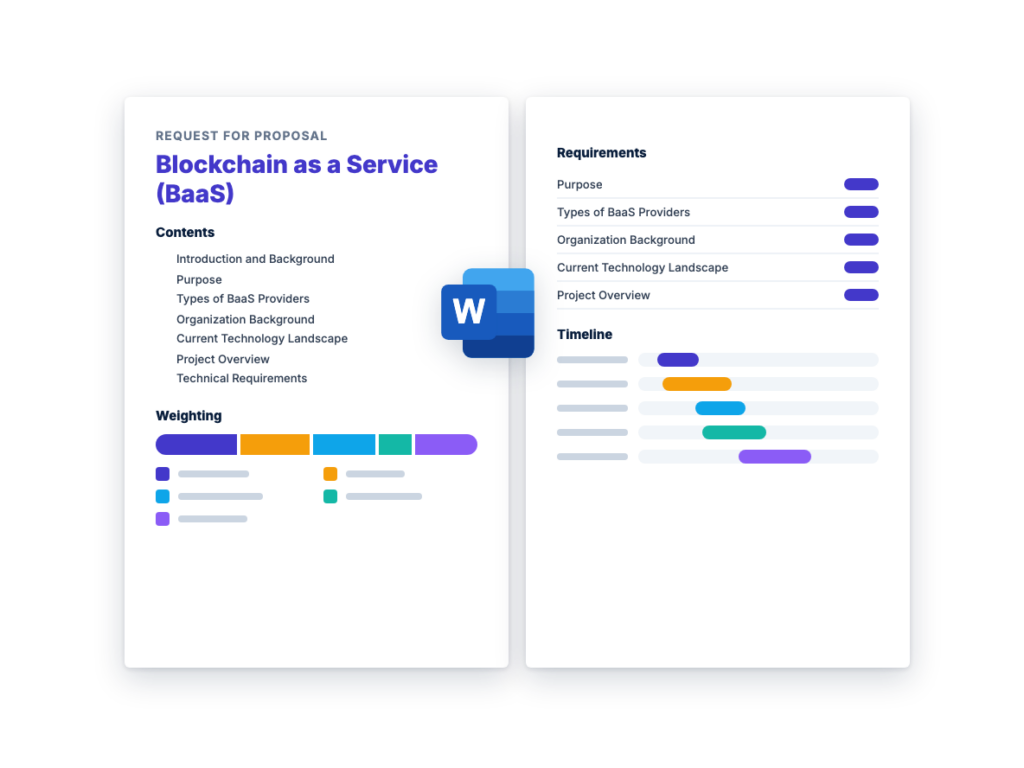
Request for Proposal: Blockchain as a Service (BaaS) Provider
Table of Contents
- Introduction and Background
- Technical Requirements
- Functional Requirements
- AI-Enhanced Features
- Vendor Qualifications
- Evaluation Criteria
- Submission Guidelines
- Timeline
- Proof of Concept Requirements
- Service Level Agreement Requirements
- Cost Structure Requirements
- Innovation and Future Development
1. Introduction and Background
1.1 Purpose
[Company Name] is seeking proposals for a comprehensive Blockchain as a Service (BaaS) solution to enable the development, deployment, and management of blockchain applications without the need to build and maintain our own blockchain infrastructure. This RFP outlines our requirements for a robust system that will provide secure, scalable, and efficient blockchain services.
1.2 Types of BaaS Providers
We are considering the following types of BaaS solutions:
- Public blockchain as a service
- Private blockchain as a service
- Hybrid blockchain as a service
- Integration blockchain as a service
- Developer-focused blockchain as a service
1.3 Organization Background
- Brief description of your company/organization
- Industry and regulatory requirements
- Current IT infrastructure overview
- Scale of operations
1.4 Current Technology Landscape
- Existing blockchain initiatives (if any)
- Current infrastructure and integration points
- Challenges and pain points to address
1.5 Project Overview
- Primary goals for implementing BaaS
- Types of blockchain applications planned
- Expected scale of operations
- Integration requirements with existing systems
2. Technical Requirements
2.1 Performance and Scalability
- Specified minimum transactions per second (TPS) capacity
- Maximum latency requirements for transaction confirmation
- Horizontal and vertical scaling capabilities
- Load balancing and high availability requirements
- Performance monitoring and optimization tools
- Scalability testing and validation procedures
2.2 Interoperability
- Support for cross-chain transactions
- Integration with other blockchain networks
- Standardized data exchange protocols
- Cross-platform compatibility
- Legacy system integration capabilities
- Interoperability testing procedures
2.3 Data Storage and Management
- On-chain and off-chain storage options
- Data encryption at rest and in transit
- Comprehensive backup and recovery mechanisms
- Data archival and retention policies
- Storage optimization and management tools
- Data integrity verification systems
2.4 Network Architecture
- Support for public, private, and consortium networks
- Node deployment and management tools
- Network topology configuration options
- Network monitoring and maintenance procedures
- Fault tolerance and redundancy mechanisms
- Disaster recovery capabilities
2.5 Smart Contract Languages and Development
- Support for multiple smart contract languages (Solidity, Go, Java)
- Integrated development environments (IDEs)
- Version control and collaboration tools
- Smart contract testing and debugging capabilities
- Code analysis and optimization tools
- Smart contract templates and libraries
2.6 API and Integration
- RESTful API support with comprehensive documentation
- WebSocket support for real-time data streaming
- Integration with common enterprise systems (SAP, Oracle)
- Custom API development capabilities
- API security and access control
- API performance monitoring and optimization
2.7 Security Measures
- Support for hardware security modules (HSMs)
- Regular security audits and penetration testing
- Compliance with industry security standards (ISO 27001, SOC 2)
- Comprehensive encryption key management
- Access control and authentication systems
- Security incident response procedures
3. Functional Requirements
3.1 Functional Infrastructure Requirements
Tip: The functional infrastructure forms the foundation of your blockchain platform. Carefully evaluate each component’s scalability, reliability, and compatibility with your existing systems. Pay special attention to consensus mechanism flexibility and transaction throughput capabilities.
| Requirement |
Sub-Requirement |
Y/N |
Notes |
| Distributed Ledger Technology |
Implementation and setup |
|
|
|
Maintenance and updates |
|
|
|
Performance monitoring |
|
|
|
Data consistency verification |
|
|
| Transactional Database |
Hosted database setup |
|
|
|
Distributed architecture |
|
|
|
Data replication |
|
|
|
Backup systems |
|
|
| Consensus Mechanisms |
PoS implementation |
|
|
|
PoW implementation |
|
|
|
PBFT implementation |
|
|
|
Custom consensus options |
|
|
| Scalable Architecture |
Transaction volume handling |
|
|
|
Network expansion capability |
|
|
|
Resource scaling |
|
|
|
Performance optimization |
|
|
3.2 Development Environment
Tip: A robust development environment accelerates blockchain application deployment while reducing errors. Focus on tool integration capabilities, testing frameworks, and documentation quality. Consider your team’s expertise and preferred programming languages.
| Requirement |
Sub-Requirement |
Y/N |
Notes |
| Smart Contract Tools |
Development interface |
|
|
|
Testing frameworks |
|
|
|
Deployment automation |
|
|
|
Version control |
|
|
| Development Framework |
Prebuilt tools |
|
|
|
Templates and libraries |
|
|
|
Documentation |
|
|
|
Best practices guide |
|
|
| APIs and SDKs |
REST API support |
|
|
|
GraphQL support |
|
|
|
Client libraries |
|
|
|
API documentation |
|
|
| Multi-language Support |
Solidity support |
|
|
|
Go support |
|
|
|
Java support |
|
|
|
Other languages |
|
|
3.3 Customization and Integration
Tip: Integration capabilities determine how effectively your blockchain solution works with existing systems. Evaluate both technical integration features and the vendor’s experience with similar integrations in your industry.
| Requirement |
Sub-Requirement |
Y/N |
Notes |
| Application Customization |
UI/UX customization |
|
|
|
Business logic adaptation |
|
|
|
Custom module development |
|
|
|
Branding options |
|
|
| Enterprise Integration |
ERP integration |
|
|
|
CRM integration |
|
|
|
Legacy system integration |
|
|
|
API gateway setup |
|
|
| Blockchain Frameworks |
Ethereum support |
|
|
|
Hyperledger support |
|
|
|
Multi-chain support |
|
|
|
Framework updates |
|
|
3.4 Security and Access Management
Tip: A comprehensive security framework should cover all aspects of blockchain operations while remaining flexible enough to adapt to new threats. Pay special attention to key management and access control mechanisms.
| Requirement |
Sub-Requirement |
Y/N |
Notes |
| Identity Management |
User authentication |
|
|
|
Role definition |
|
|
|
Access policies |
|
|
|
Directory integration |
|
|
| Encryption |
Data-at-rest encryption |
|
|
|
Data-in-transit encryption |
|
|
|
Key rotation |
|
|
|
Algorithm selection |
|
|
| Access Control |
Role-based access |
|
|
|
Policy enforcement |
|
|
|
Activity monitoring |
|
|
|
Access review |
|
|
3.5 Monitoring and Analytics
Tip: Effective monitoring and analytics capabilities are crucial for maintaining network health and optimizing performance. Ensure the system provides both real-time monitoring and historical analysis capabilities.
| Requirement |
Sub-Requirement |
Y/N |
Notes |
| Performance Tracking |
Real-time monitoring |
|
|
|
Metric collection |
|
|
|
Performance analysis |
|
|
|
Trend identification |
|
|
| Transaction Analytics |
Volume analysis |
|
|
|
Pattern recognition |
|
|
|
Anomaly detection |
|
|
|
Cost tracking |
|
|
| Network Health |
Node monitoring |
|
|
|
Connection quality |
|
|
|
Resource utilization |
|
|
|
Health alerts |
|
|
3.6 Scalability and Deployment
Tip: Scalability options should align with your growth projections and deployment preferences. Consider both horizontal and vertical scaling capabilities, as well as the flexibility to adapt to different cloud environments.
| Requirement |
Sub-Requirement |
Y/N |
Notes |
| Cloud Integration |
AWS deployment |
|
|
|
Azure deployment |
|
|
|
Google Cloud deployment |
|
|
|
Multi-cloud support |
|
|
| On-premises Options |
Local deployment |
|
|
|
Hardware requirements |
|
|
|
Network setup |
|
|
|
Security configuration |
|
|
| Scaling Capabilities |
Horizontal scaling |
|
|
|
Vertical scaling |
|
|
|
Auto-scaling |
|
|
|
Load balancing |
|
|
3.7 Compliance and Governance
Tip: Compliance and governance features should address both current regulatory requirements and have the flexibility to adapt to new regulations. Consider industry-specific compliance needs and international data protection requirements.
| Requirement |
Sub-Requirement |
Y/N |
Notes |
| Regulatory Compliance |
GDPR compliance |
|
|
|
HIPAA compliance |
|
|
|
Financial regulations |
|
|
|
Industry standards |
|
|
| Governance Tools |
Policy management |
|
|
|
Audit controls |
|
|
|
Voting mechanisms |
|
|
|
Decision tracking |
|
|
| Data Management |
Residency controls |
|
|
|
Sovereignty compliance |
|
|
|
Data lifecycle management |
|
|
|
Privacy controls |
|
|
4. AI-Enhanced Features
4.1 Smart Contract Optimization
Tip: AI-powered smart contract optimization can significantly improve code quality and security. Look for systems that combine static analysis with machine learning to identify potential vulnerabilities and optimization opportunities.
| Requirement |
Sub-Requirement |
Y/N |
Notes |
| Code Analysis |
Automated code review |
|
|
|
Vulnerability detection |
|
|
|
Gas optimization |
|
|
|
Pattern recognition |
|
|
| Performance Enhancement |
Execution optimization |
|
|
|
Resource usage analysis |
|
|
|
Bottleneck detection |
|
|
|
Improvement suggestions |
|
|
4.2 Predictive Analytics
Tip: Predictive analytics capabilities can help prevent network congestion and optimize resource allocation. Ensure the system can handle your specific transaction patterns and provide actionable insights for network management.
| Requirement |
Sub-Requirement |
Y/N |
Notes |
| Network Analysis |
Congestion prediction |
|
|
|
Usage pattern analysis |
|
|
|
Resource forecasting |
|
|
|
Performance trending |
|
|
| Dynamic Adjustment |
Fee optimization |
|
|
|
Block size adjustment |
|
|
|
Resource allocation |
|
|
|
Network scaling |
|
|
4.3 Security Enhancement
Tip: AI-driven security features should complement traditional security measures. Focus on real-time threat detection capabilities and the system’s ability to adapt to new attack patterns.
| Requirement |
Sub-Requirement |
Y/N |
Notes |
| Fraud Detection |
Real-time monitoring |
|
|
|
Pattern recognition |
|
|
|
Anomaly detection |
|
|
|
Alert system |
|
|
| Threat Intelligence |
Risk assessment |
|
|
|
Threat prediction |
|
|
|
Security updates |
|
|
|
Incident response |
|
|
4.4 Natural Language Processing
Tip: NLP capabilities can significantly improve user interaction with blockchain data and smart contracts. Consider both technical users’ needs for code documentation and business users’ needs for data querying.
| Requirement |
Sub-Requirement |
Y/N |
Notes |
| Data Querying |
Natural language queries |
|
|
|
Query optimization |
|
|
|
Results explanation |
|
|
|
User assistance |
|
|
| Documentation |
Code documentation |
|
|
|
Smart contract explanation |
|
|
|
Usage guidelines |
|
|
|
Technical writing |
|
|
4.5 Automated Testing
Tip: AI-driven testing can significantly reduce the time and resources needed for comprehensive testing. Ensure the system can generate relevant test cases for your specific use cases and industry requirements.
| Requirement |
Sub-Requirement |
Y/N |
Notes |
| Test Generation |
Test case creation |
|
|
|
Coverage optimization |
|
|
|
Scenario generation |
|
|
|
Edge case identification |
|
|
| Test Execution |
Automated running |
|
|
|
Result analysis |
|
|
|
Performance testing |
|
|
|
Security testing |
|
|
4.6 Consensus Optimization
Tip: AI-driven consensus optimization can significantly improve network efficiency and energy usage. Look for solutions that can adaptively tune consensus parameters based on network conditions while maintaining security and decentralization requirements.
| Requirement |
Sub-Requirement |
Y/N |
Notes |
| Algorithm Enhancement |
Performance optimization |
|
|
|
Energy efficiency |
|
|
|
Security balancing |
|
|
|
Adaptive tuning |
|
|
| Scalability Improvement |
Throughput optimization |
|
|
|
Latency reduction |
|
|
|
Resource utilization |
|
|
|
Network coordination |
|
|
4.7 Data Management
Tip: AI-powered data management features should optimize storage utilization while ensuring data accessibility and integrity. Consider both on-chain and off-chain storage requirements and how the system handles data growth over time.
| Requirement |
Sub-Requirement |
Y/N |
Notes |
| Storage Optimization |
Data compression |
|
|
|
Storage allocation |
|
|
|
Archive management |
|
|
|
Capacity planning |
|
|
| Data Analysis |
Pattern recognition |
|
|
|
Usage analytics |
|
|
|
Performance metrics |
|
|
|
Optimization recommendations |
|
|
4.8 Identity Management
Tip: AI-enhanced identity management should provide robust security while maintaining user privacy. Focus on the system’s ability to detect fraudulent activities and adapt to new identity verification requirements.
| Requirement |
Sub-Requirement |
Y/N |
Notes |
| Decentralized Verification |
Identity validation |
|
|
|
Credential verification |
|
|
|
Privacy protection |
|
|
|
Compliance checking |
|
|
| Risk Assessment |
Behavior analysis |
|
|
|
Access control adaptation |
|
|
|
Threat detection |
|
|
|
Security policy enforcement |
|
|
4.9 Content Generation
Tip: AI-driven content generation tools should focus on producing accurate, consistent, and maintainable documentation. Consider the quality of generated content and its usefulness for different user personas.
| Requirement |
Sub-Requirement |
Y/N |
Notes |
| Documentation |
Technical docs generation |
|
|
|
User guide creation |
|
|
|
API documentation |
|
|
|
Update management |
|
|
| Smart Contract Content |
Contract templates |
|
|
|
Code comments |
|
|
|
Usage examples |
|
|
|
Best practices |
|
|
5. Vendor Qualifications
5.1 Company Profile
- Company history and experience in blockchain technology
- Technical expertise and certifications
- Financial stability and sustainability
- Global presence and support capabilities
5.2 Experience and References
- Previous BaaS implementations
- Industry-specific experience
- Client references and case studies
- Success metrics from past projects
5.3 Support Capabilities
- Technical support infrastructure
- Service level agreements (SLAs)
- Support team qualifications
- Response time commitments
5.4 Innovation and Development
- Research and development initiatives
- Technology partnerships
- Innovation roadmap
- Continuous improvement processes
6. Evaluation Criteria
6.1 Technical Evaluation (40%)
- Solution completeness
- Technical capabilities
- Security measures
- Performance metrics
- Integration capabilities
- AI features implementation
6.2 Vendor Assessment (25%)
- Company experience
- Industry knowledge
- Support infrastructure
- Financial stability
- Innovation potential
6.3 Implementation and Support (20%)
- Implementation methodology
- Training programs
- Support services
- Documentation quality
- Resource availability
6.4 Commercial (15%)
- Total cost of ownership
- Pricing model
- Payment terms
- Value for money
7. Submission Guidelines
Proposals should include:
- Executive Summary
- Technical Solution Details
- Implementation Approach
- Support and Maintenance Plan
- Pricing Structure
- Company Profile
- Client References
- Sample Documentation
8. Timeline
- RFP Release Date: [Date]
- Questions Deadline: [Date]
- Proposal Due Date: [Date]
- Vendor Presentations: [Date Range]
- Selection Date: [Date]
- Project Kickoff: [Date]
9. Proof of Concept Requirements
9.1 PoC Scope
- Smart contract deployment demonstration
- Integration capabilities testing
- Security controls validation
- Performance testing
- AI features demonstration
9.2 PoC Success Criteria
- Technical requirements met
- Performance benchmarks achieved
- Security standards demonstrated
- Integration capabilities proven
- User experience validated
9.3 PoC Timeline
- Two-week implementation period
- One-week testing period
- One-week evaluation period
10. Service Level Agreement Requirements
10.1 Platform Availability
- 9% uptime guarantee
- Planned maintenance windows
- Emergency maintenance procedures
- Disaster recovery timeframes
10.2 Performance Metrics
- Transaction processing times
- Block creation times
- API response times
- Maximum latency requirements
10.3 Support Requirements
- 24/7 technical support
- Response time commitments
- Problem resolution timeframes
- Escalation procedures
11. Cost Structure Requirements
11.1 Implementation Costs
- Platform setup and configuration
- Integration development
- Data migration
- Training and documentation
- Project management
11.2 Recurring Costs
- Platform subscription/licensing
- Transaction fees
- Storage costs
- Support and maintenance
- Regular updates
12. Innovation and Future Development
12.1 Technology Roadmap
- Feature development plans
- Technology stack evolution
- Scalability improvements
- Security enhancements
- AI capability expansion
12.2 Industry Trends Alignment
- Web3 integration plans
- Cross-chain development
- Regulatory compliance updates
- Emerging technology adoption
12.3 Customer Input Process
- Feature request handling
- Customer feedback integration
- Beta testing programs
- User community engagement
Download Template