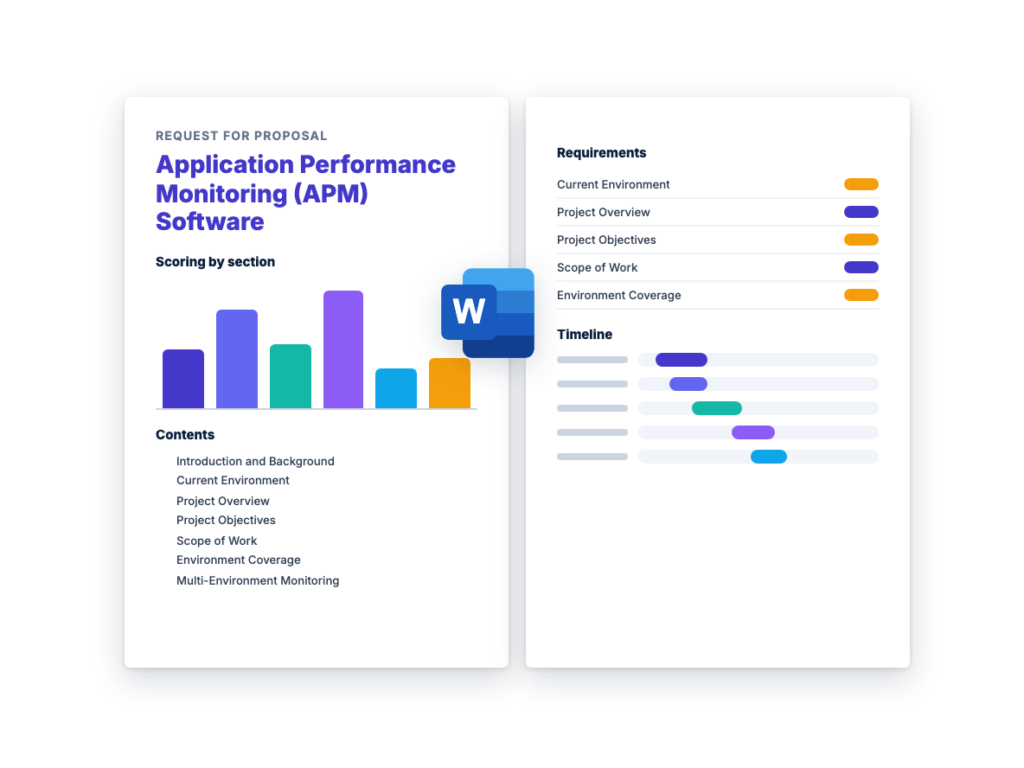
Request for Proposal: Application Performance Monitoring (APM) Software Solution
Table of Contents
- Introduction and Background
- Project Objectives
- Scope of Work
- Technical Requirements
- Functional Requirements
- AI and Advanced Features
- Reporting and Analytics
- User Management and Access Control
- Support and Maintenance
- Vendor Qualifications
- Evaluation Criteria
- Submission Guidelines
- Timeline
1. Introduction and Background
[Company Name] is seeking proposals for a comprehensive Application Performance Monitoring (APM) solution to enhance our application performance visibility and optimization capabilities. This RFP outlines our requirements for a robust system that will monitor, analyze, and optimize the performance of our software applications in real-time.
Current Environment
- Briefly describe your organization’s current application landscape
- Outline the size and complexity of your IT infrastructure
- Describe current monitoring capabilities and challenges
- List any specific regulatory requirements
Project Overview
The selected APM solution will provide real-time monitoring, analysis, and optimization capabilities across our application portfolio, including mobile, web-based, and desktop applications.
2. Project Objectives
The primary objectives of this APM implementation project are to:
- Establish comprehensive real-time monitoring across all application environments
- Improve application performance and user experience through proactive monitoring
- Reduce mean time to detection (MTTD) and mean time to resolution (MTTR) for performance issues
- Enable data-driven decision making for application optimization
- Ensure compliance with industry standards and regulations
3. Scope of Work
3.1 Environment Coverage
- Mobile applications
- Web-based applications
- Desktop applications
- Cloud infrastructure
- On-premises systems
- Hybrid environments
3.2 Multi-Environment Monitoring
- Support for various hosting environments (on-premises, cloud, hybrid)
- Consistent tracking across all application component locations
- Seamless monitoring across distributed systems
3.3 Application Topology Mapping
- Comprehensive visualization of dependencies between application components
- Performance bottleneck identification
- Transaction flow mapping across distributed systems
3.4 Key Deliverables
- Complete APM solution implementation
- Integration with existing tools and systems
- Custom dashboard creation and configuration
- User training and documentation
- Ongoing support and maintenance
4. Technical Requirements
4.1 Programming Language Support
- Multiple programming language support (Ruby, Java, C#, Python)
- Various server environment compatibility (Windows, Linux distributions)
- Support for different application frameworks and technologies
4.2 Deployment Options
- On-premises deployment support
- Cloud-based deployment capabilities
- Hybrid deployment model support
- Containerized deployment options
- Support for distributed architectures
4.3 Security and Compliance
- Data encryption (at rest and in transit)
- Compliance with industry standards (GDPR, HIPAA)
- Role-based access control
- Audit logging capabilities
- Secure data handling and storage
4.4 Integration Capabilities
- Comprehensive API access
- Pre-built integrations with DevOps tools
- Custom integration support
- Integration with network monitoring tools
- Integration with log analysis platforms
- Support for CI/CD platforms
4.5 Performance and Scalability
- High-volume data processing
- Distributed architecture support
- Real-time data processing
- Minimal performance impact
5. Functional Requirements
5.1 Real-time Performance Monitoring
Tip: Real-time monitoring capabilities are fundamental to APM success. The solution must balance comprehensive data collection with minimal system impact, while providing immediate visibility into performance issues. Look for systems that can handle high-volume data processing while maintaining accuracy and offering customizable monitoring parameters.
| Requirement |
Sub-Requirement |
Y/N |
Notes |
| Metric Tracking |
Performance metric collection across all components |
|
|
|
Resource utilization monitoring |
|
|
|
Custom metric support |
|
|
| Response Time |
End-user response time tracking |
|
|
|
Server-side response time monitoring |
|
|
|
API response time tracking |
|
|
| Transaction Processing |
Transaction success rate monitoring |
|
|
|
Transaction volume tracking |
|
|
|
Transaction path analysis |
|
|
| KPI Monitoring |
Business KPI tracking |
|
|
|
Technical KPI monitoring |
|
|
|
Custom KPI definition support |
|
|
| Resource Monitoring |
CPU utilization tracking |
|
|
|
Memory usage monitoring |
|
|
|
Network performance tracking |
|
|
5.2 Baseline Management
Tip: Baseline management is crucial for understanding normal performance patterns and detecting anomalies. The solution should automatically establish and maintain baselines across different time periods and workload patterns, while accounting for seasonal variations and growth trends. This helps reduce false positives and enables more accurate alerting.
| Requirement |
Sub-Requirement |
Y/N |
Notes |
| Baseline Creation |
Automated baseline generation |
|
|
|
Historical data analysis |
|
|
|
Seasonal pattern recognition |
|
|
| Variance Detection |
Real-time deviation monitoring |
|
|
|
Customizable threshold settings |
|
|
|
Multiple threshold levels |
|
|
| Alerting System |
Alert prioritization |
|
|
|
Custom alert rules |
|
|
|
Alert correlation capabilities |
|
|
| Trend Analysis |
Historical trend tracking |
|
|
|
Pattern recognition |
|
|
|
Trend forecasting |
|
|
5.3 Visualization and Dashboards
Tip: Effective visualization transforms complex performance data into actionable insights. The solution should provide both out-of-the-box dashboards for immediate value and extensive customization capabilities to meet specific monitoring needs. Consider the ability to create role-specific views and real-time updating capabilities.
| Requirement |
Sub-Requirement |
Y/N |
Notes |
| Custom Dashboards |
Dashboard template creation |
|
|
|
Widget customization |
|
|
|
Layout flexibility |
|
|
| Role-based Views |
User-specific dashboards |
|
|
|
Team-level views |
|
|
|
Department-specific layouts |
|
|
| Data Visualization |
Interactive charts |
|
|
|
Custom graph creation |
|
|
|
Heat maps |
|
|
| Real-time Updates |
Live data streaming |
|
|
|
Automatic refresh capabilities |
|
|
|
Real-time alerting |
|
|
| Drill-down Capabilities |
Interactive data exploration |
|
|
|
Root cause investigation |
|
|
|
Component-level analysis |
|
|
5.4 End-to-End Transaction Monitoring
Tip: Comprehensive transaction monitoring across distributed systems is essential for modern applications. The solution must track transactions across multiple services, databases, and external dependencies while maintaining context and performance data. This capability is crucial for understanding bottlenecks and optimizing application performance.
| Requirement |
Sub-Requirement |
Y/N |
Notes |
| Transaction Visibility |
Full transaction path tracking |
|
|
|
Cross-service tracing |
|
|
|
Distributed transaction monitoring |
|
|
| Component Tracking |
Service dependency mapping |
|
|
|
Component performance metrics |
|
|
|
Inter-service communication tracking |
|
|
| Bottleneck Detection |
Performance bottleneck identification |
|
|
|
Resource constraint detection |
|
|
|
Latency analysis |
|
|
| Flow Mapping |
Service topology visualization |
|
|
|
Data flow tracking |
|
|
|
API call mapping |
|
|
5.5 Root Cause Analysis (RCA)
Tip: Effective root cause analysis dramatically reduces time to resolution and prevents recurring issues. The solution should combine automated detection with detailed diagnostic capabilities, providing clear visibility into the chain of events leading to problems while offering actionable remediation steps.
| Requirement |
Sub-Requirement |
Y/N |
Notes |
| Issue Detection |
Automated problem discovery |
|
|
|
Real-time problem identification |
|
|
|
Pattern-based detection |
|
|
| Impact Analysis |
Service impact assessment |
|
|
|
User impact evaluation |
|
|
|
Business impact calculation |
|
|
| Resolution Support |
Solution recommendations |
|
|
|
Historical resolution tracking |
|
|
|
Knowledge base integration |
|
|
| Dependency Analysis |
Service dependency mapping |
|
|
|
Infrastructure dependency tracking |
|
|
|
Resource relationship analysis |
|
|
5.6 User Experience Monitoring
Tip: Understanding real user experience is crucial for application success. The solution should combine real user monitoring with synthetic testing to provide comprehensive coverage of user experience. This dual approach ensures both actual user experience measurement and proactive performance monitoring across all critical user journeys.
| Requirement |
Sub-Requirement |
Y/N |
Notes |
| Real User Monitoring |
Page load time tracking |
|
|
|
User interaction tracking |
|
|
|
Error tracking |
|
|
| Synthetic Monitoring |
Transaction script creation |
|
|
|
Global performance checking |
|
|
|
Availability monitoring |
|
|
| Session Tracking |
User session recording |
|
|
|
Session replay capabilities |
|
|
|
User journey mapping |
|
|
| Performance Impact |
User satisfaction metrics |
|
|
|
Conversion impact analysis |
|
|
|
Performance correlation |
|
|
5.7 Automated Remediation
Tip: Automated remediation capabilities significantly reduce manual intervention and accelerate issue resolution. The solution should provide flexible automation options with proper safeguards and rollback capabilities, while maintaining detailed audit trails of all automated actions taken to resolve performance issues.
| Requirement |
Sub-Requirement |
Y/N |
Notes |
| Corrective Actions |
Automated issue resolution |
|
|
|
Predefined action templates |
|
|
|
Custom action scripts |
|
|
| Resource Management |
Auto-scaling triggers |
|
|
|
Resource optimization |
|
|
|
Load balancing |
|
|
| Service Control |
Automated service restart |
|
|
|
Failover automation |
|
|
|
Recovery procedures |
|
|
| Script Management |
Custom script support |
|
|
|
Script version control |
|
|
|
Execution logging |
|
|
6. AI and Advanced Features
6.1 AI-Driven Insights
Tip: AI-driven insights should leverage machine learning to provide actionable intelligence while minimizing false positives. The solution must demonstrate clear value in automating analysis and decision-making processes, while providing transparent reasoning for its recommendations and maintaining historical context for continuous improvement.
| Requirement |
Sub-Requirement |
Y/N |
Notes |
| Anomaly Detection |
ML-based pattern recognition |
|
|
|
Automated anomaly classification |
|
|
|
False positive reduction |
|
|
| Predictive Analysis |
Performance prediction |
|
|
|
Resource utilization forecasting |
|
|
|
Capacity planning insights |
|
|
| Root Cause Analysis |
Automated problem identification |
|
|
|
Impact analysis |
|
|
|
Resolution suggestions |
|
|
| Optimization |
Performance optimization recommendations |
|
|
|
Resource allocation suggestions |
|
|
|
Configuration improvement proposals |
|
|
6.2 Predictive Analytics
Tip: Predictive analytics capabilities must enable proactive issue prevention and capacity planning while maintaining accuracy over time. The solution should combine multiple data sources and provide clear, actionable predictions with confidence levels and supporting evidence for its forecasts.
| Requirement |
Sub-Requirement |
Y/N |
Notes |
| Historical Analysis |
Pattern recognition |
|
|
|
Trend analysis |
|
|
|
Seasonal variation detection |
|
|
| Future Prediction |
Performance forecasting |
|
|
|
Resource needs prediction |
|
|
|
Capacity requirements forecasting |
|
|
| Issue Prevention |
Early warning system |
|
|
|
Proactive alert generation |
|
|
|
Risk assessment |
|
|
| Trend Analysis |
Long-term trend prediction |
|
|
|
Growth pattern analysis |
|
|
|
Usage pattern forecasting |
|
|
6.3 Dynamic Baseline Generation
Tip: Dynamic baselines are essential for accurate anomaly detection in constantly evolving environments. The solution must automatically adjust to seasonal patterns and growth trends while maintaining historical context and providing clear visibility into baseline calculations and adjustments.
| Requirement |
Sub-Requirement |
Y/N |
Notes |
| AI Baseline Creation |
Pattern-based baseline generation |
|
|
|
Seasonal adjustment |
|
|
|
Automatic updates |
|
|
| Threshold Management |
Dynamic threshold adjustment |
|
|
|
Multi-level thresholds |
|
|
|
Custom threshold rules |
|
|
| Pattern Recognition |
Behavioral pattern learning |
|
|
|
Usage pattern analysis |
|
|
|
Trend incorporation |
|
|
6.4 Intelligent Alerting
Tip: Intelligent alerting must reduce alert fatigue while ensuring critical issues are noticed immediately. The solution should provide sophisticated correlation capabilities and noise reduction while maintaining clear audit trails of alert decisions and allowing for quick manual override when necessary.
| Requirement |
Sub-Requirement |
Y/N |
Notes |
| Alert Correlation |
Related alert grouping |
|
|
|
Root cause identification |
|
|
|
Impact assessment |
|
|
| Storm Prevention |
Alert deduplication |
|
|
|
Alert suppression rules |
|
|
|
Priority-based filtering |
|
|
| Contextual Alerts |
Environment awareness |
|
|
|
Business context integration |
|
|
|
User impact assessment |
|
|
6.5 Autonomous Learning
Tip: Autonomous learning capabilities ensure the system continues to improve over time without constant manual tuning. The solution should demonstrate clear learning patterns and adaptation capabilities while providing transparency into its learning process and allowing for manual oversight of automated decisions.
| Requirement |
Sub-Requirement |
Y/N |
Notes |
| Self-Learning |
Pattern recognition |
|
|
|
Behavior modeling |
|
|
|
Continuous improvement |
|
|
| Environment Adaptation |
Infrastructure changes |
|
|
|
Load pattern adaptation |
|
|
|
Configuration updates |
|
|
| Behavioral Analysis |
User behavior learning |
|
|
|
Application behavior modeling |
|
|
|
System interaction patterns |
|
|
6.6 AIOps Integration
Tip: AIOps integration enables advanced operational intelligence and automated response capabilities. The solution must demonstrate sophisticated integration capabilities while maintaining clear visibility into automated decisions and providing proper safeguards for critical operations.
| Requirement |
Sub-Requirement |
Y/N |
Notes |
| ML Integration |
Data source integration |
|
|
|
Pattern recognition |
|
|
|
Predictive analytics |
|
|
| Warning Detection |
Early issue identification |
|
|
|
Trend analysis |
|
|
|
Risk assessment |
|
|
| Automated Response |
Incident response automation |
|
|
|
Remediation workflows |
|
|
|
Self-healing capabilities |
|
|
6.7 User Behavior Analysis
Tip: Understanding user behavior patterns through AI enables better application optimization and user experience improvements. The solution should provide deep insights into user interactions while maintaining privacy and compliance with data protection regulations.
| Requirement |
Sub-Requirement |
Y/N |
Notes |
| Pattern Recognition |
User interaction patterns |
|
|
|
Session behavior analysis |
|
|
|
Usage trend identification |
|
|
| Experience Impact |
Performance impact analysis |
|
|
|
User satisfaction correlation |
|
|
|
Conversion rate analysis |
|
|
| Journey Optimization |
Path analysis |
|
|
|
Bottleneck identification |
|
|
|
Optimization recommendations |
|
|
| Anomaly Detection |
Unusual behavior identification |
|
|
|
Security incident detection |
|
|
|
Performance anomalies |
|
|
6.8 Cloud Resource Optimization
Tip: AI-driven cloud resource optimization ensures efficient resource utilization while maintaining performance targets. The solution should provide sophisticated optimization algorithms that balance cost efficiency with performance requirements while maintaining compliance with service level agreements.
| Requirement |
Sub-Requirement |
Y/N |
Notes |
| Resource Allocation |
AI-driven scaling decisions |
|
|
|
Resource distribution optimization |
|
|
|
Workload balancing |
|
|
| Usage Analysis |
Pattern identification |
|
|
|
Utilization prediction |
|
|
|
Capacity planning |
|
|
| Cost Optimization |
Resource cost analysis |
|
|
|
Cost-performance balancing |
|
|
|
Budget optimization |
|
|
| Performance Balance |
Service level maintenance |
|
|
|
Performance optimization |
|
|
|
Resource efficiency |
|
|
6.9 AI-Enhanced Root Cause Analysis
Tip: AI-enhanced root cause analysis must accelerate problem resolution through intelligent analysis and correlation across complex systems. The solution should provide comprehensive visibility into the problem-solving process while maintaining historical context for similar issues and their resolutions.
| Requirement |
Sub-Requirement |
Y/N |
Notes |
| Problem Identification |
Automated issue detection |
|
|
|
Pattern-based analysis |
|
|
|
Anomaly correlation |
|
|
| Dependency Mapping |
Service relationship analysis |
|
|
|
Impact chain identification |
|
|
|
Infrastructure mapping |
|
|
| Impact Analysis |
Service impact assessment |
|
|
|
User impact evaluation |
|
|
|
Business impact calculation |
|
|
| Resolution Support |
Solution recommendations |
|
|
|
Similar issue correlation |
|
|
|
Prevention suggestions |
|
|
6.10 Synthetic Data Generation and Testing
Tip: AI-powered synthetic data generation enables comprehensive testing without compromising sensitive information. The solution should create realistic test scenarios that cover the full range of possible use cases while maintaining data privacy and security compliance requirements.
| Requirement |
Sub-Requirement |
Y/N |
Notes |
| Data Generation |
Test data creation |
|
|
|
Pattern replication |
|
|
|
Scenario generation |
|
|
| Performance Testing |
Load test data |
|
|
|
Stress test scenarios |
|
|
|
Scalability testing |
|
|
| Security Assessment |
Security test data |
|
|
|
Vulnerability testing |
|
|
|
Threat simulation |
|
|
| User Simulation |
Behavior replication |
|
|
|
Transaction simulation |
|
|
|
Load pattern generation |
|
|
6.11 AI-Powered Scalability Solutions
Tip: AI-powered scalability ensures systems can handle growing demands efficiently while maintaining performance. The solution should provide intelligent scaling capabilities that anticipate demand changes and adjust resources proactively while optimizing cost efficiency.
| Requirement |
Sub-Requirement |
Y/N |
Notes |
| Data Volume Management |
Large-scale data processing |
|
|
|
Data throughput optimization |
|
|
|
Storage optimization |
|
|
| Real-time Processing |
Stream processing capability |
|
|
|
Real-time analysis |
|
|
|
Performance maintenance |
|
|
| Microservices Support |
Service monitoring |
|
|
|
Container orchestration |
|
|
|
Service mesh analysis |
|
|
| Distribution Management |
Distributed system analysis |
|
|
|
Cross-component correlation |
|
|
|
Network optimization |
|
|
6.12 Continuous AI Learning and Adaptation
Tip: Continuous learning capabilities ensure the system improves over time through experience and new data. The solution should demonstrate clear evolution in its decision-making processes while maintaining transparency and allowing for administrative oversight of learning patterns.
| Requirement |
Sub-Requirement |
Y/N |
Notes |
| Model Improvement |
Self-improving algorithms |
|
|
|
Performance optimization |
|
|
|
Accuracy enhancement |
|
|
| Adaptation Capabilities |
Environment changes |
|
|
|
Workload adaptation |
|
|
|
Policy updates |
|
|
| Pattern Learning |
Behavior pattern analysis |
|
|
|
Usage pattern learning |
|
|
|
Trend adaptation |
|
|
| Model Updates |
Automated updates |
|
|
|
Version control |
|
|
|
Validation processes |
|
|
7. Reporting and Analytics
7.1 Customizable Reporting
- Custom report creation
- Scheduled report generation
- Report distribution automation
- Template management
- Export capabilities
7.2 Advanced Analytics
- Trend analysis
- Performance forecasting
- Business impact analysis
- Custom metric analytics
- Correlation analysis
7.3 Data Export and Integration
- Multiple export formats (CSV, JSON, etc.)
- Business intelligence tool integration
- Custom API access
- Automated data export
- Real-time data feeds
8. User Management and Access Control
8.1 Role-based Access Control
- Granular permission settings
- Custom role creation
- Single sign-on (SSO) support
- Multi-factor authentication
- User group management
8.2 Audit Logging
- Comprehensive audit trails
- User action tracking
- System change logging
- Compliance reporting
- Security event logging
9. Support and Maintenance
9.1 Technical Support
- 24/7 support availability
- Multiple support channels
- Defined SLAs
- Priority-based support
- Knowledge base access
9.2 Documentation and Training
- Comprehensive documentation
- User training programs
- Admin training
- Best practices guides
- Video tutorials
9.3 Updates and Upgrades
- Regular software updates
- Security patch management
- Version control
- Upgrade assistance
- Backward compatibility
10. Vendor Qualifications
10.1 Company Stability and Reputation
- Financial stability
- Market presence
- Customer references
- Industry recognition
- Innovation track record
10.2 Product Development
- Clear product roadmap
- Innovation strategy
- Technology partnerships
- Research and development
- Future vision
10.3 Implementation Capability
- Professional services
- Implementation methodology
- Project management
- Technical expertise
- Success track record
11. Evaluation Criteria
Proposals will be evaluated based on:
- Technical capability and feature completeness
- AI and advanced monitoring capabilities
- Integration flexibility
- Scalability and performance
- Security and compliance features
- Implementation approach
- Support and training
- Total cost of ownership
- Vendor expertise and stability
- Customer references
12. Submission Guidelines
Proposals must include:
- Executive summary
- Detailed solution description
- Technical specifications
- Implementation plan
- Training and support details
- Pricing structure
- Company background
- Customer references
- Sample reports and screenshots
- Product roadmap
13. Timeline
- RFP Release Date: [Date]
- Question Submission Deadline: [Date]
- Response to Questions: [Date]
- Proposal Due Date: [Date]
- Vendor Presentations: [Date Range]
- Vendor Selection: [Date]
- Project Kickoff: [Date]
Please submit proposals and questions to: [Contact Information]
Download Template