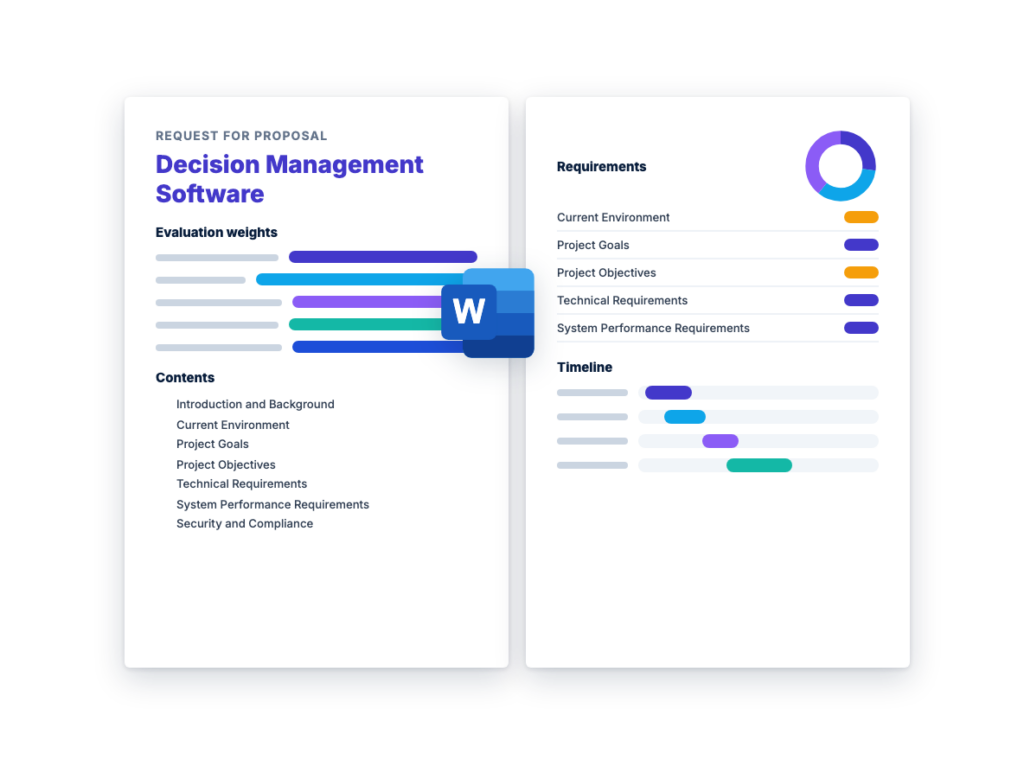
Request for Proposal: Decision Management Software Solution
Table of Contents
- Introduction
- Project Objectives
- Technical Requirements
- Functional Requirements
- AI and Advanced Features
- Vendor Qualifications
- Evaluation Criteria
- Submission Guidelines
- Timeline
1. Introduction and Background
[Company Name] is seeking proposals for a comprehensive Decision Management Software solution (also known as Business Rule Management System – BRMS) to optimize and automate our decision-making processes. This RFP outlines our requirements for a robust system that will enable us to author, store, test, and execute business rules efficiently across our organization.
Current Environment
- [Insert your current decision management processes]
- [Insert your existing IT infrastructure]
- [Insert current challenges and pain points]
Project Goals
The primary goals of implementing a new Decision Management Software solution are to:
- Streamline and automate decision-making processes
- Ensure consistency in business rule application
- Improve operational efficiency
- Enable real-time decision capabilities
- Enhance compliance and governance
2. Project Objectives
The key objectives of this project are to:
- Implement a centralized platform for business rule management that provides:
- Intuitive rule authoring capabilities
- Automated rule execution
- Version control and rule repository management
- Real-time decision-making capabilities
- Enable business users to:
- Create and modify business rules without coding
- Test and validate decision logic
- Monitor rule performance and outcomes
- Collaborate effectively across teams
- Ensure seamless integration with:
- Existing IT systems and data sources
- Enterprise applications (ERP, CRM, etc.)
- Various deployment environments (cloud, on-premise, hybrid)
- Enhance decision-making capabilities through:
- AI and machine learning integration
- Predictive and prescriptive analytics
- Natural language processing features
- Real-time adaptive decision-making
3. Technical Requirements
3.1 System Performance Requirements
- System response time:
- Rule execution: < 100ms for simple rules
- Complex decision processing: < 500ms
- Batch processing capabilities: > 10,000 decisions per minute
- System availability:
- 9% uptime guarantee
- Planned maintenance windows
- Automatic failover capabilities
- Load handling:
- Support for concurrent users: Minimum 1000
- Peak load management
- Auto-scaling capabilities
3.2 Security and Compliance
- Robust data encryption and access controls
- Compliance with industry-specific regulations (GDPR, HIPAA)
- Security audit trails and monitoring
- Role-based access control and authentication
- Data privacy protection measures
- Security incident response procedures
3.3 Deployment Options
- Support for cloud, on-premise, and hybrid deployments:
- Public cloud platforms (AWS, Azure, Google Cloud)
- Private cloud implementations
- Hybrid cloud configurations
- Multi-tenancy capabilities
- Environment management tools
- Deployment automation
- Cloud-specific security measures
3.4 Interoperability
- Open APIs and web services:
- REST and SOAP web services
- GraphQL support
- Webhook capabilities
- Real-time event streaming
- Support for industry-standard formats:
- JSON, XML, CSV
- MQTT, AMQP
- OAuth 2.0
- SAML
- Connector frameworks for third-party systems
- API versioning and lifecycle management
3.5 Backup and Disaster Recovery
- Automated backup and recovery processes:
- Point-in-time recovery options
- Automated backup scheduling
- Data retention policy management
- High availability and fault tolerance:
- Active-active or active-passive configuration
- Geographic redundancy
- Real-time data replication
- Business continuity features:
- Recovery Time Objective (RTO) < 4 hours
- Recovery Point Objective (RPO) < 15 minutes
- Automated failover testing
3.6 Mobile Accessibility
- Responsive design for multiple devices
- Native mobile applications
- Offline capabilities
- Mobile-optimized interfaces
- Secure mobile access
- Cross-platform compatibility
4. Functional Requirements
4.1 Rule Authoring and Management
Tip: Rule authoring is the cornerstone of decision management, requiring careful attention to user experience, rule representation flexibility, and version control. Focus on how business users can create and maintain rules effectively while ensuring technical accuracy and compliance with established standards and practices.
| Requirement |
Sub-Requirement |
Y/N |
Notes |
| Interface Design |
Intuitive drag-and-drop interface |
|
|
|
Visual rule builder with graphical elements |
|
|
|
Customizable workspace layouts |
|
|
| Rule Representations |
Decision tables support |
|
|
|
Decision trees visualization |
|
|
|
Rule flow diagrams |
|
|
|
Business process modeling notation support |
|
|
| Logic Definition |
No-code rule creation capability |
|
|
|
Complex condition building |
|
|
|
Mathematical expression support |
|
|
|
Custom function creation |
|
|
| Version Control |
Rule versioning system |
|
|
|
Change history tracking |
|
|
|
Version comparison tools |
|
|
|
Rollback capabilities |
|
|
| Custom Vocabulary |
Business terminology definition |
|
|
|
Domain-specific language support |
|
|
|
Terminology management tools |
|
|
|
Glossary maintenance features |
|
|
4.2 Rule Execution Engine
Tip: The rule execution engine must balance performance, reliability, and scalability while maintaining decision accuracy. Consider how the system handles complex rule sets, manages resource utilization, and maintains consistency across distributed environments while providing clear visibility into execution results.
| Requirement |
Sub-Requirement |
Y/N |
Notes |
| Execution Capabilities |
Real-time rule processing |
|
|
|
Batch processing support |
|
|
|
Parallel execution capabilities |
|
|
|
Priority-based execution |
|
|
| Performance |
High-throughput processing |
|
|
|
Low latency execution |
|
|
|
Resource optimization |
|
|
|
Performance monitoring tools |
|
|
| Scalability |
Horizontal scaling support |
|
|
|
Vertical scaling capabilities |
|
|
|
Load balancing features |
|
|
|
Resource allocation management |
|
|
4.3 Integration Capabilities
Tip: Integration capabilities determine how effectively your decision management system connects with existing enterprise systems and data sources. Evaluate the breadth of supported protocols, ease of configuration, and ability to maintain data integrity across integrated systems while ensuring secure data exchange.
| Requirement |
Sub-Requirement |
Y/N |
Notes |
| System Integration |
IT system connectivity |
|
|
|
Legacy system support |
|
|
|
Real-time integration |
|
|
|
Batch integration |
|
|
| API Support |
REST API support |
|
|
|
SOAP web services |
|
|
|
Custom API development |
|
|
|
API security features |
|
|
| Enterprise Applications |
ERP integration |
|
|
|
CRM integration |
|
|
|
BPM system integration |
|
|
|
Custom application support |
|
|
| Deployment Options |
Cloud deployment |
|
|
|
On-premise installation |
|
|
|
Hybrid deployment |
|
|
|
Multi-environment support |
|
|
4.4 Testing and Simulation
Tip: Comprehensive testing and simulation capabilities are essential for validating decision logic before deployment. Look for features that support both technical testing and business scenario simulation, with tools that help visualize outcomes and identify potential issues proactively.
| Requirement |
Sub-Requirement |
Y/N |
Notes |
| Test Tools |
Test case management |
|
|
|
Unit testing framework |
|
|
|
Integration testing capabilities |
|
|
|
Automated test execution |
|
|
| Rule Validation |
Syntax checking |
|
|
|
Logic validation |
|
|
|
Conflict detection |
|
|
|
Redundancy checking |
|
|
| Impact Analysis |
Change impact visualization |
|
|
|
Rule dependency analysis |
|
|
|
Performance impact assessment |
|
|
|
Risk evaluation tools |
|
|
| Scenario Testing |
What-if analysis tools |
|
|
|
Scenario comparison |
|
|
|
Batch scenario testing |
|
|
|
Result analysis tools |
|
|
4.5 Analytics and Reporting
Tip: Analytics and reporting functionality must provide insights across multiple dimensions while supporting both operational and strategic decision-making. Consider how the system helps track rule effectiveness, monitor performance trends, and demonstrate compliance through comprehensive audit trails and customizable reports.
| Requirement |
Sub-Requirement |
Y/N |
Notes |
| Dashboards |
Real-time monitoring |
|
|
|
Customizable layouts |
|
|
|
KPI visualization |
|
|
|
Interactive elements |
|
|
| Performance Analytics |
Rule execution metrics |
|
|
|
System performance tracking |
|
|
|
Resource utilization analysis |
|
|
|
Trend analysis |
|
|
| Compliance Reporting |
Audit trail generation |
|
|
|
Regulatory compliance reports |
|
|
|
Custom compliance templates |
|
|
|
Evidence collection tools |
|
|
| Business Intelligence |
Custom report builder |
|
|
|
Data export capabilities |
|
|
|
Advanced analytics tools |
|
|
|
Predictive analytics |
|
|
4.6 Collaboration Features
Tip: Effective collaboration features should support seamless interaction between technical and business users while maintaining proper governance and security controls. Evaluate how the system facilitates knowledge sharing, version control, and workflow management across different teams and roles.
| Requirement |
Sub-Requirement |
Y/N |
Notes |
| Access Control |
Role-based permissions |
|
|
|
User group management |
|
|
|
Feature-level access control |
|
|
|
Authentication integration |
|
|
| Workflow Management |
Rule approval workflows |
|
|
|
Change request management |
|
|
|
Task assignment |
|
|
|
Status tracking |
|
|
| Team Collaboration |
Comment and annotation tools |
|
|
|
Shared workspaces |
|
|
|
Notification system |
|
|
|
Discussion forums |
|
|
4.7 Data Management
Tip: Robust data management capabilities are crucial for maintaining data quality and accessibility across the decision management lifecycle. Focus on how the system handles data integration, validation, and governance while ensuring optimal performance and security compliance.
| Requirement |
Sub-Requirement |
Y/N |
Notes |
| Data Source Integration |
Database connectivity |
|
|
|
File system integration |
|
|
|
External service integration |
|
|
|
Real-time data streaming |
|
|
| Data Validation |
Data quality checks |
|
|
|
Format validation |
|
|
|
Business rule validation |
|
|
|
Error handling |
|
|
| Data Cleansing |
Data standardization |
|
|
|
Duplicate detection |
|
|
|
Data enrichment |
|
|
|
Error correction |
|
|
| Data Type Support |
Structured data handling |
|
|
|
Unstructured data processing |
|
|
|
Semi-structured data support |
|
|
|
Binary data management |
|
|
5. AI and Advanced Features
5.1 AI-Enhanced Decision Automation
Tip: AI-enhanced decision automation requires careful balance between automated intelligence and human oversight. Consider how the system integrates machine learning with traditional rule-based decision making while maintaining transparency, control, and the ability to adjust automated processes.
| Requirement |
Sub-Requirement |
Y/N |
Notes |
| Machine Learning Integration |
Automated model training |
|
|
|
Model performance monitoring |
|
|
|
Model versioning |
|
|
|
Model deployment automation |
|
|
| Adaptive Decision-Making |
Real-time model updates |
|
|
|
Dynamic rule adjustment |
|
|
|
Learning from decisions |
|
|
|
Performance optimization |
|
|
| Integration Framework |
API-based model integration |
|
|
|
Pre-built model connections |
|
|
|
Custom model support |
|
|
|
Model lifecycle management |
|
|
5.2 Predictive and Prescriptive Analytics
Tip: Effective predictive and prescriptive analytics capabilities should combine historical data analysis with forward-looking insights. Evaluate how the system leverages advanced analytics to not only forecast outcomes but also recommend optimal actions while maintaining accuracy and relevance.
| Requirement |
Sub-Requirement |
Y/N |
Notes |
| Forecasting Capabilities |
Time-series analysis |
|
|
|
Pattern recognition |
|
|
|
Trend identification |
|
|
|
Anomaly detection |
|
|
| Optimization Features |
Decision optimization |
|
|
|
Resource allocation |
|
|
|
Cost-benefit analysis |
|
|
|
Risk assessment |
|
|
| Reporting and Visualization |
Interactive dashboards |
|
|
|
Custom report generation |
|
|
|
Data visualization tools |
|
|
|
Export capabilities |
|
|
5.3 Natural Language Processing
Tip: Natural language processing features should enhance user interaction while maintaining precision in rule interpretation and documentation. Focus on accuracy of language understanding, support for industry-specific terminology, and the ability to generate clear, context-aware documentation.
| Requirement |
Sub-Requirement |
Y/N |
Notes |
| Query Interface |
Natural language queries |
|
|
|
Query optimization |
|
|
|
Multi-language support |
|
|
|
Context awareness |
|
|
| Documentation |
Automated documentation |
|
|
|
Compliance reporting |
|
|
|
Audit trail generation |
|
|
|
Documentation templates |
|
|
| Language Processing |
Text analysis |
|
|
|
Sentiment analysis |
|
|
|
Entity recognition |
|
|
|
Language translation |
|
|
5.4 Explainable AI
Tip: Explainable AI capabilities must provide clear visibility into decision rationale while maintaining technical accuracy. The system should offer multiple levels of explanation detail suitable for different stakeholders, from business users to compliance auditors and technical teams.
| Requirement |
Sub-Requirement |
Y/N |
Notes |
| Decision Transparency |
Decision path visualization |
|
|
|
Factor influence analysis |
|
|
|
Confidence scoring |
|
|
|
Alternative scenario analysis |
|
|
| Audit Capabilities |
Automated audit trail |
|
|
|
Decision justification |
|
|
|
Compliance documentation |
|
|
|
Version control |
|
|
| Explanation Features |
Natural language explanations |
|
|
|
Technical detailed views |
|
|
|
Visual decision trees |
|
|
|
Impact analysis |
|
|
5.5 Intelligent Process Automation
Tip: Intelligent process automation should enhance workflow efficiency while maintaining process integrity and compliance. Consider how the system combines AI-driven insights with traditional automation to optimize processes, detect bottlenecks, and suggest improvements.
| Requirement |
Sub-Requirement |
Y/N |
Notes |
| Workflow Optimization |
Process mining |
|
|
|
Bottleneck detection |
|
|
|
Performance optimization |
|
|
|
Automated workflow adjustment |
|
|
| Event Processing |
Real-time event handling |
|
|
|
Complex event processing |
|
|
|
Event correlation |
|
|
|
Pattern recognition |
|
|
| Process Intelligence |
Process analytics |
|
|
|
Predictive monitoring |
|
|
|
Anomaly detection |
|
|
|
Resource optimization |
|
|
5.6 Advanced Data Integration
Tip: Advanced data integration capabilities must handle diverse data sources while ensuring data quality and performance. Evaluate how the system manages real-time integration, data transformation, and quality control while maintaining security and compliance requirements.
| Requirement |
Sub-Requirement |
Y/N |
Notes |
| Data Discovery |
Automated source detection |
|
|
|
Schema inference |
|
|
|
Metadata management |
|
|
|
Data profiling |
|
|
| Integration Features |
Real-time integration |
|
|
|
Batch processing |
|
|
|
ETL capabilities |
|
|
|
Error handling |
|
|
| Data Analysis |
Unstructured data analysis |
|
|
|
Text analytics |
|
|
|
Image processing |
|
|
|
Voice data analysis |
|
|
5.7 AI-Assisted Rule Creation
Tip: AI-assisted rule creation should streamline the rule development process while maintaining accuracy and compliance. Evaluate how the system leverages AI to suggest improvements, detect potential issues, and accelerate rule development without compromising quality control.
| Requirement |
Sub-Requirement |
Y/N |
Notes |
| Rule Suggestions |
Pattern-based suggestions |
|
|
|
Historical analysis |
|
|
|
Optimization recommendations |
|
|
|
Similar rule identification |
|
|
| Testing Automation |
Automated test case generation |
|
|
|
Impact prediction |
|
|
|
Performance testing |
|
|
|
Regression testing |
|
|
| Rule Optimization |
Rule redundancy detection |
|
|
|
Efficiency recommendations |
|
|
|
Complexity analysis |
|
|
|
Performance optimization |
|
|
5.8 Collaborative AI
Tip: Collaborative AI features should enhance team productivity while maintaining clear accountability and control. Consider how AI augments human decision-making in collaborative scenarios, facilitates knowledge sharing, and improves team efficiency while preserving governance.
| Requirement |
Sub-Requirement |
Y/N |
Notes |
| Inquiry Routing |
Smart task assignment |
|
|
|
Load balancing |
|
|
|
Priority management |
|
|
|
Expertise matching |
|
|
| Collaboration Tools |
AI-assisted reviews |
|
|
|
Automated documentation |
|
|
|
Knowledge sharing |
|
|
|
Team analytics |
|
|
| Decision Support |
Recommendation engine |
|
|
|
Risk assessment |
|
|
|
Impact analysis |
|
|
|
Best practice suggestions |
|
|
6. Vendor Qualifications
6.1 Required Vendor Qualifications
Vendors must provide detailed information about:
- Industry Experience and Expertise
- Years of experience in decision management software
- Domain expertise in relevant industries
- Implementation track record
- Technical certifications and partnerships
- Customer Support and Training
- Support service levels and availability
- Training programs and methodologies
- Knowledge transfer approach
- Documentation and resources
- Innovation and Product Development
- Product roadmap and vision
- Research and development initiatives
- Innovation track record
- Technology partnerships
- Implementation and Professional Services
- Implementation methodology
- Professional services capabilities
- Project management approach
- Resource availability and expertise
- Past implementation success stories
- Total Cost of Ownership (TCO) Analysis
- Detailed breakdown of all costs
- Pricing model transparency
- Implementation costs
- Training and support costs
- Additional service costs
- Scalability of pricing as usage grows
6.2 Pricing and Licensing Details Required
Vendors must provide:
- Detailed breakdown of licensing costs
- Pricing model specifications (per user, per decision, etc.)
- Implementation and integration costs
- Training and support service costs
- Additional costs for customization or specific features
- Scaling costs as usage grows
- Maintenance and upgrade costs
- Any additional fees or charges
6.3 Implementation and Support Requirements
Vendors must outline:
- Detailed implementation plan and timeline
- Training and knowledge transfer programs:
- Administrative training
- User training
- Technical training
- Ongoing education options
- Ongoing support and maintenance services:
- Support levels and availability
- Maintenance schedules
- Update and upgrade processes
- Service Level Agreements (SLAs) for:
- System uptime
- Issue resolution
- Response times
- Performance metrics
7. Evaluation Criteria
Proposals will be evaluated based on:
- Solution Capabilities (40%)
- Technical requirements compliance
- Functional requirements compliance
- AI and advanced features implementation
- Integration capabilities
- Performance and scalability
- Security and compliance features
- Mobile and remote access capabilities
- Vendor Qualifications (25%)
- Experience and expertise in decision management
- Customer references in similar implementations
- Support capabilities and SLAs
- Financial stability and market presence
- Innovation track record and product roadmap
- Implementation Approach (20%)
- Methodology and best practices
- Timeline and milestones
- Resource allocation and expertise
- Risk management and mitigation
- Training and knowledge transfer approach
- Total Cost of Ownership (15%)
- License costs and pricing model
- Implementation and integration costs
- Training and support costs
- Maintenance and upgrade costs
- Additional services and customization costs
8. Submission Guidelines
Proposals must include the following components:
8.1 Required Documentation
- Executive Summary
- Overview of proposed solution
- Key differentiators
- Implementation approach
- Total cost summary
- Timeline overview
- Company Background
- Company history and stability
- Relevant experience
- Customer success stories
- Financial information
- Organizational structure
- Detailed Solution Description
- Technical architecture
- Features and capabilities
- Integration approach
- Security measures
- Deployment options
- Implementation Approach
- Project methodology
- Resource allocation
- Risk management
- Quality assurance
- Change management
- Project Timeline
- Major milestones
- Deliverables
- Resource requirements
- Dependencies
- Critical path items
- Detailed Pricing
- License costs
- Implementation fees
- Training expenses
- Ongoing support costs
- Additional services
- Client References
- Minimum three references
- Similar industry/size
- Implementation scope
- Contact information
- Supporting Materials
- Product documentation
- Technical specifications
- Sample reports
- Training materials
- SLA documentation
9. Timeline
Key Dates:
- RFP Release Date: [Date]
- Vendor Questions Deadline: [Date]
- Response to Questions: [Date]
- Proposal Submission Deadline: [Date]
- Initial Proposal Review: [Date]
- Vendor Presentations: [Date Range]
- Reference Checks: [Date Range]
- Final Vendor Selection: [Date]
- Contract Negotiations: [Date Range]
- Project Kickoff: [Date]
Contact Information
Submit all proposals and inquiries to:
[Contact Name] [Title] [Email Address] [Phone Number]
[Company Name] [Address] [City, State, ZIP]
Download Template