How to run a Fractional CIO RFP
Choosing a fractional CIO is closer to hiring an executive than buying a product: the person matters more than the firm, so this process puts the interview with the named lead and their plan for the first phase at the center. The example schedule in this template runs about 8 weeks from kickoff to a signed engagement; allow more if owners or a board must approve the choice.
- Write down why you need a CIO now (weeks 1-2). List the decisions and problems behind this RFP: IT spending nobody owns, a system selection coming up, an MSP contract up for renewal, a merger or new site, or leadership asking for a plan. Then collect the facts providers will price against: employees and locations, main business systems, internal IT staff, the MSP and other IT vendors with their contract renewal dates, and who leads security today. Decide what the CIO will own outright and what they will only advise on.
- Assemble the buying team. Include the executive the CIO will report to (for example the CEO, CFO or COO), finance, the heads of the business functions that depend most on IT, any internal IT staff, and whoever leads security. Add procurement and legal for the contract. If your current MSP may bid with its own vCIO, keep its staff off the buying team and out of the evaluation.
- Choose the engagement model, and decide whether you need an RFI (weeks 2-3). Decide between an ongoing retainer, a defined project such as an assessment and roadmap, or an interim full-time CIO, and whether you want an independent fractional CIO or a vCIO from an MSP. If those choices are still open, or you have more candidates than you can interview, send a short RFI asking each provider for the named lead's background, the engagement models it offers, and whether it sells managed services, hardware or software. Use the answers to build a shortlist.
- Tailor and issue the RFP (weeks 3-5). Delete requirements that don't apply, adjust priorities, and fill in Section 1 with your background and the reasons for the engagement. Share your vendor and contract list under NDA so providers can size the work. Ask each provider to name the person who would act as your CIO and to state the time that person would commit. Give providers two weeks to respond, with a written question-and-answer window in the first week.
- Score the proposals (weeks 5-6). Have each evaluator score independently against the rubric before comparing notes, and set aside any provider that misses a Must-have. Check that the named lead is the person who will actually do the work, that the time commitment is stated, and that every resale or referral relationship is disclosed. Compare the sample deliverables side by side: they show what you'll actually receive.
- Interview the named leads and call references (weeks 6-7). Meet the named lead from each of two or three shortlisted providers, with the whole buying team. Give each the same real problem from your list, such as an MSP that keeps missing service levels or a system selection coming up, and ask them to walk through their first-phase plan. Call at least one reference from a similar client and one from an engagement that has ended, and ask how the handover went.
- Negotiate and sign (weeks 7-8). Use the pricing table to compare like for like, including the time included in each fee and the rates for extra work. Before signing, agree the first-phase deliverables and dates, how extra time is approved, the notice period, ownership of documents and accounts, and the handover terms.
Fractional CIO RFP requirements
Each line is written to paste straight into your RFP. Must-have means a provider that cannot meet it is out; Nice-to-have earns extra points. Change the priorities to fit your situation, and delete what doesn't apply.
Scope of services
| ID |
Requirement |
Priority |
| S1 |
An initial IT assessment covering business systems, infrastructure, IT support, vendors and contracts, IT staff and skills, spending, and the state of backup and recovery, with findings ranked by business risk and recommended actions with rough cost and effort. |
Must-have |
| S2 |
An IT strategy and multi-year roadmap tied to our business plan, listing the projects, their order, owners, rough cost ranges and dependencies, reviewed with leadership and updated at least [frequency]. |
Must-have |
| S3 |
Ownership of the IT budget: building the operating and capital budget with finance, tracking spending against it, and planning replacement cycles for hardware, software and services. |
Must-have |
| S4 |
Vendor and contract management: an inventory of IT vendors, contracts, licenses, and renewal and notice dates; review of each renewal before its notice deadline; and support in negotiating price and terms. |
Must-have |
| S5 |
Oversight of our managed service provider: reviewing its performance against the contract's service levels, checking its invoices and proposed projects, escalating missed service levels, and advising on renewal, renegotiation or replacement. |
Must-have |
| S6 |
Leadership of system selection projects [list planned ones, such as ERP, CRM or a cloud migration]: business requirements, the RFP, scripted demos, scoring, contract review, and oversight of the implementation partner. |
Must-have |
| S7 |
IT policies written or updated, approved by leadership and reviewed on a set schedule [list required policies, such as acceptable use, access management, data retention and change management]. |
Must-have |
| S8 |
Backup, disaster recovery and business continuity planning for IT: recovery objectives agreed with the business for each critical system, a written recovery plan, and scheduled recovery tests with the results reported to leadership. |
Must-have |
| S9 |
Coordination with whoever leads security [internal security lead, vCISO or MSSP]: a written split of responsibilities, security projects and costs included in the IT roadmap and budget, and joint review of changes that affect security. |
Must-have |
| S10 |
A defined role during major IT outages: coordinating the MSP and other vendors, keeping leadership informed, and leading a written review afterward. During security incidents, the role supports whoever leads the response. State the named lead's availability outside business hours. |
Must-have |
| S11 |
IT planning for mergers, acquisitions and new sites: technology due diligence on a target, an integration or separation plan, and the IT setup for new offices. Make this Must-have if a transaction or a new site is planned. |
Nice-to-have |
| S12 |
Guidance on AI in the business: a policy for staff use of AI tools, review of AI features in the systems we already license, and a process for evaluating requests for new AI tools, agreed with whoever leads security. |
Nice-to-have |
| S13 |
Leadership of our internal IT staff: role definitions, goals, coaching, and help with hiring for IT roles. |
Nice-to-have |
Named lead and team
| ID |
Requirement |
Priority |
| L1 |
A named fractional CIO who will do the work, with a career summary showing CIO or senior IT leadership roles, experience with organizations of our size, industry and complexity [describe], and examples of projects like those on our roadmap [list]. |
Must-have |
| L2 |
No replacement of the named lead without our written approval. If the named lead leaves the provider or can't continue, the provider proposes a replacement with comparable experience for our approval within [time] and covers the handover at no extra charge. |
Must-have |
| L3 |
A stated time commitment from the named lead [hours or days per month], how that time is split between scheduled meetings and on-demand work, how time is tracked and reported to us, and how many other clients the named lead currently serves. |
Must-have |
| L4 |
A regular meeting cadence with our leadership [state], response times for routine and urgent requests [state], and the named lead's working hours and time zone. |
Must-have |
| L5 |
A named backup who knows our account and covers when the named lead is on leave or otherwise unavailable. |
Must-have |
| L6 |
Identification of everyone else who would work on our account (analysts, project managers, specialists), their roles and how their time is billed, plus any subcontractors. |
Must-have |
Deliverables and reporting
| ID |
Requirement |
Priority |
| D1 |
A first-phase plan agreed before work starts, with dated deliverables [for example: assessment report, risk register, roadmap and budget] and a target completion date [date]. |
Must-have |
| D2 |
A written leadership report [monthly or quarterly] covering spending against budget, roadmap and project status, MSP and vendor performance, the top IT risks, and decisions needed from leadership, written for non-technical readers. |
Must-have |
| D3 |
Attendance at leadership meetings [frequency] and, when requested, at owner or board meetings, with a short summary of IT spending, risk and plans for each board meeting. |
Must-have |
| D4 |
An IT risk register kept current, listing each risk, its business impact, owner and planned action, and kept consistent with any security risk register maintained by whoever leads security. |
Must-have |
| D5 |
Documentation kept in a repository we own, not on the provider's systems: system and network inventory, vendor and contract list, policies, recovery plans, roadmap, budget and a log of major decisions. |
Must-have |
| D6 |
A scorecard for the MSP and other key vendors, reviewed with each vendor at a set cadence [state], with agreed actions recorded. |
Nice-to-have |
Security, confidentiality and independence
| ID |
Requirement |
Priority |
| I1 |
Disclosure of every resale, referral, commission, rebate or partner fee the provider or the named lead receives, or could receive, from hardware, software, cloud, telecom, managed service or other IT vendors, and of any ownership or financial interest in such vendors. |
Must-have |
| I2 |
If the provider, or a company connected to it, sells managed services, hardware or software: a description of how its advice stays objective, who the named lead reports to inside the provider, how a recommendation to buy from the provider is handled, and whether the named lead will assess, and if needed recommend replacing, services the provider itself delivers to us. |
Must-have |
| I3 |
For every purchase recommendation, a written record of the options considered, the reasons for the choice and any relationship the provider has with each option. |
Must-have |
| I4 |
A confidentiality agreement covering our business, financial and technical information, binding on the named lead, the team and any subcontractors, continuing after the engagement ends, and stating how our documents are stored on the provider's systems and returned or deleted at the end. |
Must-have |
| I5 |
Access to our systems only through named accounts we issue, with MFA, least-privilege permissions and no shared credentials, and all access removed at the end of the engagement with written confirmation. |
Must-have |
| I6 |
Notice to us of any security incident at the provider that affects our data, systems or accounts, within a stated time [state]. |
Must-have |
| I7 |
Professional liability (errors and omissions) and cyber liability insurance, with limits stated [minimum limits], and certificates provided before work starts. |
Must-have |
| I8 |
Background checks for the named lead and any team members with access to our systems or data. |
Nice-to-have |
Engagement and transition
| ID |
Requirement |
Priority |
| E1 |
An onboarding plan for the start of the engagement: introductions to leadership and staff, access requests, document gathering, and first meetings with the MSP and key vendors. |
Must-have |
| E2 |
A written statement of work for each phase (initial assessment, ongoing leadership and any named projects) stating the scope, deliverables, time included, what falls outside the scope, and how extra work is estimated and approved before it is billed. |
Must-have |
| E3 |
Contracts, licenses, domains, cloud subscriptions and administrator accounts held in our name, with our own staff holding top-level administrator access. The provider does not sign vendor contracts on our behalf without written approval. |
Must-have |
| E4 |
Ownership by us of all documents, plans, policies, diagrams and data created for us, including working files, delivered in editable formats. |
Must-have |
| E5 |
Term and termination: the initial term [state], our right to end the engagement for convenience with [notice period] notice, and no penalty for ending after the first phase. |
Must-have |
| E6 |
A handover plan for the end of the engagement: transfer of documents, accounts and vendor contacts, a briefing for the successor (a full-time CIO, an IT director or another provider), and transition support for [period]. |
Must-have |
| E7 |
Support for hiring a full-time CIO or IT director when we're ready: role definition, help with interviews, and a planned handover to the new hire. |
Nice-to-have |
Commercial and pricing
| ID |
Requirement |
Priority |
| C1 |
Pricing for the ongoing retainer, stating the named lead's time included [hours or days per month], what happens to unused time, and the time detail shown on each invoice. |
Must-have |
| C2 |
A fixed fee for the initial assessment, roadmap and budget, listing the deliverables it covers. |
Must-have |
| C3 |
Hourly or daily rates for the named lead and each other role, for work beyond the retainer. |
Must-have |
| C4 |
Pricing for on-call availability outside business hours for major outages and incidents, if offered, or a statement that it is not available. |
Must-have |
| C5 |
An expenses and travel policy: what is billable, what needs our prior approval, and how on-site visits are charged. |
Must-have |
| C6 |
How long rates stay fixed, and a cap on increases at renewal [state the cap]. |
Must-have |
| C7 |
Fixed-fee or capped pricing options for leading a system selection or other large project on the roadmap [list]. |
Nice-to-have |
Questions to ask Fractional CIO providers
These questions are designed to separate providers, not to collect brochure answers. Ask for evidence: a sample deliverable, an interview with the named lead or a reference.
- Introduce the fractional CIO you're proposing. Which of their past roles most resemble our situation [size, industry, locations, main systems], what did they change first in those roles, and why?
- Arrange a working session between the named lead and our buying team on one current problem [describe it]. We want to see how they ask questions, set priorities and explain trade-offs to non-technical executives.
- Provide a sample IT assessment, roadmap and leadership report from past engagements, with client details removed. Which parts would look different for us?
- Lay out your first-phase plan for us week by week: who you'd meet, what information you'd ask for, and which deliverables we'd receive and when.
- Our MSP has missed its response-time service level for several months running and disputes the figures. Show how you'd establish the facts, raise it with the MSP, and decide between enforcing the contract, renegotiating and starting a replacement.
- Do you, or any company connected to you, sell managed services, hardware, software, cloud or telecom services, or earn referral fees on them? If we asked you to assess whether to replace a service you sell us, how would that review be run, and who would sign it off?
- Our leadership team asks for next year's IT budget by [date]. Show the budget format you'd use, and how you'd separate the cost of running what we have, planned projects and risk reduction.
- We plan to replace our [ERP or CRM] system. How would you run the selection and keep it independent of software vendors and implementation partners, and where does your role end once an implementation partner is hired?
- Our main business system goes down on a busy day, and the MSP and the software vendor each blame the other. What would the named lead do in the first hours, and who would they keep informed?
- A customer sends a security questionnaire with a tight deadline. Which parts would you answer, which would go to [our security lead, vCISO or MSSP], and how would you split other security responsibilities with them?
- How do you decide what gets the named lead's time in a busy month, and what happens when our needs exceed the retainer?
- We're opening a new site [or acquiring a company]. What IT work would you plan, in what order, and what would you need from us?
- Provide a reference from a client of similar size and industry, and one from an engagement that has ended. What did the handover to the next CIO, IT director or provider look like?
Scoring rubric
Score each criterion from 1 to 5, multiply by its weight, and add the results. The weights below are a starting point; agree on your own before any proposals arrive so the scoring can't be bent around a favorite.
| Criterion |
Weight |
What a strong response shows |
| Named lead's fit and experience |
25% |
A named CIO who has led IT at organizations like yours, handled the working session well, explained trade-offs in plain language, and has the capacity your account needs. |
| Quality of the first-phase plan |
20% |
A specific, dated plan built around your situation and problems, with clear deliverables, rather than a generic checklist. |
| Independence and vendor oversight |
15% |
Full disclosure of resale and referral fees, a credible way to manage any conflict, and a practical approach to holding the MSP and other vendors to their contracts. |
| Scope coverage |
10% |
Covers the scope you need, including budget, contracts, system selection, policies, continuity planning and coordination with whoever leads security. |
| Deliverables and reporting |
10% |
Sample assessments, roadmaps, budgets and leadership reports that are specific and readable by non-technical executives. |
| Engagement terms and transition |
10% |
A stated time commitment, a named backup, documents and accounts in your name, fair termination terms and a written handover plan. |
| Commercials and value |
10% |
Clear rates, a fixed fee for the first phase, written approval before extra time is billed, and a total cost that matches the time committed. |
| Total |
100% |
|
Scoring scale
- 5 Exceeds: meets every Must-have and most Nice-to-haves, shown through an interview with the named lead, sample deliverables and a matching reference client.
- 4 Strong: meets every Must-have and some Nice-to-haves, with clear evidence.
- 3 Adequate: meets most Must-haves; gaps have a credible plan.
- 2 Weak: misses one or more Must-haves, or the answer is vague.
- 1 Poor: does not meet the requirement, or no answer.
Frequently asked questions
What does a fractional CIO do?
A fractional CIO is a part-time chief information officer who takes ownership of the technology a company runs on: the IT strategy and roadmap, the IT budget, and the vendors the business depends on, including its managed service provider. The role also covers leading projects such as an ERP or CRM selection, setting IT policies, planning backup and disaster recovery, and reporting to leadership on spending, risk and progress. Engagements can be an ongoing retainer, a defined project such as an assessment and roadmap, or an interim full-time role while you hire a permanent CIO.
vCIO from our MSP or an independent fractional CIO?
A vCIO from your managed service provider already knows your systems and may be part of your existing service plan, which suits planning and budgeting on top of an MSP relationship that works well. The catch is that the vCIO works for the company selling you services, so advice about that MSP's performance, pricing or replacement has a built-in conflict. An independent fractional CIO doesn't sell managed services and can review the MSP's work and contracts on your behalf, but needs time to learn your environment and is paid separately. If MSP oversight or an MSP renewal is part of the job, independence matters most; either way, the independence requirements in this template ask each provider to disclose what it sells and how it handles the conflict.
How much does a fractional CIO cost?
Cost depends mainly on how much of the named lead's time you need and how the work is structured: an ongoing retainer, a fixed-fee project such as an assessment and roadmap, or an interim full-time role. Other drivers are the number of locations, systems and vendors involved, whether the CIO leads specific projects such as a system selection, your industry's regulatory demands, any on-call availability outside business hours, and travel for on-site work. Providers package these differently, so ask each one to price the same scope in this RFP's pricing table and to state the time included in every fee.
Fractional CIO or fractional CTO?
A fractional CIO looks after the technology the company runs on: business systems, infrastructure, IT support, vendors and the IT budget. A fractional CTO looks after the technology the company builds and sells: the product's architecture, the engineering team and how software gets built and released. If your problem is internal IT, use this template; if it's a software product, use the RFPhub fractional CTO services RFP template. Some providers offer both roles, so if you need both, say so in the background section of the RFP and ask which person would cover each.
Related RFP templates
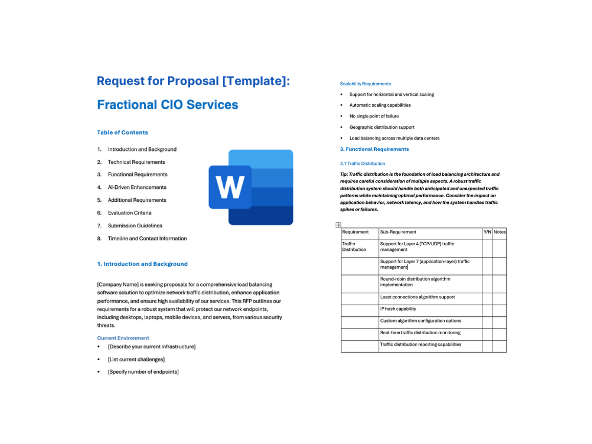
Download Template
 BD Emerson
 CBIZ Technology
 Centric Consulting
 CIO Professional Services
 CIO Solutions
 DAG Tech
 Elliott Davis
 Fortium Partners
 Hartman Executive Advisors
 Innovation Vista
 Integris
 Macktez
 Network Right
 Ntiva
 Performance Improvement Partners
 RSM US
 SC&H Group
 Sikich
 TechCXO
 Withum