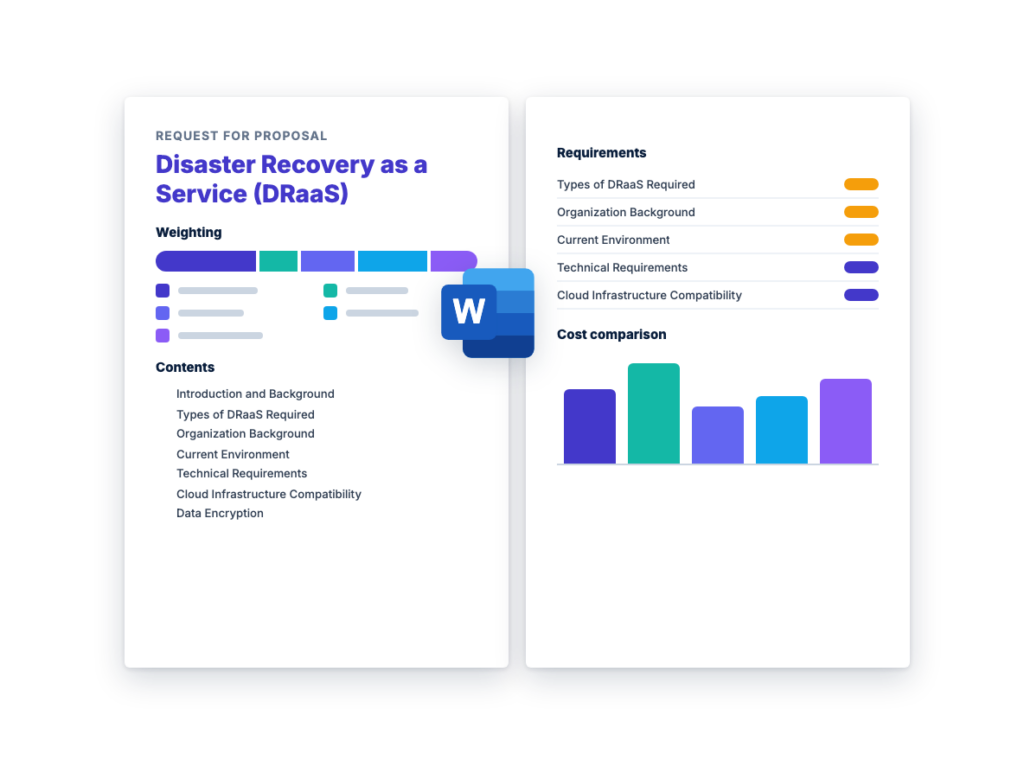
Request for Proposal: Disaster Recovery as a Service (DRaaS) Solutions
Table of Contents
- Introduction and Background
- Technical Requirements
- Functional Requirements
- AI-Driven Features
- Vendor Evaluation Criteria
- Implementation and Onboarding
- Ongoing Management and Optimization
- Submission Guidelines
- Timeline
1. Introduction and Background
[Company Name] is seeking proposals for a comprehensive Disaster Recovery as a Service (DRaaS) solution to enhance our business continuity capabilities. DRaaS is a cloud-based solution that enables businesses to back up their data and IT infrastructure in a third-party environment, providing failover capabilities in case of disasters to ensure business continuity.
Types of DRaaS Required
- Self-service DRaaS
- Assisted DRaaS
- Managed DRaaS
Organization Background
- Industry: [Specify industry]
- Current IT Infrastructure Scale: [Specify scale]
- Number of mission-critical applications: [Specify number]
- Current data volume: [Specify volume]
Current Environment
- Existing backup and recovery systems
- Current recovery time objectives (RTOs) and recovery point objectives (RPOs)
- Primary data center specifications
- Current challenges in disaster recovery processes
2. Technical Requirements
2.1 Cloud Infrastructure Compatibility
- Support major cloud platforms (AWS, Azure, Google Cloud)
- Enable hybrid and multi-cloud deployments
- Support cross-platform compatibility
- Provide cloud-native service integration
- Enable seamless cloud resource management
- Support cloud-to-cloud migration capabilities
2.2 Data Encryption
- Provide end-to-end encryption for data at rest and in transit
- Support customer-managed encryption keys
- Implement robust key management
- Enable secure key rotation
- Support multiple encryption standards
- Provide encryption audit trails
2.3 Network Configuration
- Offer flexible network configuration options
- Support VPN and direct connect capabilities
- Enable software-defined networking
- Provide network isolation capabilities
- Support custom routing configurations
- Enable network performance optimization
2.4 API Integration
- Provide comprehensive API for integration with existing tools
- Support webhook notifications for critical events
- Enable custom integration development
- Support RESTful API standards
- Provide detailed API documentation
- Enable automated workflow triggers
2.5 Performance Metrics
- Offer detailed performance monitoring and reporting
- Provide historical data analysis
- Support capacity planning
- Enable custom metric creation
- Provide real-time performance dashboards
- Support trend analysis and forecasting
2.6 Backup and Retention Policies
- Allow customizable backup schedules and retention policies
- Support incremental and differential backups
- Implement automated retention management
- Enable policy-based backup rules
- Support multiple backup types
- Provide backup verification mechanisms
2.7 Testing Capabilities
- Provide non-disruptive testing environments
- Offer automated and scheduled testing options
- Support customizable test scenarios
- Enable regular disaster recovery testing
- Provide detailed test reporting
- Support test environment management
3. Functional Requirements
3.1 Failover Capabilities
Tip: Effective failover capabilities are crucial for minimizing downtime during disasters. Focus on automation, speed, and reliability of the failover process. Ensure the solution provides both automated and manual failover options with clear verification procedures.
| Requirement |
Sub-Requirement |
Y/N |
Notes |
| Automatic Failover |
Provide automatic failover to cloud computing environments |
|
|
|
Support multiple failover triggers and conditions |
|
|
|
Enable automated health checks and verification |
|
|
| One-Click Failover |
Enable one-click failover for mission-critical systems |
|
|
|
Provide failover status monitoring and reporting |
|
|
|
Support rollback capabilities |
|
|
3.2 Data Replication and Backup
Tip: Data replication strategy significantly impacts recovery time and point objectives. Consider both synchronous and asynchronous replication options, and ensure the solution offers flexible scheduling and bandwidth management capabilities.
| Requirement |
Sub-Requirement |
Y/N |
Notes |
| Continuous Replication |
Continuously replicate data and IT infrastructure |
|
|
|
Support both synchronous and asynchronous replication |
|
|
|
Enable bandwidth throttling and optimization |
|
|
| Recovery Points |
Offer various recovery point options |
|
|
|
Support customizable retention policies |
|
|
|
Provide point-in-time recovery capabilities |
|
|
3.3 Orchestration
Tip: Orchestration capabilities determine how smoothly and efficiently recovery processes can be executed. Look for solutions that offer both pre-defined and customizable workflows with clear dependency management.
| Requirement |
Sub-Requirement |
Y/N |
Notes |
| Recovery Automation |
Automate recovery process for applications and servers |
|
|
|
Support complex dependency mapping |
|
|
|
Enable custom workflow creation |
|
|
| IT Intervention |
Minimize IT intervention during DR operations |
|
|
|
Provide automated validation checks |
|
|
|
Support self-service recovery options |
|
|
3.4 Automated Discovery
Tip: Automated discovery and dependency mapping are essential for maintaining an accurate DR environment. The solution should continuously monitor and update system relationships while minimizing manual intervention and potential human error.
| Requirement |
Sub-Requirement |
Y/N |
Notes |
| Manual Step Reduction |
Reduce manual steps in DR process |
|
|
|
Automate configuration documentation |
|
|
|
Enable automated updates of DR plans |
|
|
| Dependency Mapping |
Automatically identify system dependencies |
|
|
|
Map application relationships |
|
|
|
Track infrastructure dependencies |
|
|
3.5 Bandwidth Optimization
Tip: Efficient bandwidth usage is crucial for maintaining replication without impacting production systems. Look for solutions that offer intelligent data transfer mechanisms and compression capabilities while ensuring data integrity.
| Requirement |
Sub-Requirement |
Y/N |
Notes |
| Data Transfer |
Optimize ongoing data transfers |
|
|
|
Implement data compression |
|
|
|
Support bandwidth throttling |
|
|
| Production Impact |
Minimize impact on production systems |
|
|
|
Enable scheduling of intensive transfers |
|
|
|
Provide bandwidth usage reporting |
|
|
3.6 DNS Redirection
Tip: DNS redirection capabilities are critical for ensuring seamless user access during failover. The solution should handle both automated updates and complex DNS configurations while maintaining security and providing rollback options.
| Requirement |
Sub-Requirement |
Y/N |
Notes |
| DNS Updates |
Automate DNS record updates |
|
|
|
Support multiple DNS providers |
|
|
|
Enable custom DNS configurations |
|
|
| User Transition |
Ensure seamless end-user experience |
|
|
|
Manage DNS propagation |
|
|
|
Support DNS failback processes |
|
|
3.7 Multi-Cloud Compatibility
Tip: Multi-cloud support provides flexibility and reduces vendor lock-in. Evaluate the solution’s ability to manage diverse cloud environments while maintaining consistent policies and performance across platforms.
| Requirement |
Sub-Requirement |
Y/N |
Notes |
| Cloud Integration |
Support multiple cloud providers |
|
|
|
Enable cross-cloud failover |
|
|
|
Maintain consistent management |
|
|
| Hardware Support |
Support virtual infrastructure |
|
|
|
Support physical hardware |
|
|
|
Enable hybrid configurations |
|
|
3.8 Real-Time Monitoring and Alerts
Tip: Comprehensive monitoring and alerting are fundamental to proactive DR management. Focus on customizable alerts, detailed metrics, and the ability to integrate with existing monitoring systems while avoiding alert fatigue.
| Requirement |
Sub-Requirement |
Y/N |
Notes |
| Monitoring |
Offer continuous tracking of processes |
|
|
|
Monitor replication status |
|
|
|
Track system health metrics |
|
|
| Alerting |
Provide automated alerts |
|
|
|
Support customizable thresholds |
|
|
|
Enable alert prioritization |
|
|
3.9 Customizable SLAs
Tip: Flexible SLA management allows organizations to align DR capabilities with business requirements. Ensure the solution provides granular control over recovery objectives while maintaining clear monitoring and reporting of SLA compliance.
| Requirement |
Sub-Requirement |
Y/N |
Notes |
| SLA Configuration |
Allow tailoring of service agreements |
|
|
|
Support multiple SLA tiers |
|
|
|
Enable custom metrics |
|
|
| Recovery Objectives |
Offer flexible RTO/RPO settings |
|
|
|
Support business-specific requirements |
|
|
|
Provide SLA compliance reporting |
|
|
3.10 Automated Failback
Tip: Automated failback is crucial for returning to normal operations after a disaster. The solution should provide controlled, tested processes for returning workloads to primary systems while ensuring data consistency and minimal disruption.
| Requirement |
Sub-Requirement |
Y/N |
Notes |
| Transition Management |
Ensure smooth transition to primary systems |
|
|
|
Validate data consistency |
|
|
|
Support incremental data sync |
|
|
| Manual Intervention |
Minimize manual intervention |
|
|
|
Enable automated testing |
|
|
|
Provide progress monitoring |
|
|
3.11 Compliance Management
Tip: Comprehensive compliance management ensures DR processes meet regulatory requirements. The solution should provide built-in compliance tools while supporting custom compliance frameworks and simplified audit processes.
| Requirement |
Sub-Requirement |
Y/N |
Notes |
| Compliance Tools |
Include built-in compliance tools |
|
|
|
Support multiple regulatory frameworks |
|
|
|
Enable custom compliance rules |
|
|
| Audit Management |
Streamline audit processes |
|
|
|
Maintain audit trails |
|
|
|
Generate compliance reports |
|
|
3.12 Scalability
Tip: Scalability ensures the DR solution can grow with your organization. Focus on both horizontal and vertical scaling capabilities while maintaining performance and ensuring cost-effective resource utilization.
| Requirement |
Sub-Requirement |
Y/N |
Notes |
| Resource Management |
Allow dynamic resource adjustment |
|
|
|
Support automatic scaling |
|
|
|
Enable resource optimization |
|
|
| Growth Support |
Handle infrastructure expansion |
|
|
|
Support increased workloads |
|
|
|
Maintain performance at scale |
|
|
4. AI-Driven Features
4.1 Predictive Analytics and Proactive Risk Assessment
Tip: Predictive analytics can help identify potential failures before they occur. Focus on the accuracy of predictions and the breadth of data sources used for analysis while ensuring actionable insights are generated from the collected data.
| Requirement |
Sub-Requirement |
Y/N |
Notes |
| Historical Analysis |
Utilize AI algorithms to analyze historical data |
|
|
|
Support multiple data source integration |
|
|
|
Provide trend analysis and forecasting |
|
|
| Early Warning |
Implement early warning systems |
|
|
|
Enable customizable alert thresholds |
|
|
|
Support automated response triggers |
|
|
4.2 Intelligent Automation
Tip: AI-driven automation can significantly reduce response times and human error. Ensure the solution offers both pre-built and customizable automation capabilities with appropriate safety controls and validation mechanisms.
| Requirement |
Sub-Requirement |
Y/N |
Notes |
| Recovery Actions |
Implement AI-powered recovery systems |
|
|
|
Support automated incident classification |
|
|
|
Enable intelligent workflow selection |
|
|
| Routine Tasks |
Automate testing and runbook creation |
|
|
|
Support automated documentation updates |
|
|
|
Provide automation audit trails |
|
|
4.3 Dynamic Recovery Planning
Tip: AI-driven recovery planning should adapt to changing environments and learned experiences. The solution should continuously optimize recovery strategies while maintaining alignment with business objectives and compliance requirements.
| Requirement |
Sub-Requirement |
Y/N |
Notes |
| Plan Generation |
Create context-aware recovery plans |
|
|
|
Support dynamic plan updates |
|
|
|
Enable scenario-based planning |
|
|
| Optimization |
Adapt strategies through machine learning |
|
|
|
Incorporate historical performance data |
|
|
|
Provide plan effectiveness metrics |
|
|
4.4 Smart Resource Allocation
Tip: Intelligent resource management ensures optimal use of DR infrastructure while controlling costs. Look for AI capabilities that can predict resource needs and automatically adjust allocations based on workload patterns and recovery requirements.
| Requirement |
Sub-Requirement |
Y/N |
Notes |
| Resource Optimization |
Optimize resource allocation |
|
|
|
Predict resource requirements |
|
|
|
Enable dynamic scaling |
|
|
| Schedule Management |
Adjust backup schedules intelligently |
|
|
|
Balance workload distribution |
|
|
|
Monitor resource utilization |
|
|
4.5 Enhanced Data Replication
Tip: AI-enhanced replication should optimize data transfer while ensuring consistency and minimizing storage costs. Focus on intelligent data placement, access pattern analysis, and automated optimization of replication strategies.
| Requirement |
Sub-Requirement |
Y/N |
Notes |
| Replication Strategy |
Implement AI-driven replication |
|
|
|
Analyze data patterns |
|
|
|
Optimize replication timing |
|
|
| Performance Analysis |
Monitor system performance |
|
|
|
Analyze access patterns |
|
|
|
Provide optimization recommendations |
|
|
4.6 AI-Assisted Decision Making
Tip: AI-driven decision support should provide clear, actionable insights while maintaining human oversight. The solution should offer both automated decisions for routine matters and decision support for complex scenarios.
| Requirement |
Sub-Requirement |
Y/N |
Notes |
| Recovery Insights |
Provide AI-powered insights |
|
|
|
Support decision automation |
|
|
|
Enable manual override options |
|
|
| Impact Analysis |
Analyze recovery options |
|
|
|
Assess potential impacts |
|
|
|
Generate recommendation reports |
|
|
4.7 Continuous Learning
Tip: The system should continuously improve its performance through learning from past incidents and outcomes. Focus on mechanisms for capturing lessons learned and incorporating them into future recovery strategies while maintaining security and compliance.
| Requirement |
Sub-Requirement |
Y/N |
Notes |
| Incident Learning |
Learn from DR incidents |
|
|
|
Capture performance metrics |
|
|
|
Update response patterns |
|
|
| Strategy Improvement |
Analyze recovery effectiveness |
|
|
|
Suggest process improvements |
|
|
|
Track improvement impacts |
|
|
4.8 Intelligent Data Prioritization
Tip: Smart prioritization ensures critical data is protected first during resource constraints. The solution should automatically identify and classify data importance while adapting to changing business needs and compliance requirements.
| Requirement |
Sub-Requirement |
Y/N |
Notes |
| Data Classification |
Identify critical data |
|
|
|
Implement priority levels |
|
|
|
Support custom classification rules |
|
|
| Lifecycle Management |
Manage data lifecycles |
|
|
|
Apply retention policies |
|
|
|
Monitor compliance requirements |
|
|
4.9 Advanced Threat Detection
Tip: AI-powered threat detection should provide comprehensive protection while minimizing false positives. Focus on integration with existing security tools and the ability to respond automatically to detected threats while maintaining accurate threat intelligence.
| Requirement |
Sub-Requirement |
Y/N |
Notes |
| Threat Intelligence |
Integrate AI security features |
|
|
|
Process threat data in real-time |
|
|
|
Support threat pattern recognition |
|
|
| Response Automation |
Enable automated responses |
|
|
|
Support custom response rules |
|
|
|
Provide incident reporting |
|
|
4.10 Natural Language Processing
Tip: NLP capabilities should enhance user interaction while maintaining precision in technical operations. Consider both the accuracy of language processing and the breadth of supported queries and commands across multiple languages and technical contexts.
| Requirement |
Sub-Requirement |
Y/N |
Notes |
| Interface Design |
Implement conversational interfaces |
|
|
|
Support natural language queries |
|
|
|
Enable voice commands |
|
|
| Information Access |
Provide quick information retrieval |
|
|
|
Support context-aware responses |
|
|
|
Enable multi-language support |
|
|
5. Vendor Evaluation Criteria
5.1 Service Level Agreements (SLAs)
- Clearly defined RPO and RTO guarantees
- Compensation policies for SLA breaches
- Performance metrics and monitoring
- Clear escalation procedures
- Regular SLA review and updates
5.2 Support and Maintenance
- 24/7 technical support availability
- Regular software updates and patch management
- Proactive maintenance procedures
- Comprehensive implementation support
- Emergency response procedures
- Health checks and system optimization
5.3 Pricing Model
- Transparent pricing structure
- Flexible billing options (pay-as-you-go, reserved capacity)
- Cost optimization features
- Volume discounts
- Custom pricing options for specific requirements
5.4 Vendor Reputation and Stability
- Financial stability and market presence
- Customer references and case studies
- Industry recognition and awards
- Company longevity and experience
- Market share and growth trajectory
5.5 Compliance and Certifications
- Industry-specific compliance certifications
- Regular third-party audits
- Compliance monitoring and reporting
- Security certifications
- Quality management standards
6. Implementation and Onboarding
6.1 Implementation Timeline
- Detailed project plan with milestones
- Resource allocation for implementation
- Risk management procedures
- Phase-wise implementation strategy
- Success criteria for each phase
6.2 Training and Documentation
- Comprehensive training programs for IT staff
- Up-to-date documentation and knowledge base
- Ongoing training support
- Video tutorials and guides
- Regular updates to training materials
6.3 Data Migration
- Efficient data migration strategies
- Minimal disruption to existing operations
- Data validation procedures
- Rollback procedures
- Progress monitoring and reporting
7. Ongoing Management and Optimization
7.1 Continuous Improvement
- Regular service reviews
- Proactive capacity planning
- Performance optimization recommendations
- Periodic system assessments
- Technology refresh planning
7.2 Reporting and Analytics
- Customizable reporting dashboards
- Advanced analytics capabilities
- Trend analysis and forecasting
- Compliance reporting
- Cost optimization analysis
7.3 Vendor Roadmap Alignment
- Clear communication of product roadmap
- Regular feature updates
- Technology advancement integration
- Industry trend alignment
- Custom development opportunities
8. Submission Guidelines
Proposals must include:
- Detailed solution description addressing all requirements
- Implementation methodology and timeline
- Comprehensive pricing structure
- Support and maintenance plans
- Company profile and qualifications
- Client references and case studies
- Sample SLAs and compliance documentation
- Training and documentation examples
9. Timeline
- RFP Release Date: [Date]
- Questions Deadline: [Date]
- Proposal Due Date: [Date]
- Vendor Presentations: [Date Range]
- Selection Decision: [Date]
- Project Kickoff: [Date]
Submit all proposals to: [Contact Information] [Email Address] [Phone Number]
Download Template