RFP Cover Letter Template (Free, Word) + Examples
A free, vendor-neutral RFP cover letter template for the one-page letter that goes on top of a proposal, with two filled-in examples…
Word · FreeDownload Template →
A free, vendor-neutral POC template for testing finalists' software with your own data before you choose, with success criteria, test scenarios, data handling, costs, scoring and a go/no-go decision.
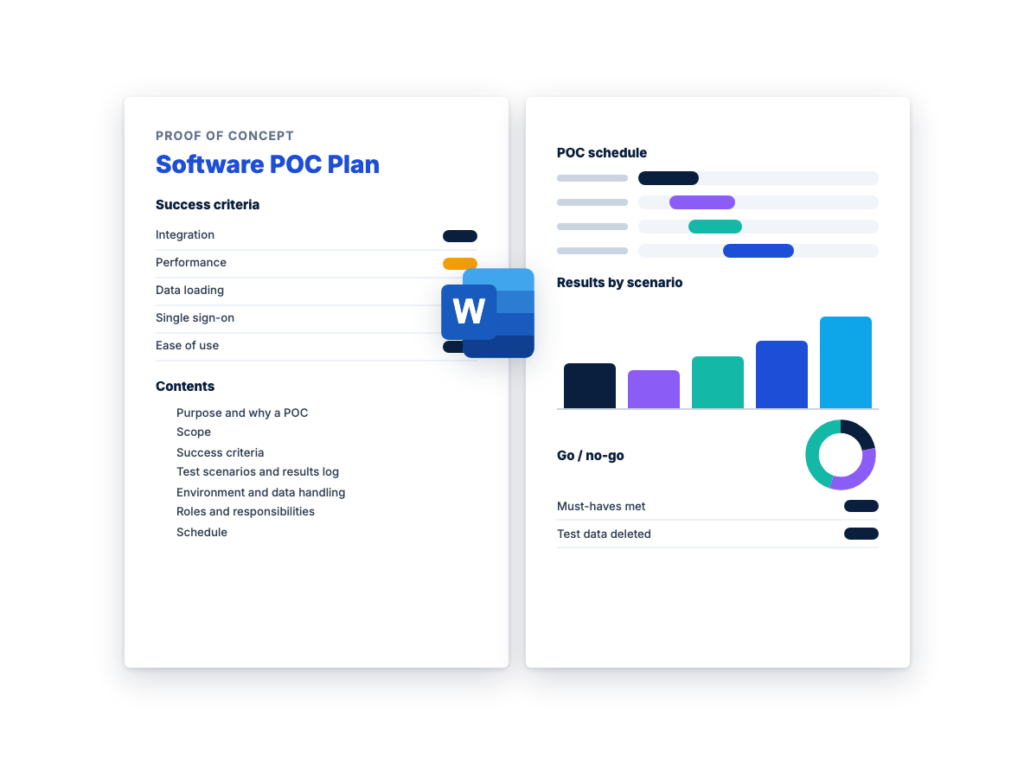
See the structure before you download. The Word file has every section listed below, ready to fill in.
The sections in the document, in order.
Use this proof of concept template when you're choosing software and a demo can't prove a requirement that matters, such as an integration with your systems or performance at your volumes. That's step 8 of the RFP process: after scoring the proposals, you test the finalists' software with your own data and scenarios, for a fixed period, against success criteria agreed in writing before the work starts.
It's written for whoever runs the selection, such as a procurement lead or IT manager, and it's also the plan you agree with each finalist. Both sides sign off the scope, success criteria, test data, who provides what, the schedule and who pays before any work begins. Proof of concept can also mean testing your own product or startup idea before you build it, but this template is for buyers testing a vendor's software.
The Word file is a complete POC document you can use as it stands. The first part is the plan you share with the vendor, including a results log. The second part stays with your evaluation team: it turns POC results into updated RFP scores, compares two or three finalists side by side and records the go/no-go decision.
Download the editable Microsoft Word version below. The full text is on this page, so you can read it before you download.
Fill in Sections 1 to 8 before you send the plan to the finalists, agree them with each one, and get Section 9 signed before any work starts. Sections 10 to 13 are for your evaluation team only.
All three let you see software working before you commit, so they’re easy to mix up, and vendors don’t all use the words the same way. Some offer a proof of value (POV), which puts more weight on business results, but the labels are used loosely. Whatever the name, what matters is who runs it, with whose data, and what it can prove.
How they differ:
Success criteria decide whether a vendor passes, so write them before the POC starts and give every finalist the same ones. A criterion holds up when two evaluators looking at the same evidence would reach the same verdict.
Start from the RFP. If your requirements name the user, the task and the proof, as How to Write an RFP recommends, most of the criteria are already drafted. Then rewrite anything vague, using placeholders until you’ve agreed your own numbers:
There’s no fixed rule. Some vendors run a POC at their own cost as part of the sale. Others charge for it, particularly when it needs integration work or their consultants’ time. Ask each finalist early, because the answer can affect how many finalists you can afford to test.
Either way, the POC costs you too: testers’ time, data preparation and masking, a security review, and any test connections your IT team sets up. Budget for them.
Agree these points in writing before the POC starts:
This is the complete text of the Word document. Fill in the [bracketed] placeholders and delete the italic guidance before you send it.
Buyer instructions: replace every [bracketed placeholder], delete
anything that doesn’t apply, and delete all italic guidance before you
send this plan. Sections 1 to 9 are the POC plan: make one copy per
finalist, with identical success criteria and scenarios, and have both
sides sign Section 9 before any work starts. Sections 10 to 13 are for
your evaluation team only, so delete them from every vendor’s
copy.
| Item | Details |
|---|---|
| RFP reference | [RFP number and title] |
| Buyer | [Organization legal name] |
| Vendor | [Vendor legal name] |
| Product and edition tested | [Product, edition and version, as proposed] |
| POC period | [Start date to end date] |
| Buyer POC lead | [Name, title, email] |
| Vendor POC lead | [Name, title, email] |
| Plan version | [Version number and date] |
[Organization name] (“we”, “us”) is selecting [type of software]
through [RFP number]. [Vendor name] (“the vendor”) is one of [two /
three] finalists. This proof of concept (POC) tests whether [product]
meets the requirements in Section 1.2 when our own staff use it with our
data, in the environment in Section 5, over the period in Section 7.
The results will update our evaluation of the vendor’s proposal. This
POC does not commit us to buy [product], or either party to enter into a
contract. [The confidentiality terms in the RFP / The non-disclosure
agreement dated [date]] apply to everything shared during the POC.
List only requirements that matter to the decision and that a
scripted demo, a reference call or a document can’t settle, such as
integrations, performance at your volumes, loading your real data, or
configuration by your own staff.
| RFP requirement ID | Requirement | Why the demo didn’t prove it | Tested in scenario |
|---|---|---|---|
| [INT-03] | [Two-way sync of accounts and orders with [ERP]] | [Shown with a simulated ERP] | [TS-1] |
| [NFR-07] | [Search and reporting speed with [number] records] | [Demo held far fewer records] | [TS-2] |
| [DM-02] | [Import of our customer data without manual rework] | [Not shown with data in our format] | [TS-3] |
| [SEC-04] | [Single sign-on with [identity provider]] | [Shown with the vendor’s own setup] | [TS-4] |
| [FR-21] | [Our administrators configure [approval workflow] without code] | [Configured by the vendor’s engineer] | [TS-5] |
Use the same criteria for every finalist, and set every pass
threshold before the POC starts. Must: a vendor that fails it fails the
POC. Nice: it adds to the score.
| ID | Criterion | How measured | Pass threshold | Priority | Scenario |
|---|---|---|---|---|---|
| SC-1 | Accounts and orders sync both ways with [ERP] | Create and update [number] test records on each side; compare field by field |
All records match within [time]; failed records logged with a reason |
Must | TS-1 |
| SC-2 | Performance at our volumes | Our IT team times [search or report] over [number] runs, all test data loaded |
[Seconds] or less in at least [number] of [number] runs | Must | TS-2 |
| SC-3 | Our data loads without manual rework | Import our masked [data set] extract; reconcile record counts | [X]% load without manual correction; every reject has an error reason |
Must | TS-3 |
| SC-4 | Single sign-on with [identity provider] | Test users sign in through [identity provider] using [SAML 2.0 / OpenID Connect] |
Every test user signs in; a disabled user loses access within [time] |
Must | TS-4 |
| SC-5 | Our administrators can configure [workflow] | Our administrator builds the workflow after [hours] of vendor training |
Workflow runs end to end with no code and no vendor help | Nice | TS-5 |
| SC-6 | Ease of use for [role] | Testers rate ease of use from 1 to 5 after their scenarios | Average rating of [score] or higher | Nice | All |
| SC-7 | Vendor support during the POC | Response times to questions and issues in the results log | First response within [number] business hours | Nice | All |
A must-have criterion not met by the end of the retest window
(Section 7) is a fail, and a partial result counts as not met.
Base each scenario on one of your hardest real processes, as you
did for the demo script.
| ID | Scenario and steps | Data used | Run by | Expected result | Criteria |
|---|---|---|---|---|---|
| TS-1 | [Create an account and order in [product]; update the account in [ERP]; check both] |
[Masked accounts, [number] records] | [Sales rep, finance tester] | [Changes in both systems within [time]] | SC-1, SC-6 |
| TS-2 | [Run [report] and [search] [number] times each with all test data loaded] |
[Generated data, [number] records] | [Our IT team] | [Within the SC-2 threshold] | SC-2 |
| TS-3 | [Import our [data set] extract with the standard import tools] | [Masked extract, [number] records] | [Our data lead] | [Records load; rejects listed with reasons] | SC-3 |
| TS-4 | [Sign in through [identity provider]; disable a test user and try again] |
[Test user accounts] | [Our identity team] | [Access granted, then removed] | SC-4 |
| TS-5 | [Build [approval workflow] from our written specification] | [Workflow specification] | [Our administrator] | [Workflow runs as specified] | SC-5, SC-6 |
Complete this during the POC. Share a vendor’s log only with that
vendor, to confirm the facts. “How achieved” uses the RFP’s response
codes; an unreleased feature counts as not met.
| Scenario | Date | Result | How achieved | Evidence | Issues and follow-up |
|---|---|---|---|---|---|
| [TS-1] | [Date] | [Pass / Fail / Partial] | [Standard / Configuration / Custom / Third party / Not met] | [Screenshots, logs or reports] | [Issue, owner, retest date] |
| [TS-2] | |||||
| [TS-3] | |||||
| [TS-4] | |||||
| [TS-5] |
| Item | Details |
|---|---|
| Environment | [Vendor-hosted test tenant / our sandbox / test server on our premises] |
| Hosting location | [Country or region where our data is stored and processed] |
| Access | [Named test users only, with single sign-on or multi-factor authentication] |
| Connections to our systems | [Test instances of [systems] only. No connection to production systems.] |
| Access ends | [Date], when the vendor disables all test accounts and connections |
Use the least data that will prove the criteria. Prefer generated
data, or real data with personal and confidential details
masked.
| Data set | Source | Volume | Personal or confidential data? | Masked or generated | Provided by |
|---|---|---|---|---|---|
| [Customer accounts] | [Extract from [system]] | [Number] records | [Yes: names, contact details] | [Masked: names and contact details replaced] | [Us] |
| [Performance test data] | [Generated] | [Number] records | [No] | [Generated] | [Vendor] |
| [Data set] | [Source] | [Volume] | [Yes / No] | [Method] | [Us / Vendor] |
If real personal data is involved, ask your privacy or legal team
whether you need a data processing agreement or other terms before the
POC starts. Requirements vary by country and sector.
| Item | Provided by | Due by |
|---|---|---|
| Test environment and licenses for [number] test users | [Vendor] | [Date] |
| Security documentation (Section 5.3) | [Vendor] | [Date] |
| Masked data extracts (Section 5.2) | [Us] | [Date] |
| Access to test instances of [systems] | [Us] | [Date] |
| Configuration for scenarios TS-1 to TS-4 | [Vendor] | [Date] |
| Testers, for [number] hours each | [Us] | [Date] |
| Training for testers and administrators | [Vendor] | [Date] |
| Role | Side | Name | Responsibilities |
|---|---|---|---|
| Executive sponsor | Us | [Name] | Approves the plan; makes the go/no-go decision |
| POC lead | Us | [Name] | Owns the plan and schedule; single point of contact for the vendor; keeps the results log |
| Testers | Us | [Names] | Run the scenarios; record results and evidence |
| IT and integration lead | Us | [Name] | Test instances of our systems, data extracts, performance tests |
| Security and privacy | Us | [Name] | Approves the environment and data handling; checks data deletion |
| Evaluators | Us | [Names] | Score the results |
| POC lead | Vendor | [Name] | Vendor’s single point of contact; plans and staffs the vendor’s work; responds to issues |
| Technical consultant | Vendor | [Name] | Configures the product, sets up test connections, trains testers |
All communication about the POC, including commercial questions, goes
through the two POC leads. The contact rules in the RFP still apply.
Ask the vendor to staff the POC with people who would work on
your implementation, where possible.
An example only: about a week of preparation, then three weeks
from kickoff to decision. Adjust it to your scope, allow more time if
test integrations have to be built, and give every finalist the same
length of time.
| When | Dates | Activity | Owner | Output |
|---|---|---|---|---|
| Preparation (about one week) | [Dates] | Plan signed; security review; data masked; environment requested |
Both POC leads | Signed plan; approved environment |
| Week 1 | [Dates] | Kickoff; environment, test users, data and test connections set up; vendor configures the scenarios |
Vendor; our IT lead | Environment ready |
| End of week 1 | [Date] | Testers trained; dry run of each scenario | Vendor; testers | Scenarios ready |
| Week 2 | [Dates] | Scenarios run for the record; results and issues logged daily | Testers | Results log |
| Week 3, first half | [Dates] | Retest window: vendor fixes logged issues; testers retest | Vendor; testers | Final results |
| Week 3, second half | [Dates] | Scoring, findings meeting, go/no-go decision | Evaluators; sponsor | Scores and decision |
| Within [number] days after the POC | [Date] | Test access removed; data deletion confirmed in writing | Vendor; our security lead | Written confirmation |
Whether vendors charge for a POC varies. Agree every cost below
in writing before the POC starts, and budget for your own: testers’
time, data preparation, the security review and test connections on your
side.
| Cost item | Paid by | Amount or cap | Notes |
|---|---|---|---|
| Vendor staff time: configuration, test connections, training, support |
[Vendor / Us] | [Amount, or no charge] | [Daily rates, if charged] |
| Test environment and licenses | [Vendor / Us] | [Amount, or no charge] | Licenses end on [date] |
| Third-party products or connectors | [Vendor / Us] | [Amount] | [Product] |
| Travel and expenses | [Vendor / Us] | [Cap] | Only with our written approval in advance |
| Total charged to us | [Amount, or no charge] |
Public-sector buyers: check with your procurement office before
accepting a POC at no charge or paying for one, and offer every finalist
the same terms.
By signing, both parties agree to the scope, success criteria, test
scenarios, data handling, roles, schedule and costs in Sections 1 to 8.
This plan does not commit either party to a contract for [product].
| Name | Title | Organization | Signature | Date |
|---|---|---|---|---|
| [Name] | [Buyer POC lead] | [Organization name] | ||
| [Name] | [Executive sponsor or budget holder] | [Organization name] | ||
| [Name] | [Vendor POC lead] | [Vendor name] | ||
| [Name] | [Authorized signatory, if the POC is charged] | [Vendor name] |
Have legal review the plan before signing if the POC is charged,
uses real personal data or connects to your systems.
Internal: delete Sections 10 to 13 from every copy you send to a
vendor.
The POC doesn’t replace the RFP evaluation. Its results update the
scores for the RFP criteria it tested, at the weights set before
proposals arrived. Before the POC starts, decide which RFP criteria each
POC criterion informs.
| Score | Meaning |
|---|---|
| 5 | Beat the threshold with standard functionality or configuration, and no vendor help |
| 4 | Met the threshold with standard functionality or configuration |
| 3 | Met the threshold, but needed vendor help, a workaround or a retest |
| 2 | Missed the threshold, or met it only with custom code or a third-party product |
| 1 | Not met, or not attempted |
Edit the definitions to suit, before the POC starts.
The weights shown are an example only. Use the weights from your
RFP, unchanged.
| POC criteria | RFP criterion they inform | RFP weight | Score before POC (1 to 5) | Score after POC (1 to 5) | Reason for any change |
|---|---|---|---|---|---|
| SC-1, SC-2, SC-4 | [Technical and security] | [20] | [Evidence from the results log] | ||
| SC-5, SC-6 | [Functional fit] | [35] | |||
| SC-3, SC-7 | [Implementation and support] | [15] |
Recalculate each finalist’s weighted total the same way you did for
the proposals. If a scenario passed only with custom work or a
third-party product, get the vendor’s written price for it and add it to
the cost comparison before you rescore cost.
Use this when two or three finalists take part, each with the
same plan, scenarios, data and length of time, run as close together as
you can. If your testers can’t give that time two or three times over,
test the leading one or two finalists and keep the others in the process
until you decide.
| Item | Priority | [Vendor A] | [Vendor B] | [Vendor C] | Notes |
|---|---|---|---|---|---|
| SC-1 to SC-4 | Must | [Pass / Fail for each] | |||
| All must-haves passed? | [Yes / No] | ||||
| SC-5 to SC-7 | Nice | [Score for each] | |||
| Custom work or extra cost found | [Description and price] | ||||
| Open issues at the end | [Number and severity] | ||||
| Updated RFP weighted total | [Total] | ||||
| Rank | [1 / 2 / 3] |
Set these before the POC starts.
| Item | Details |
|---|---|
| Vendor | [Vendor name: one record per finalist] |
| Decision | [Go / Conditional go / No-go] |
| Date | [Date] |
| Decided by | [Name and title] |
| Reasons and risks found | [Short summary, referring to Sections 10 and 11] |
| Conditions, owners and dates | [Condition, owner, date] |
After a go:
After a no-go:
In every case:
We confirm that the results in Section 4.3 and the scores in Sections
10 and 11 are accurate, and we approve the decision in Section 12.
| Name | Role | Signature | Date |
|---|---|---|---|
| [Name] | POC lead | ||
| [Name] | Evaluator | ||
| [Name] | Executive sponsor |
A proof of concept (POC) is a short, structured test of a vendor’s software that a buyer runs before choosing, to check requirements a demo can’t prove. Your own staff run agreed scenarios with your data in a test environment, and the results are judged against success criteria set in advance. For example, a team choosing a CRM might test whether each finalist’s product can keep customer accounts in sync with its ERP test system.
The requirements the POC will test and why, the scope, success criteria with pass thresholds, test scenarios, environment and data handling rules, roles on both sides, a schedule, the costs and who pays, and sign-off. For your own team, it also needs a way to score the results and a record of the go/no-go decision. This template includes all of them, plus a results log and a side-by-side comparison of finalists.
Tie each criterion to a requirement in your RFP, and state how it will be measured, what result counts as a pass and whether it’s a must-have or nice-to-have. Replace words like “works” or “fast” with a test, a volume and a threshold. Agree the criteria with every finalist and fix them before the POC starts.
Long enough to run every scenario and retest any fixes, and no longer. The example schedule in this template runs three weeks from kickoff to decision, after about a week of preparation. Allow more time if test integrations have to be built, and agree a fixed end date in writing.
A POC tests whether specific requirements can be met, in a test environment with your data, while you’re still choosing a vendor. A pilot puts the product in front of real users doing real work, such as one team or site, to see how it performs day to day and whether to roll it out further. A pilot needs its own commercial and data protection terms.
A free, vendor-neutral RFP cover letter template for the one-page letter that goes on top of a proposal, with two filled-in examples…
A free, vendor-neutral RFP response template for suppliers answering a request for proposal, with an executive summary outline, a requirements compliance matrix,…
A free, vendor-neutral scorecard template for rating an existing supplier's performance every quarter, with KPIs and targets, a defined 1-to-5 scale, weights,…
Please provide your feedback below.
"*" indicates required fields