Proof of Concept Template (Free, Word): Software POC Plan
A free, vendor-neutral POC template for testing finalists' software with your own data before you choose, with success criteria, test scenarios, data…
Word · FreeDownload Template →
A free, vendor-neutral RFP response template for suppliers answering a request for proposal, with an executive summary outline, a requirements compliance matrix, pricing tables and a pre-submission checklist.
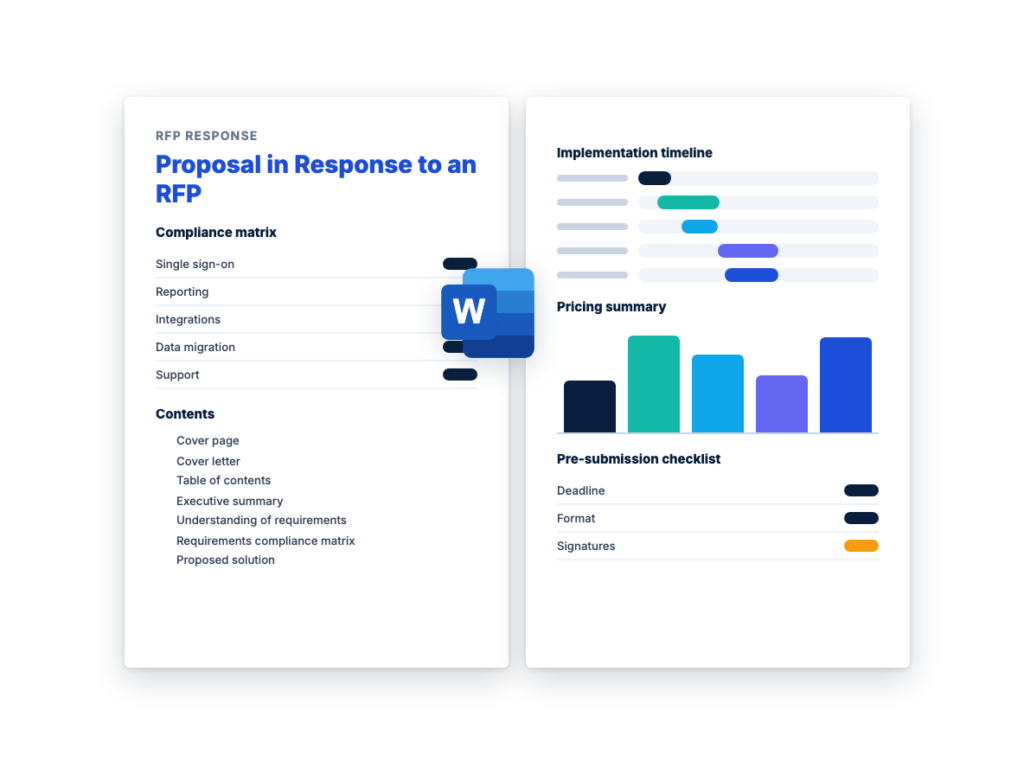
See the structure before you download. The Word file has every section listed below, ready to fill in.
The sections in the document, in order.
Use this RFP response template when a buyer has sent you a request for proposal and you need to answer it. It's written for the vendor side: account executives, proposal writers, pre-sales engineers and small-business owners responding to RFPs for software, IT and professional services, including first-timers. If you're the buyer, start from the RFP templates in the RFP examples library instead.
A strong response follows the buyer's structure and answers every requirement directly. Treat this document as a starting outline. If the RFP sets its own section order, response form or pricing table, use it and move your content into it. Evaluators score against the RFP's structure, and an answer they can't find is hard to score.
The Word file is a complete proposal response template with example entries, running from the cover page and executive summary through the compliance matrix, implementation timeline, pricing, and assumptions and exceptions to a pre-submission checklist. For the letter that goes on top, use the free RFP cover letter template.
Download the editable Microsoft Word version below. The full text is on this page, so you can read it before you download.
The buyer’s RFP decides the final structure. These steps show how to fit this template to it.
Writing is only part of the job. These steps take you from receiving an RFP to a submitted proposal. For the full process, with an example response plan and what happens after you submit, see how to respond to an RFP.
A proper response takes time from sales, pre-sales, delivery, finance and legal. Work through these checks as a team, early, and record the decision and the reasons.
A buyer running a structured process evaluates proposals in stages. RFPhub’s guide to the RFP process sets out the evaluation steps from the buyer’s side, and each one has a lesson for your proposal.
This is the complete text of the Word document. Fill in the [bracketed] placeholders and delete the italic guidance before you send it.
About this template: This is an outline for a proposal that
answers a buyer’s request for proposal (RFP) for software, IT or
professional services. The buyer’s RFP comes first. If it sets a section
order, numbering, page limit, response form or pricing table, follow it
and move the content below into that structure. Text in [square
brackets] is for you to fill in, and the examples show the level of
detail to aim for. Instructions in italics are for your bid team: delete
them, and Section 17, before you submit.
| Item | Details |
|---|---|
| Proposal title | [Proposal for [short description of the project]] |
| Submitted to | [Buyer organization legal name] |
| Attention | [RFP contact name and title, as named in the RFP] |
| RFP title and number | [RFP title], [RFP number] |
| Submitted by | [Your organization legal name] |
| Proposal contact | [Name, title, email, phone] |
| Submission date | [Date] |
| Version | [Version number or internal reference] |
[Confidentiality marking, if the RFP allows one. For example: “This
proposal contains confidential information of [Your organization],
provided only for the evaluation of [RFP number].”]
Mark only material that is genuinely confidential, in the way the
RFP allows. Proposals sent to a public body may be subject to public
records laws.
This proposal is valid for [number] days after the submission
deadline [or: for the period required in Section [X] of the RFP].
| Item | Details |
|---|---|
| Name | [Name of the person authorized to submit this proposal] |
| Title | [Title] |
| Signature | |
| Date | [Date] |
Depending on the RFP’s terms and the law that applies, a proposal
can be treated as an offer that the buyer may accept. Have it signed by
someone with authority to commit your organization, and have your legal
team review it, especially Section 13, before you submit. If the RFP
includes its own signature or certification forms, complete those as
well.
Insert your signed cover letter here, on your letterhead, and
keep it to one page. It should name the RFP title and number, list every
addendum you received by number, confirm the validity period in Section
1.1, and name the person authorized to commit your organization and the
contact for questions. For a ready-made structure, start from RFPhub’s
free RFP cover letter template. If the RFP asks for a transmittal letter
or a specific form instead, use that.
[Cover letter]
Update this table after your final edit, or replace it with one
generated in Word. The third column shows evaluators where each part of
the RFP is answered.
| Section | Title | RFP section it answers | Page |
|---|---|---|---|
| 4 | Executive summary | [RFP section] | [Page] |
| 5 | Understanding of requirements | [RFP section] | [Page] |
| 6 | Requirements compliance matrix | [RFP section] | [Page] |
| 7 | Proposed solution | [RFP section] | [Page] |
| 8 | Implementation approach and timeline | [RFP section] | [Page] |
| 9 | Project team | [RFP section] | [Page] |
| 10 | Support and service levels | [RFP section] | [Page] |
| 11 | Security and compliance | [RFP section] | [Page] |
| 12 | Pricing | [RFP section] | [Page] |
| 13 | Assumptions and exceptions | [RFP section] | [Page] |
| 14 | References | [RFP section] | [Page] |
| 15 | Company information | [RFP section] | [Page] |
| 16 | Appendices | [RFP section] | [Page] |
Write this section last and keep it within [one or two pages /
the length the RFP allows]. Someone who reads nothing else should
understand what you propose, what it costs and why it fits. Back up
every claim elsewhere in the proposal, and make every price and date
match Sections 8 and 12.
[In two or three sentences, restate what [Buyer] wants to achieve,
using the RFP’s own terms. Example: “[Buyer] wants to replace its
regional help desk tools with one service management system before the
current contracts end in [month and year], and to give its agents and
employees one place to raise and track requests.”]
[Summarize what you propose: the product or service, the
implementation and services, the timeline, and the total price over the
contract term. Example: “We propose [product], implemented in [number]
phases over [number] months, with [support level] support. The total
price over the [number]-year term is [amount], set out in Section
12.”]
[Give the reasons that matter to this buyer. Tie each one to a
requirement or evaluation criterion in the RFP and back it with evidence
elsewhere in the proposal, such as a reference customer of similar size
and scope, a named team or a specific capability. Leave out claims you
can’t support, such as “industry-leading”.]
[Describe what [Buyer] will have at the end of the project, and by
when, in terms of the goals in 4.1. Example: “By [date], every agent
will work in one system, requests from all regions will arrive in one
queue, and the service desk manager will be able to run reports without
help from IT.” Quote results only if you can support them.]
Restate the need in your own words rather than copying the RFP
back, and include what you learned from the buyer’s answers to questions
and from addenda.
[Summarize the buyer’s situation, the problem this purchase solves
and the objectives stated in the RFP.]
| Area | In scope | Out of scope |
|---|---|---|
| [e.g. Users and sites] | [Who and where] | [Anything excluded] |
| [e.g. Integrations] | [Systems to connect] | [Systems not included] |
| [e.g. Data migration] | [Data to move, and from which systems] | [Data to be archived or left behind] |
| [Area] | [In scope] | [Out of scope] |
[List the constraints that shape your proposal, such as the required
go-live date, end dates of current contracts, funding limits stated in
the RFP and regulatory requirements.]
If your understanding differs from the RFP, record it as an
assumption or exception in Section 13.
Copy every requirement from the RFP into this table, with the
buyer’s requirement IDs and exact wording, in the buyer’s order. Answer
every line. If the RFP supplies its own compliance form or spreadsheet,
complete that instead, attach it as an appendix and refer to it
here.
If the RFP defines its own response codes, such as standard,
configuration, custom or roadmap, use those and delete this
table.
| Code | Meaning |
|---|---|
| Yes | Fully met by the proposed solution as delivered. In the explanation, say whether it’s standard functionality or needs configuration. |
| Partial | Partly met. Explain the gap and how it would be closed, for example with custom work, a partner product or a workaround, and what that costs. |
| Roadmap | Not available today but planned. Give the planned timing and say whether you will commit to it in the contract. |
| No | Not met. Offer an alternative if there is one. |
| Req. ID | Requirement | Response | Explanation | Proposal reference |
|---|---|---|---|---|
| [e.g. TR-04] | [e.g. The system must support single sign-on with our identity provider.] |
[Yes] | [e.g. Standard functionality. Single sign-on is configured during the build phase.] |
[Section 7.2] |
| [e.g. FR-17] | [e.g. Agents must be able to merge duplicate tickets.] | [Partial] | [e.g. Agents can link duplicate tickets as standard but can’t merge them. Merging is available as custom work, priced as an option in Section 12.2.] |
[Section 7.4] |
| [ID] | [Requirement] | [Yes / Partial / Roadmap / No] | [Explanation] | [Section] |
| [ID] | [Requirement] | [Yes / Partial / Roadmap / No] | [Explanation] | [Section] |
Keep explanations short and specific. A “Yes” with no explanation
is hard to score, and a “Yes” that turns out to be wrong can come to
light in a demo, a reference call or contract negotiation.
Organize this section around the RFP’s requirement areas and
questions, in the RFP’s order, rather than around your product’s feature
list. Answer each question first, then explain how.
[Describe the products or services, editions or service tiers, how
the solution is hosted or delivered, and how it fits the buyer’s current
systems. Add a diagram if it helps.]
[For each requirement area in the RFP, explain how the solution meets
it, under the buyer’s own headings. Example headings: [Functional
requirements], [Reporting], [Integrations], [Administration].]
[List each system to be integrated, the method (standard connector,
API, file transfer or custom build) and who builds and maintains it.
Then describe the data to be migrated, where it comes from and how its
accuracy will be checked.]
[Describe any optional items or alternative approaches. Keep them
clearly separate from the main proposal and price them separately in
Section 12. If an option is needed to meet a must-have requirement, say
so.]
[List anything a reader might assume is included but isn’t, such as
hardware, third-party licenses, ongoing administration or changes to the
buyer’s other systems.]
[Describe how you will deliver the project: the phases, project
governance, how decisions and changes are handled, how testing and
acceptance work, and how you will report progress.]
Plan back from the buyer’s required go-live date if the RFP gives
one. If that date isn’t achievable, say so here and in Section
13.
| Phase | Main activities | Deliverables | Buyer involvement | Dates or duration |
|---|---|---|---|---|
| [e.g. Discovery and design] | [Workshops, confirm requirements, design sign-off] | [Design document] | [Process owners attend workshops] | [Dates] |
| [e.g. Build and configure] | [Configuration, integrations, trial data migration] | [Configured system in a test environment] | [Test data, access to systems] | [Dates] |
| [e.g. Test and train] | [User acceptance testing, training] | [Signed acceptance, trained users] | [Testers and trainees] | [Dates] |
| [e.g. Go-live and early support] | [Cutover, early-life support] | [Live system, handover to support] | [Cutover decisions] | [Dates] |
[List the buyer’s responsibilities: people and their time, access to
systems and data, decisions and approvals, and the date each is needed.
The plan depends on them, so list them as assumptions in Section 13 as
well.]
| Risk | Effect if it happens | How we will reduce it | Owner |
|---|---|---|---|
| [e.g. Data in the old system needs more cleanup than planned] | [Migration delays go-live] | [Trial migration during the build phase; cleanup plan agreed in discovery] |
[Buyer’s data owner, supported by our migration lead] |
| [Risk] | [Effect] | [Mitigation] | [Owner] |
[Describe the training for each group (administrators, end users,
support staff), the format and materials, and how the buyer’s team takes
over at the end of the project.]
Name people only if they will actually work on the project, and
say how much of their time they will give it. Put full résumés in the
appendices.
| Role | Name | Responsibilities | Relevant experience | Time on this project |
|---|---|---|---|---|
| [Project manager] | [Name] | [Plan, status reporting, single point of contact] | [Similar projects, certifications] | [e.g. Half time] |
| [Solution architect] | [Name] | [Design and integrations] | [Experience] | [Time] |
| [Implementation consultant] | [Name] | [Configuration and testing] | [Experience] | [Time] |
| [Account or customer success manager] | [Name] | [Relationship after go-live] | [Experience] | [Time] |
[Describe how the team is organized, who the buyer escalates to, and
whether any of the work will be done by subcontractors or partners. Name
them.]
Describe the support you actually provide, and get sign-off from
your support and legal teams for any commitment beyond your standard
terms. If the RFP sets its own severity levels or targets, answer
against those.
| Item | Our commitment |
|---|---|
| Support hours and time zones | [Hours, days and time zones covered] |
| Support channels | [Portal, email, phone, chat] |
| Service availability | [Availability commitment and how it’s measured, if applicable] |
| Service credits | [What the buyer receives if you miss the commitment] |
| Planned maintenance | [Maintenance windows and notice given] |
| Updates and upgrades | [How often, how the buyer is told, and whether there is any cost] |
| Escalation path | [Named roles, from first-line support to executive sponsor] |
| Account management | [Named contact and regular review meetings] |
| Severity | Definition | Response target | Resolution or workaround target |
|---|---|---|---|
| [Critical] | [e.g. Service unavailable for all users] | [Target] | [Target] |
| [High] | [e.g. A major function is unavailable, with no workaround] | [Target] | [Target] |
| [Medium] | [e.g. A function is impaired, but a workaround exists] | [Target] | [Target] |
| [Low] | [e.g. A question or minor issue] | [Target] | [Target] |
If the buyer sends a security questionnaire, complete it in the
buyer’s format and attach it. Claim only certifications and reports you
hold today, with their dates.
| Topic | Our response | Evidence available |
|---|---|---|
| Certifications and audit reports | [e.g. ISO/IEC 27001 certificate or SOC 2 report: scope and date] |
[Certificate or report, under a confidentiality agreement if required] |
| Where data is stored and processed | [Countries or regions, hosting provider] | [Hosting documentation] |
| Encryption | [In transit and at rest] | [Security documentation] |
| Access control | [Single sign-on, multi-factor authentication, role-based access, and how your staff access customer data] |
[Policy summary] |
| Vulnerability management | [Patching, scanning, independent penetration testing] | [Summary of the latest test] |
| Incident response | [How and when you notify customers of a security incident] | [Policy summary] |
| Business continuity and disaster recovery | [Backups, recovery objectives, how often the plan is tested] | [Plan summary or test results] |
| Subprocessors | [Third parties that will process the buyer’s data] | [Subprocessor list] |
| Privacy | [Data processing agreement and the privacy laws you support] | [Data processing agreement] |
| Accessibility | [Accessibility standards the product meets] | [Accessibility conformance report] |
| Insurance | [Types and limits of cover] | [Certificate of insurance] |
Use the buyer’s pricing table exactly as issued: the same line
items, units, columns and contract term. If your pricing model doesn’t
fit it, complete it as closely as you can and explain the differences in
12.3 and Section 13. Use the tables below only where the RFP doesn’t
supply its own.
Match the columns to the contract term in the RFP.
| Cost element | [Year 1] | [Year 2] | [Year 3] | Total for the term |
|---|---|---|---|---|
| One-time: implementation and services | [Amount] | [Amount] | [Amount] | [Amount] |
| One-time: other [e.g. data migration, training] | [Amount] | [Amount] | [Amount] | [Amount] |
| Recurring: subscription or license fees | [Amount] | [Amount] | [Amount] | [Amount] |
| Recurring: support and maintenance | [Amount] | [Amount] | [Amount] | [Amount] |
| Total | [Amount] | [Amount] | [Amount] | [Amount] |
| Item | One-time or recurring | Quantity and unit | Unit price | Total |
|---|---|---|---|---|
| [e.g. Subscription, [edition]] | [Recurring, annual] | [Number of users] | [Price] | [Amount] |
| [e.g. Implementation services] | [One-time] | [Fixed price, or number of days] | [Price or day rate] | [Amount] |
| [e.g. Training] | [One-time] | [Sessions or days] | [Price] | [Amount] |
| [e.g. Option from Section 7.4] | [Type] | [Quantity] | [Price] | [Amount, shown separately from the total] |
List everything your solution, timeline or price depends on that
the buyer controls or hasn’t confirmed.
| No. | Assumption | What changes if it doesn’t hold |
|---|---|---|
| A1 | [e.g. The buyer provides a test environment for each integrated system by the end of the design phase.] |
[The build phase moves back by the length of the delay.] |
| A2 | [e.g. Data migration covers [systems] and [number] years of history.] |
[Additional migration is charged at the day rate in Section 12.2.] |
| A3 | [Assumption] | [Effect] |
List every requirement, term or condition in the RFP that you
can’t meet or accept as written, with a proposed alternative for each.
Repeat any exception you’ve mentioned elsewhere, so the buyer finds them
all in one place, and write “None” if you have none. Read the RFP’s
instructions on exceptions closely: some buyers can reject a proposal
that takes exception to a mandatory requirement or term. Have your legal
team review this section.
| RFP section | Requirement or term | Our exception | Proposed alternative |
|---|---|---|---|
| [e.g. Contract terms, clause [X]] | [e.g. Unlimited liability for data breaches] | [e.g. We can’t accept unlimited liability.] | [e.g. Liability capped at [amount], with a separate, higher cap for data breaches.] |
| [Section] | [Requirement or term] | [Exception] | [Alternative] |
Choose references that match the buyer’s size, industry and
scope, ideally delivered by the team you are proposing. Get each
reference’s permission and brief them before you list them.
| Organization | Contact | What we delivered and when | Why it’s relevant |
|---|---|---|---|
| [Customer name] | [Name, title, email, phone] | [Product or service, scope, go-live date] | [Similar size, industry or scope] |
| [Customer name] | [Name, title, email, phone] | [Scope and date] | [Relevance] |
| [Customer name] | [Name, title, email, phone] | [Scope and date] | [Relevance] |
[Optional: a short case study for each reference, in an appendix.
Include results only if the customer has agreed to share them.]
| Item | Details |
|---|---|
| Legal name and any trading names | [Names] |
| Headquarters address | [Address] |
| Year founded | [Year] |
| Ownership | [Privately held, publicly listed, or a subsidiary of [parent company]] |
| Employees | [Total, and the number in roles relevant to this proposal] |
| Experience with the proposed solution | [How long you have provided it, and comparable customers you can name] |
| Company registration and tax ID | [Numbers, as the RFP requires] |
| Financial information | [What the RFP asks for, e.g. audited financial statements, in Appendix [X]] |
| Partners and subcontractors | [Name and role of each, if any] |
| Conflicts of interest | [None, or a description of any relationship with the buyer’s staff or anyone involved in the RFP] |
| Other disclosures required by the RFP | [e.g. pending litigation, or confirmation that you are eligible to contract with the buyer] |
Include only what the RFP asks for or what supports an answer,
and refer to each appendix from the main text.
| Appendix | Contents |
|---|---|
| A | [Forms required by the RFP, completed and signed, including addendum acknowledgments] |
| B | [Completed buyer questionnaires or response forms, such as a security questionnaire or pricing form] |
| C | [Résumés of the people in Section 9] |
| D | [Product documentation, sample reports or screenshots] |
| E | [Certificates and reports from Section 11, if they can be shared] |
| F | [Draft project plan or statement of work, if requested] |
| G | [Your standard agreements, if the RFP asks for them] |
| H | [Financial statements, if required] |
For your bid team only. Work through every line before you
submit, then delete this section.
| Check | What to confirm | Done |
|---|---|---|
| Deadline | Date, time and time zone confirmed. Portal login and file size limits tested. Submission planned [how far] ahead of the deadline. |
|
| Format | File types, names, page limits, separate volumes (such as a separate price proposal) and number of copies match the RFP’s instructions. |
|
| Structure | Sections follow the RFP’s order and numbering, and the table of contents shows which RFP section each part answers. |
|
| Every question answered | Every compliance matrix line has a response code and explanation, and every RFP question has an answer. |
|
| Addenda | Every addendum is acknowledged and reflected in the answers and pricing. |
|
| Signatures | The cover letter, Section 1.1 and every required form are signed and dated by someone authorized to commit your organization. |
|
| Pricing matches | Totals agree across the pricing section, the buyer’s pricing form, the executive summary and the cover letter. Arithmetic checked. |
|
| Exceptions listed | Every exception is in Section 13.2 with a proposed alternative, and legal has reviewed them. |
|
| Assumptions listed | Every assumption that affects scope, timeline or price is in Section 13.1. |
|
| Names and reused text | The buyer’s name is correct throughout, and no other customer’s details remain from reused content. |
|
| Confidential material | Marked only as the RFP allows. | |
| References | Each reference has agreed to be contacted. | |
| Final read | Someone who didn’t write the proposal has read it against the RFP. |
|
| Clean copy | Italic guidance, unused placeholders, tracked changes and comments removed, and this checklist deleted. |
|
| Receipt | Confirmation of receipt obtained and saved. |
Everything the RFP asks for, in the order and format it asks for it. Where the RFP leaves the structure to you, a complete proposal covers a cover letter, executive summary, your understanding of the requirements, the proposed solution, a compliance matrix, the implementation plan and team, support and security, pricing, assumptions and exceptions, references and company information. This template includes all of them.
Decide first whether to bid. If you do, read the whole RFP and every addendum, send any questions before the question deadline, and list every requirement in a compliance matrix before you start writing. Then answer each requirement directly, following the buyer’s structure and scoring criteria, have someone who didn’t write the proposal review it against the RFP, and submit before the deadline.
It’s a table that lists every requirement in the RFP, with the buyer’s IDs and wording, and your response to each one. In this template, each line gets a response code (Yes, Partial, Roadmap or No), a short explanation and a pointer to where the proposal covers it in detail. If the RFP supplies its own compliance form or response codes, use those instead.
Say so plainly. Mark it Partial, Roadmap or No, explain the gap, and offer a workaround or alternative if you have one. Don’t mark it Yes: buyers can test claims in demos and reference calls, and commitments in a proposal can end up in the contract. If it’s a must-have you can’t meet, reconsider whether to bid at all.
As long as it takes to answer every question, and no longer than any page limit in the RFP. Answer each question directly before adding detail, and move supporting material such as résumés and product documentation into appendices if the RFP allows them. Padding makes the answers harder to find and score.
A free, vendor-neutral POC template for testing finalists' software with your own data before you choose, with success criteria, test scenarios, data…
A free, vendor-neutral RFP cover letter template for the one-page letter that goes on top of a proposal, with two filled-in examples…
A free, vendor-neutral scorecard template for rating an existing supplier's performance every quarter, with KPIs and targets, a defined 1-to-5 scale, weights,…
Please provide your feedback below.
"*" indicates required fields