Proof of Concept Template (Free, Word): Software POC Plan
A free, vendor-neutral POC template for testing finalists' software with your own data before you choose, with success criteria, test scenarios, data…
Word · FreeDownload Template →
A free request for information template for software and technology purchases, with vendor questions in eight sections, a capability checklist and non-binding terms.
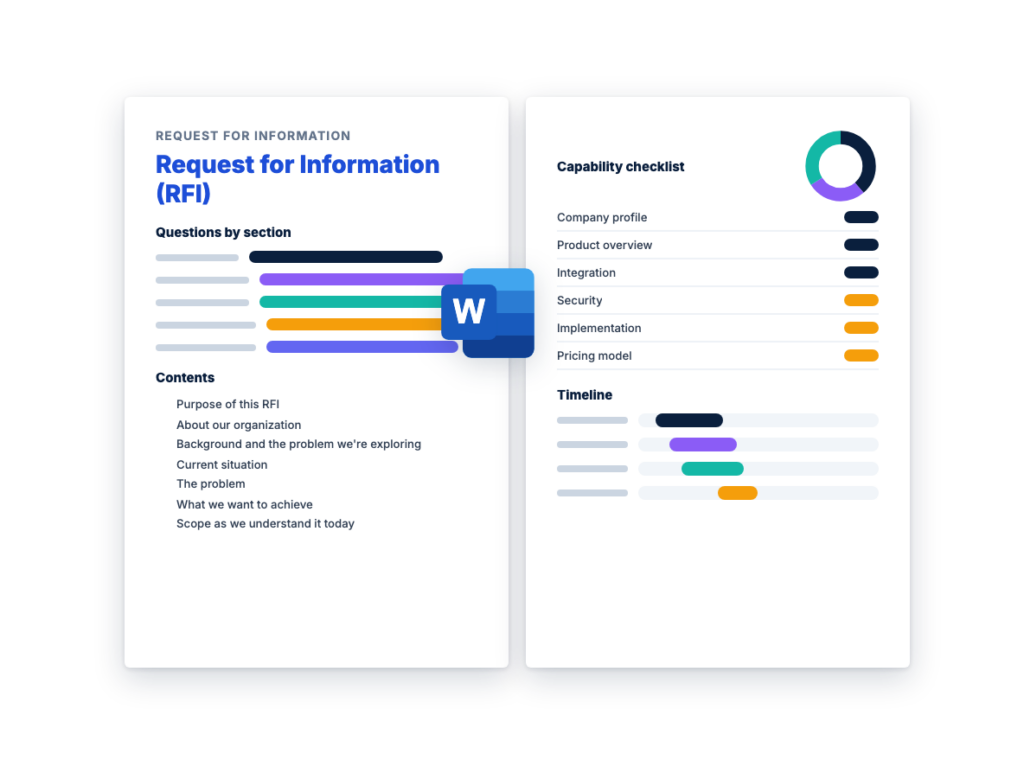
See the structure before you download. The Word file has every section listed below, ready to fill in.
The sections in the document, in order.
Use this RFI template when you need to learn what the market offers before you commit to a full RFP for software or a technology service. It's written for procurement leads, IT managers and department heads who know the problem they need to solve, but not yet which products, vendors and price levels are realistic.
The editable Word document is ready to send once you fill in the placeholders. It describes your organization and the problem you're exploring, makes clear the RFI isn't a commitment to buy, and asks RFI questions for vendors in eight sections, followed by a capability checklist and a response cover sheet. The full text is below, so you can read it as an RFI example before you download.
This is a procurement RFI. If you need a construction RFI, the form a contractor uses to ask the design team about drawings or specifications during a project, this template isn't built for that.
Download the editable Microsoft Word version below. The full text is on this page, so you can read it before you download.
The document works once the placeholders are filled in, but an RFI is only worth sending if the answers help you decide something. These steps take you from a blank template to a shortlist.
An RFI helps you learn the market. An RFP helps you choose a supplier. The RFI asks general questions and doesn’t commit either side to a purchase. The RFP sets out your requirements and asks a shortlist for detailed proposals and pricing you can score. What is an RFI? covers the RFI in depth, and RFP vs RFQ vs RFI compares all three documents.
You can skip the RFI if you already have a credible shortlist and know enough to write your requirements. If every vendor would deliver the same thing and only price and terms differ, use a request for quotation instead, starting from the RFQ template. Send an RFI first when one or more of these is true:
You don’t need a weighted scoring model for an RFI; that comes with the RFP. You do need to treat every response the same way, so the shortlist reflects your needs rather than the best-written answer. Work through each response in this order:
Give vendors enough time to answer properly, but keep the process moving. The right period depends on how many questions you keep and how complex the purchase is.
Allow more time if you’ve kept most of the questions, if the response period runs over a holiday, or if vendors will need input from partners. If you’re a public body, check whether your rules set a minimum notice or response period. They vary by jurisdiction, so ask your procurement office.
The timeline in this template is an example schedule that gives vendors two weeks:
This is the complete text of the Word document. Fill in the [bracketed] placeholders and delete the italic guidance before you send it.
| Item | Details |
|---|---|
| Issued by | [Organization name] |
| RFI reference | [RFI-YYYY-NNN] |
| Issue date | [Date] |
| Deadline for questions | [Date, time and time zone] |
| Responses due | [Date, time and time zone] |
| Contact | [Name, title, email address] |
How to adapt this RFI to your category (delete this note
before sending)This template is written for a generic software or technology
purchase. To fit it to yours:
- Replace every [square-bracket placeholder]. Search the document for
“[” to find them.- Describe your problem in Section 3 in your own words and fill in the
scope table. Without your user numbers, systems and data volumes,
vendors can’t give useful answers or indicative prices.- Replace [Key need 1] to [Key need 5] in Section 8.3 and Section 9
with the things the product must do for you. For a CRM, that might be
pipeline management, email and calendar sync, and service cases. For a
service desk tool, incident and request workflows and a self-service
portal. For an ERP system, multi-entity accounting, purchasing and
inventory.- Add two or three questions where your category’s decision is really
made. For a security product, expand Section 8.5. For an AI product,
expand question E7 to cover where prompts and outputs are stored and for
how long.- Delete questions whose answers won’t change who goes on your
shortlist. Every question you keep is work for the vendor and for your
reviewers.- Have your procurement office or legal counsel check Section 4 before
you send it. This matters most for public bodies, because the rules on
RFIs, public records and vendor contact vary by jurisdiction.- Delete this note and the italic instructions addressed to buyers.
Keep the italic notes addressed to respondents.
[Organization name] is issuing this request for information (RFI) to
learn about [software category, e.g., “customer relationship management
(CRM) software”] and the vendors that provide it.
We are at an early stage. We want to understand the products and
approaches available, how they are usually implemented and priced, and
which vendors work with organizations like ours. We will use responses
to:
This RFI is for information and planning only. It is not a request
for proposal or a request for quotation. Section 4 explains what it does
and does not commit us to.
Buyers: give vendors enough context to tailor their answers. A
short paragraph and the table below are enough.
[Organization name] is a [type of organization, e.g., “regional
healthcare provider” or “business-to-business software company”] based
in [location]. We [one sentence on what the organization does and who it
serves].
| Item | Details |
|---|---|
| Industry or sector | [Industry] |
| Employees | [Number] |
| Locations and regions in scope | [Countries, states or sites] |
| Departments affected | [e.g., Sales, Customer Service, Finance, IT] |
| Regulations that apply to us | [e.g., HIPAA, GDPR, PCI DSS, public-sector rules, or “none specific”] |
| Website | [URL] |
[Describe how the work is done today: the systems, spreadsheets or
manual processes in use, roughly how long they’ve been in place, and who
uses them.]
[Describe the problems you want to solve, in business terms. For
example: “Sales and service teams keep customer records in separate
systems, so no one has a complete view of an account,” or “Our current
system reaches end of support on [date].”]
[List three to five outcomes. For example: “One customer record
shared by sales and service” or “Month-end reports without manual
spreadsheet work.”]
Buyers: these figures help vendors give realistic answers and
indicative pricing. Estimates are fine; mark them as estimates.
| Item | Current figure or estimate | Notes |
|---|---|---|
| Users | [Number, by type, e.g., full users and occasional users] | [Expected growth, if known] |
| Sites, regions or business units | [Number and list] | |
| Data volumes | [e.g., number of records, transactions per month, storage] | |
| Systems to integrate with | [e.g., our ERP, identity provider, HR system, data warehouse] | |
| Data to migrate | [Source systems and approximate volume] | |
| Target timing | [e.g., “decision by [quarter], live by [quarter]”] | |
| Budget range (optional) | [Range, or “not shared at this stage”] |
Buyers: list the open questions you want the market to help you
answer, so vendors address the questions you actually have.
Buyers: check this section with your procurement office or legal
counsel before you send it, especially if you are a public body. The
rules that apply to RFIs, confidentiality and public records vary by
organization and jurisdiction.
No commitment to buy. This RFI is issued for
information and planning purposes only. It is not a request for
proposal, a request for quotation or an invitation to submit offers.
[Organization name] is not obliged to issue an RFP or to buy anything,
from any respondent.
No contract. Responses to this RFI are not offers,
and no response will be accepted to form a contract. Any purchase would
follow a separate process and a written agreement signed by both
parties.
Indicative information only. We will treat pricing,
timelines and similar information in responses as indicative and use it
for planning only. It will not bind the respondent.
Costs borne by respondents. Each respondent bears
its own costs of preparing and submitting a response, and of any
follow-up such as meetings or demonstrations. We will not pay for
information provided in response to this RFI.
Future eligibility. [Choosing not to respond to this
RFI will not, by itself, exclude a vendor from any later RFP.]
Buyers: delete or change this if your rules differ.
Our confidentiality. The information about
[Organization name] in this RFI is confidential. Use it only to prepare
your response, and share it only with employees and partners who need it
for that purpose. [Optional: Respondents must sign the attached
non-disclosure agreement before responding.]
Your confidentiality. Mark any part of your response
that is confidential or commercially sensitive, but don’t mark the whole
response. We will take reasonable steps to protect marked information,
share responses only with the people involved in this review [and our
advisers], and not disclose one respondent’s confidential information to
another. [Public bodies: replace this paragraph with your jurisdiction’s
public-records wording, including whether responses may be disclosed if
the law requires it.]
Use of responses. We may use what we learn from
responses to plan our project and write requirements for any later RFP.
We will keep responses for our records and will not return them.
Changes and cancellation. We may change the
timeline, issue written addenda or cancel this RFI at any time. We will
send any change to every recipient [or: post it at [location]].
Buyers: the dates below are an example schedule that gives
vendors two weeks to respond. Adjust them to suit your purchase and your
organization’s rules.
| Event | Date | Notes |
|---|---|---|
| RFI issued | [Date] | Sent to all recipients on the same day |
| Intent to respond (optional) | [Date, e.g., one week after issue] | Email to the RFI contact |
| Deadline for questions | [Date, time and time zone, e.g., end of week 1] | In writing to the RFI contact only |
| Answers sent to all recipients | [Date, e.g., early in week 2] | Questions shared without naming the vendor who asked |
| Responses due | [Date, time and time zone, e.g., end of week 2] | See Section 5 for format |
| Review of responses | [Dates, e.g., week 3] | |
| Possible follow-up: clarification calls or demonstrations | [Dates, e.g., week 4] | By invitation; not every respondent will be invited |
| Decision on next step | [Date] | For example, issuing an RFP to a shortlist |
All dates after the response deadline are indicative and may
change.
All communication about this RFI must go through one contact:
These rules apply from the issue date until [the decision on next
step / a date]:
Answer every question that applies to you. Where a question
refers to “our needs” or “our scope”, see Section 3.
A1. Give your company’s legal name, headquarters
location, year founded and ownership (for example, publicly listed,
privately held, investor-backed or part of a larger group).
A2. How many people do you employ in total, and how
many work in product development, customer support and implementation
services?
A3. Where are the staff who would sell to, implement
for and support us? Do you have a presence in [our countries or
regions]?
A4. How long has the product you’re describing been
generally available, and roughly how many organizations use it
today?
A5. Describe any recent or planned acquisition,
merger, change of ownership or end-of-life announcement that affects
this product.
A6. If we go ahead to an RFP, could you provide
evidence of financial stability, such as audited accounts or a credit
report?
B1. Summarize the product or service you would
propose for the needs in Section 3, in no more than [one page]. Name the
editions, modules or tiers involved.
B2. What types and sizes of organization is the
product designed for? Where is it not a good fit?
B3. Which deployment models do you offer (for
example, multi-tenant cloud, single-tenant hosted or installed on our
own infrastructure)? Which would you recommend for us, and why?
B4. Which parts of the solution do you build and
operate yourselves, and which come from partners or third parties?
B5. Describe your roadmap for the next [12 to 24]
months where it touches our needs. Which items are committed, and which
are under consideration?
Buyers: replace the placeholders with the key needs from Section
3. Keep the list short, and use the same list in Section 9.
C1. For each need below, explain how your product
meets it, and say whether that is standard functionality, configuration,
custom development, a partner product or a roadmap item.
C2. Walk us through how a user would complete [our
most important scenario, e.g., “a new customer order, from quote to
invoice”] in your product, step by step.
C3. What can our own administrators configure
without code (for example, fields, forms, workflows, approval rules and
reports), and what needs your team, a partner or a developer?
C4. What reporting and analytics are included? What
needs an add-on module or a separate tool?
C5. What practical limits apply, for example to
users, records, storage, file sizes or transaction volumes? What happens
if we exceed them?
C6. How do users work on mobile devices: a native
app, a mobile browser or both? Do you publish an accessibility
conformance report, and which accessibility standard and level does the
product meet (for example, WCAG 2.1 Level AA)?
C7. Based on what you know of our situation, what
are the main limitations or risks of your product for us?
D1. Where would our data be hosted and processed?
Name the hosting provider and the countries or regions available, and
say whether we can choose.
D2. Which integration methods do you support (for
example, REST APIs, webhooks, file import and export, and prebuilt
connectors)? Is your API documentation publicly available?
D3. Do you have prebuilt integrations with [our
systems, e.g., our ERP, identity provider and HR system]? Who builds,
supports and updates them?
D4. Do you support single sign-on through SAML 2.0
or OpenID Connect, multi-factor authentication and automated user
provisioning (for example, SCIM)? How are roles and permissions
managed?
D5. How would you migrate our data from [current
system]? Which tools do you provide, and what work would fall to us?
D6. Can we export all of our data, including
attachments and history, at any time and at the end of the contract? In
which formats?
E1. Which independent security reports or
certifications cover this product (for example, a SOC 2 Type II report
or ISO/IEC 27001 certification)? Give the date of the most recent report
or audit, and say whether you can share it under a non-disclosure
agreement.
E2. How is our data protected in transit and at
rest? What options do we have for managing encryption keys?
E3. How do you detect and respond to security
incidents, and how quickly would you notify us of an incident that
affects our data?
E4. Will you sign a data processing agreement?
Describe your list of sub-processors and how you support [the privacy
laws that apply to us, e.g., GDPR or US state privacy laws].
E5. Describe your status against [the sector
frameworks that apply to us, e.g., HIPAA, PCI DSS or FedRAMP], or say
that they do not apply to your product.
E6. Describe your backup and disaster recovery
arrangements, including the recovery point and recovery time objectives
you commit to and how often you test them.
E7. Does the product include AI features that
process our data? If so, which models or providers do they use, is our
data used to train models that serve other customers, and can we turn
the features off?
F1. Describe a typical implementation for an
organization of our size and scope: the phases, the main tasks and a
typical duration range.
F2. Who would deliver the implementation: your
company, a partner or both? If partners, name those that work in [our
region or industry].
F3. What staff and time would we need to commit
during implementation, and in which roles?
F4. Describe your support model: hours, channels,
severity levels and response-time targets. What is included as standard,
and what costs extra?
F5. What availability do you commit to in your
service level agreement? How is it measured, and what remedies apply if
you miss it?
We are asking for indicative pricing to help us plan a budget. It
is not a quote, it will not bind you, and we will not treat it as an
offer. Base it on the scope in Section 3.4 and state your
assumptions.
G1. Describe your pricing model. Which metric drives
the price (for example, per named user, per module, by usage or a flat
subscription), and how do you define it?
G2. Complete the table below with indicative ranges
for our scope.
| Cost item | Pricing metric | Indicative range | Assumptions and notes |
|---|---|---|---|
| Subscription or license, first year | [e.g., per user per year] | [Range] | |
| Subscription or license, each later year | |||
| Implementation services | |||
| Data migration | |||
| Integrations | |||
| Training | |||
| Premium support, if offered | |||
| Other costs |
G3. What is included in the subscription or license,
and what is charged separately (for example, extra environments, premium
support, additional storage or API usage)?
G4. Which contract terms do you usually offer, and
how are prices set at renewal?
G5. What else commonly affects the total cost over
[three to five] years for an organization like ours?
H1. Describe up to [three] customers similar to us
in size, industry or scope. For each, give the industry, approximate
size, what they use the product for and when they went live. You may
leave out their names at this stage, and you may attach a case
study.
H2. If we go ahead to an RFP, could you provide [two
or three] references we can speak to, ideally organizations that moved
from [our current system or approach]?
Buyers: replace rows K1 to K5 with the key needs from Section
8.3, edit or delete the other rows, and mark each row Must-have or
Nice-to-have.
Respondents: complete the Response and Comment columns for every
row.
Use one of these response codes for each row:
| ID | Capability | Importance to us | Response (Yes / Partial / Roadmap / No) | Comment |
|---|---|---|---|---|
| K1 | [Key need 1] | [Must-have / Nice-to-have] | ||
| K2 | [Key need 2] | [Must-have / Nice-to-have] | ||
| K3 | [Key need 3] | [Must-have / Nice-to-have] | ||
| K4 | [Key need 4] | [Must-have / Nice-to-have] | ||
| K5 | [Key need 5] | [Must-have / Nice-to-have] | ||
| K6 | Single sign-on through SAML 2.0 or OpenID Connect | [Must-have / Nice-to-have] | ||
| K7 | Documented API for reading and writing our data | [Must-have / Nice-to-have] | ||
| K8 | Prebuilt integration with [system] | [Must-have / Nice-to-have] | ||
| K9 | Our data hosted in [country or region] | [Must-have / Nice-to-have] | ||
| K10 | Export of all our data at any time in a standard format | [Must-have / Nice-to-have] | ||
| K11 | Current SOC 2 Type II report or ISO/IEC 27001 certification | [Must-have / Nice-to-have] | ||
| K12 | Published accessibility conformance report | [Must-have / Nice-to-have] |
Respondents: complete this sheet and put it at the front of your
response.
| Item | Response |
|---|---|
| RFI reference | [RFI-YYYY-NNN] |
| Company legal name | |
| Trading name, if different | |
| Headquarters address | |
| Website | |
| Contact name and title | |
| Contact email and phone | |
| Products and editions described in this response | |
| Partners involved in this response, if any | |
| Sections of the response marked confidential | |
| Date of response |
Confirmation. We have read Section 4 of this RFI. We
understand that this RFI is not a commitment to buy, that our response
is not an offer and will not form a contract, and that we bear our own
costs of responding. To the best of our knowledge, the information in
our response is accurate on the date above.
| Signed for the respondent | Details |
|---|---|
| Name | |
| Title | |
| Signature | |
| Date |
End of RFI.
A short description of your organization and the problem you’re exploring, a statement that the RFI isn’t a commitment to buy, response instructions, a timeline and a single contact. Then grouped questions about the vendor, the product, technology, security, implementation, indicative pricing and references. A capability checklist and a response cover sheet make the answers easier to compare, and this template includes both.
An RFI is meant to gather information, not to form a contract, and its terms should say so. Section 4 of this template states that there is no commitment to buy and that responses are not offers. In US federal procurement, FAR 15.201(e), as published on acquisition.gov in October 2026, says responses to RFIs are not offers and cannot be accepted by the government to form a binding contract. State, local and private-sector rules vary, so have your procurement office or legal counsel check the wording; this isn’t legal advice.
Ask for the pricing model and indicative ranges, not a quote. You need enough to estimate a budget and spot vendors far outside it, and vendors can’t commit to firm prices before they see your detailed requirements. Section 8.7 of this template asks for indicative figures and says they aren’t binding. Ask for firm, itemized pricing in the RFP, or in an RFQ if the requirement is fully specified.
There’s no fixed number. Include every vendor you would seriously consider, but only as many as your team can read properly, because each response takes time to review. If the long list is too long, remove vendors that clearly don’t serve your size, region or sector before you send it.
No. In construction, an RFI is a question a contractor raises during a project, usually asking the designer or owner to clarify drawings or specifications. This template is a procurement RFI: a buyer sends it to vendors to learn about the market before running an RFP for software or technology.
A free, vendor-neutral POC template for testing finalists' software with your own data before you choose, with success criteria, test scenarios, data…
A free, vendor-neutral RFP cover letter template for the one-page letter that goes on top of a proposal, with two filled-in examples…
A free, vendor-neutral RFP response template for suppliers answering a request for proposal, with an executive summary outline, a requirements compliance matrix,…
Please provide your feedback below.
"*" indicates required fields