Sources Sought Response Template (Free, Word)
A free sources sought response template for IT and security firms answering federal market research notices, with a notice checklist, cover letter,…
Word · FreeDownload Template →
A free, one-page capability statement template for IT and security firms selling to government, with company data, past performance, a tailoring checklist and a worked example.
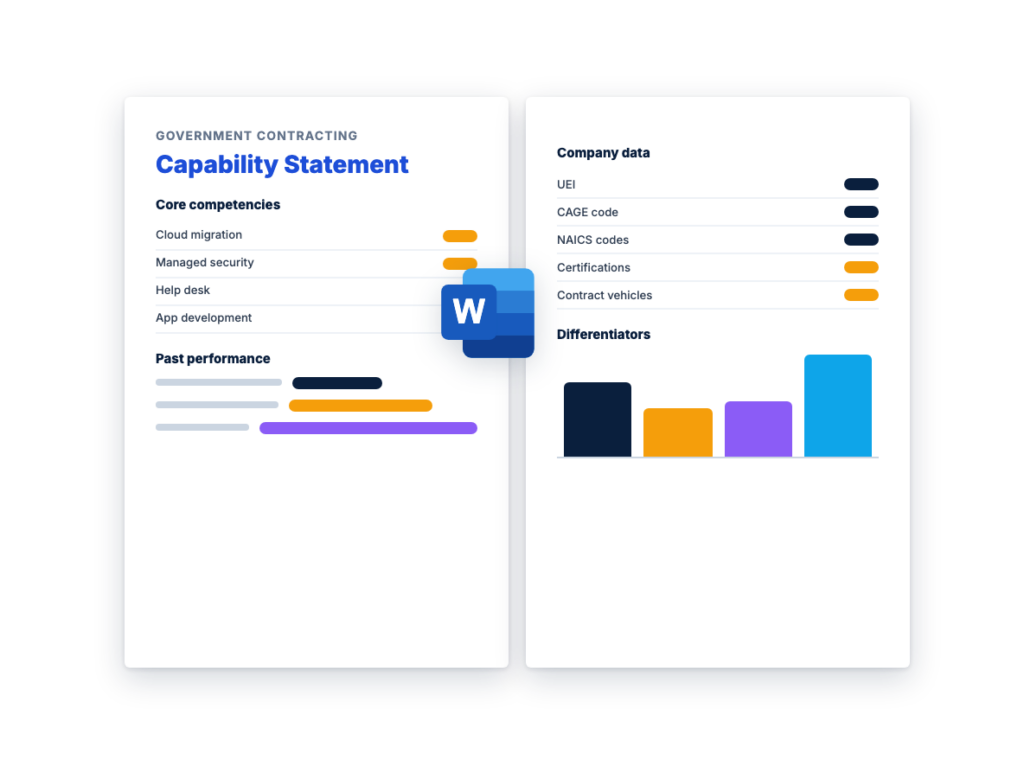
See the structure before you download. The Word file has every section listed below, ready to fill in.
The sections in the document, in order.
A capability statement is a one-page summary of your company for government buyers: what you do, the relevant work you've delivered, and the registration data an agency uses to look you up, such as your Unique Entity ID, CAGE code and NAICS codes. Use this capability statement template to build one for IT and cybersecurity work, then tailor a copy for each agency or opportunity you find on the federal IT RFP radar.
It's written for IT and security firms selling to federal, state and local government, from cloud migration and managed security to help desk and application development. You'll use it in sources sought responses, meetings with agency small business specialists, teaming conversations and industry days. When a sources sought notice asks questions, the sources sought response template covers the rest of the response.
The Word file has the capability statement itself, laid out in tables so it holds together as you edit it. After it come guidance for each block, a tailoring checklist, a worked example for a fictional IT and security firm, and a pre-send checklist. Delete everything after the statement before you save it as a PDF.
Download the editable Microsoft Word version below. The full text is on this page, so you can read it before you download.
Fill in Section 1 once as your master copy, then tailor a copy for each agency or opportunity. Sections 2 to 4 are guidance, a worked example and a checklist, so delete them from every copy you send.
A capability statement is what you hand over whenever someone in government contracting needs an accurate picture of your company on one page. Keep a master copy, and tailor one for each of these:
A contracting officer or a prime reads a capability statement quickly, so every line has to say something specific they can check. Some rewrites, using the worked example in the template:
This is the complete text of the Word document. Fill in the [bracketed] placeholders and delete the italic guidance before you use or send it.
Instructions: Section 1 is the capability statement. Replace
every [bracketed placeholder], delete any row or bullet that doesn’t
apply, and delete all italic guidance. Filled in, it should fit on one
page, two at most. Sections 2 to 4 are guidance, a worked example and a
pre-send checklist: delete them before you save the statement as a PDF.
Keep this as your master copy, and tailor a new copy for each agency or
opportunity.
| [Company logo] | [Company legal name, exactly as registered in SAM.gov] |
|---|---|
| [One-line positioning statement: the work you do and who you do it for] |
|
| [Prepared for [agency, or notice ID and title]], [month and year] |
Four to six services you can deliver now, the ones that match the
opportunity first.
The three projects closest to the work you’re pursuing, most
relevant first.
| Customer | Contract or order number | Scope | Period | Result |
|---|---|---|---|---|
| [Agency and office, or company. If you were a subcontractor, say so and name the prime.] |
[Contract or order number] | [What you delivered, in one line] | [Month and year to month and year] | [An outcome you can document] |
| [Customer] | [Contract or order number] | [Scope] | [Period] | [Result] |
| [Customer] | [Contract or order number] | [Scope] | [Period] | [Result] |
Copy each item exactly from your SAM.gov registration. Section
2.2 explains where each one comes from.
| Item | Details |
|---|---|
| Unique Entity ID (UEI) | [12-character UEI] |
| CAGE code | [CAGE code] |
| Primary NAICS code | [NAICS code and title] |
| Other NAICS codes | [NAICS codes and titles, the opportunity’s code first] |
| PSC codes | [Product and service codes for the work] |
| Size status | [Small business / Other than small] under [NAICS code] |
| Socioeconomic certifications | [SBA certifications held: 8(a), HUBZone, WOSB, EDWOSB, VOSB, SDVOSB, or None] |
| Contract vehicles held | [Vehicle, your contract number and, for a GSA schedule, your special item numbers, or None] |
| Government purchase card | [Accepted / Not accepted] |
| SAM.gov registration | [Active / In progress] |
| Address | [Physical address, as registered in SAM.gov] |
| Name and title | Phone | Website | |
|---|---|---|---|
| [Name, title] | [Email] | [Phone] | [Website] |
Delete Sections 2 to 4 from every copy you send.
| Block | What to write | Leave out |
|---|---|---|
| Header | Your legal name as SAM.gov shows it, with a trading name after it if you use one. One sentence on what you do and for whom, in the words agencies use for that work. Add the “prepared for” line when you tailor a copy. |
A slogan or mission statement that could describe any company |
| Core competencies | Four to six services, each specific enough that a contracting officer can match it to a requirement. Name what each one includes. |
Long lists, broad labels such as “IT solutions”, and skills you’d have to hire for |
| Past performance | Three projects, chosen for relevance: similar work, for a similar customer, at a similar size. Give the customer, the contract or order number, the scope, the period and a result. If you were a subcontractor, say so and name the prime if you’re allowed to. |
Results you can’t document, and customers who haven’t agreed to be named |
| Differentiators | Two to four facts that set you apart and that a buyer could check, such as a credential, how you staff the work, a delivery record or where the team is based. |
Claims every competitor also makes, such as “quality” or “customer focus” |
| Company data | The IDs and codes from your SAM.gov registration, copied exactly (Section 2.2). |
Codes that aren’t in your registration, and certifications you don’t hold yet |
| Point of contact | One named person who answers email and phone promptly and can talk about the work. |
A general inbox that nobody checks |
| Item | Where it comes from | What to check |
|---|---|---|
| UEI | SAM.gov assigns the Unique Entity ID, a 12-character code, when you register your entity, or when you request an ID without registering. It replaced the DUNS number. |
Copy it from your SAM.gov entity record. |
| CAGE code | A Commercial and Government Entity (CAGE) code identifies your company at a specific location. For US entities, the Defense Logistics Agency’s CAGE branch assigns it, and if you don’t have one, SAM.gov has one assigned after you submit your registration. |
It matches SAM.gov for the address on the statement. |
| NAICS codes | NAICS codes classify businesses by the products or services they supply. You list yours in your SAM.gov registration, usually with one primary code. The contracting officer designates a NAICS code for each contract, and notices usually show it. |
The opportunity’s code is listed first, if it fits your work and is in your registration. If it fits but isn’t registered, add it in SAM.gov first. |
| PSC codes | Product and service codes (PSCs) describe what the government buys. The PSC manual is on acquisition.gov. Adding PSCs to your SAM.gov registration is optional. |
The codes match the work you’re pursuing. A notice usually shows the code the agency chose. |
| Size status | SBA sets a size standard for each NAICS code, generally based on the number of employees or average annual receipts, and your affiliates count toward your size. So you can be small under one code and other than small under another. You state your size in your SAM.gov registration. |
Your size under the opportunity’s NAICS code. SBA’s size standards tool checks it. |
| Socioeconomic certifications | SBA certifies businesses for the 8(a) Business Development program, the HUBZone program and the Women-Owned Small Business (WOSB) Federal Contract program, which includes economically disadvantaged WOSBs (EDWOSB). Its Veteran Small Business Certification program certifies veteran-owned (VOSB) and service-disabled veteran-owned (SDVOSB) small businesses. Some contracts are set aside for certified firms. |
List a certification only once SBA has granted it, and keep it current. |
| Contract vehicles | Existing contracts that agencies can order from, such as a GSA Multiple Award Schedule contract, a governmentwide acquisition contract (GWAC) for IT, or a blanket purchase agreement (BPA). |
Each vehicle has your contract number. If you’re on it as a subcontractor, say so. |
| Government purchase card | Federal purchase cards are issued through GSA’s SmartPay program and used to buy supplies and services. GSA says a business that already accepts the major charge cards is set up to accept them. |
Say “Accepted” only if you can take card payments now. |
Your legal name, address, IDs and codes in Section 1 have to
match your SAM.gov registration, and SAM.gov registrations must be
renewed every 365 days to stay active.
Run this for each agency or opportunity, on a copy of your master
statement.
| Check | Done |
|---|---|
| You’ve read the notice, its attachments and any draft statement of work, and noted the agency’s own words for the work. |
|
| The positioning line names the work this agency or notice needs. |
|
| Core competencies are reordered so the matching ones come first. Cut the rest if space is short. |
|
| Past performance shows the three projects closest in scope, customer type and size. |
|
| The notice’s NAICS code is listed first, with your size status under it. |
|
| The notice’s PSC is included, if it fits your work. | |
| If the notice names a set-aside or asks about socioeconomic status, the matching certification is easy to find. |
|
| Contract vehicles the agency can order from are listed first. | |
| The “prepared for” line shows the agency, or the notice ID and title. |
|
| If the notice sets a page limit, format or file name, this copy follows it. |
A fictional company, for illustration only. The IDs, codes,
numbers and contact details are placeholders. Use your own, from your
SAM.gov registration.
| [Company logo] | Example IT Services LLC |
|---|---|
| Cloud migration, managed security and help desk services for government agencies |
|
| Prepared for [agency], [notice ID and title], [month and year] |
| Customer | Contract or order number | Scope | Period | Result |
|---|---|---|---|---|
| [Federal civilian agency office], as subcontractor to Example Prime Contractor Inc. |
[Subcontract number] under [prime contract number] | Moved [number] internal applications to a cloud environment | [Month and year] to [month and year] | Cutover on the agreed schedule with no unplanned outage. Written reference from the prime. |
| Example County Health Department | [Contract number] | Security monitoring, vulnerability management and incident response support |
[Month and year] to present | Every critical vulnerability closed within the contract’s deadline. Contract renewed. |
| Example State Revenue Agency | [Contract or order number] | Help desk for [number] staff, by phone, email and portal | [Month and year] to [month and year] | Met the contract’s response-time targets in every monthly report |
| Item | Details |
|---|---|
| Unique Entity ID (UEI) | [12-character UEI] |
| CAGE code | [CAGE code] |
| Primary NAICS code | [NAICS code] Computer Systems Design Services |
| Other NAICS codes | [NAICS code] Custom Computer Programming Services; [NAICS code] Computer Facilities Management Services |
| PSC codes | [PSC codes for the IT services offered] |
| Size status | Small business under [primary NAICS code] |
| Socioeconomic certifications | Service-disabled veteran-owned small business (SDVOSB), certified by SBA |
| Contract vehicles held | GSA Multiple Award Schedule, contract [contract number], special item numbers [SINs] |
| Government purchase card | Accepted |
| SAM.gov registration | Active |
| Address | [Street address], [city, state, ZIP code] |
| Name and title | Phone | Website | |
|---|---|---|---|
| [Name], Director of Government Programs | contracts@example.com | [Phone] | www.example.com |
| Check | Done |
|---|---|
| It fits on one page, two at most, at a readable font size. | |
| It’s saved as a PDF, and you’ve opened the PDF to check the tables, logo and links. |
|
| The file name says who it’s from and what it’s for, such as [Company]-Capability-Statement-[agency or notice ID].pdf, unless the notice sets a naming rule. |
|
| Legal name, UEI, CAGE code, address and NAICS codes match your SAM.gov registration, and the registration is active. |
|
| The opportunity’s NAICS code is listed, with your size status under it. |
|
| Certifications and contract vehicles are current, and none is listed before it’s granted or awarded. |
|
| Every claim can be backed up: each result has a record behind it, and each past performance customer has agreed to be named. |
|
| The point of contact’s email and phone work, and that person knows the statement is going out. |
|
| It holds no sensitive data, such as your taxpayer ID or bank details. |
|
| If it goes with a sources sought response, the notice’s instructions, page limit and deadline come first. |
A capability statement is a one-page summary a company gives government buyers and prime contractors: what it does, the relevant work it has delivered and the registration data needed to look it up, such as its UEI, CAGE code and NAICS codes. Companies send it with sources sought responses, leave it after meetings with agency small business specialists and share it in teaming conversations. It’s an introduction, so when a solicitation asks for a proposal, you still write the proposal.
A header with your company name, logo and a one-line positioning statement, then four to six core competencies, past performance, differentiators, company data and a point of contact. Company data means your UEI, CAGE code, primary and other NAICS codes, PSC codes, size status, SBA certifications, contract vehicles and whether you accept the government purchase card. This template lays them all out in tables that fit on one page.
One page, and two at most. A single page is quick to read and makes you keep only what matters for the opportunity in front of you. If a notice sets a page limit or format for responses, follow the notice.
Use your most relevant state and local government, commercial or subcontract work, and label each project so the reader knows what it is. Work your key staff did before they joined you can show capability, but present it as staff experience rather than company past performance. Keep to fewer, stronger examples, and check that each customer will confirm the work if contacted.
Keep one master version and tailor a copy for each agency or opportunity. Reorder your competencies and past performance to match the work, list the notice’s NAICS code first with your size status under it, and use the agency’s own terms. Your company data and contact details stay the same in every copy.
A free sources sought response template for IT and security firms answering federal market research notices, with a notice checklist, cover letter,…
A free, vendor-neutral software request form for IT intake, with the business need, an already-owned check, data and access, cost and renewal…
A free, vendor-neutral vendor risk assessment template for IT suppliers: inherent risk tiering, due diligence by tier, a risk register, contract controls,…
Please provide your feedback below.
"*" indicates required fields