Capability Statement Template (Free, Word)
A free, one-page capability statement template for IT and security firms selling to government, with company data, past performance, a tailoring checklist…
Word · FreeDownload Template →
A free, vendor-neutral requirements gathering template for buying software: a requirements register, a non-functional checklist and a traceability matrix that tracks each requirement to the contract.
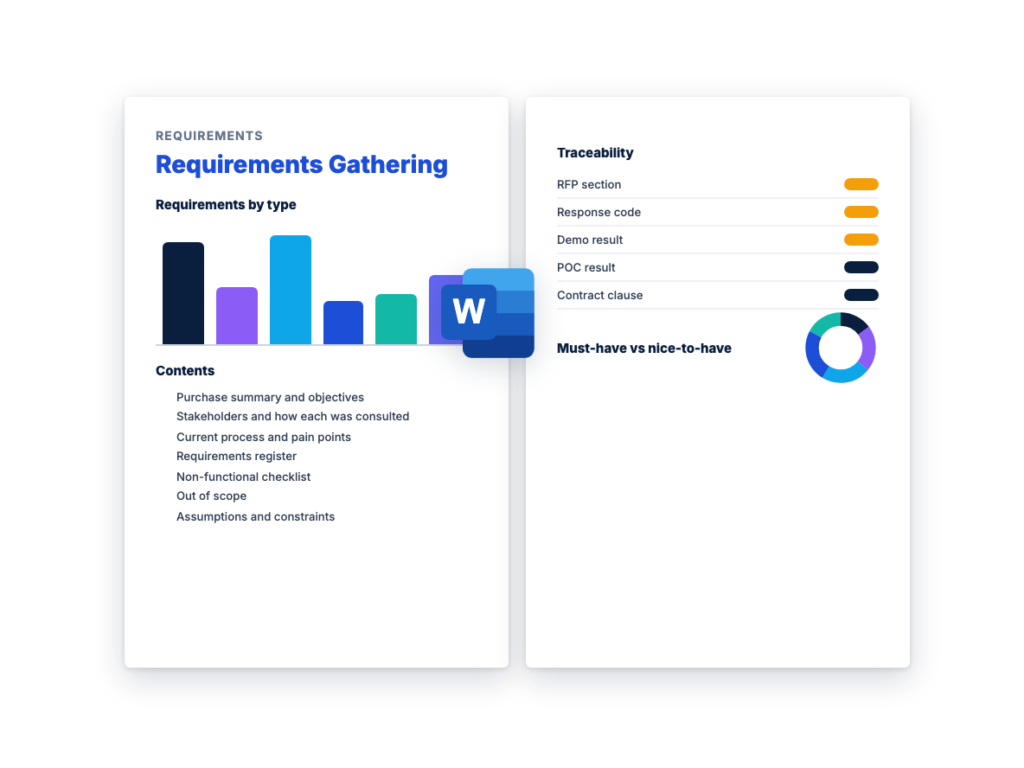
See the structure before you download. The Word file has every section listed below, ready to fill in.
The sections in the document, in order.
Use this requirements gathering template to collect, agree and write down what new software must do, and how well, before you write the RFP. It follows the requirements gathering guide: ask everyone the software will touch, record where each requirement came from, mark it Must-have or Nice-to-have, and decide how you'll check it.
It's written for teams buying software. Each requirement gets an ID with the same letters as the requirement sections of the free RFP template (F, T, I, S, M and C), so every row drops into the right RFP table and vendors answer it with a response code. The same IDs run through the requirements traceability matrix, from each finalist's response to the demo or proof of concept, the contract and acceptance testing.
The Word file is the buying team's internal working document, ready to use as it stands. Worked example rows from the guide's service desk example show how to fill in the register and the matrix: replace them with your own.
Download the editable Microsoft Word version below. The full text is on this page, so you can read it before you download.
Start the document as soon as the purchase has a sponsor, and finish Sections 1 to 8 before you write the RFP. Section 9, the traceability matrix, starts when proposals arrive and stays open until go-live.
A business requirements template, a requirements template and a requirements gathering template often cover overlapping ground, and the terms are used loosely. When you’re buying rather than building, write every requirement as an outcome a vendor can answer with a response code and you can verify, and let vendors propose how. How to Write an RFP shows where each kind sits in the finished RFP.
One common split, and where each kind goes in this template:
A requirements traceability matrix (RTM) links each requirement to everything that later addresses it. In software development that means items such as the design and the tests. In a purchase, the matrix follows each requirement through the RFP, the proposals, the demo or proof of concept, the contract and acceptance testing.
Fill it in as the purchase moves forward:
This is the complete text of the Word document. Fill in the [bracketed] placeholders and delete the italic guidance before you use or send it.
Buyer instructions: this is the buying team’s internal working
document. It is not sent to vendors. Replace every [bracketed
placeholder], replace the rows marked Example with your own, and delete
the italic guidance when you’re done. Finish Sections 1 to 8 and get
Section 10 signed before the RFP goes out. Section 9, the traceability
matrix, starts when proposals arrive and stays open until
go-live.
| Item | Details |
|---|---|
| Organization | [Organization name] |
| Purchase | [Type of software or service, e.g. a service desk tool for IT and HR support] |
| Executive sponsor | [Name, title] |
| Requirements owner | [Name, title: keeps this document and the change log] |
| Budget range and approval route | [Range for the whole contract term, and who approves it] |
| Current system and contract | [System being replaced, if any; contract end date and notice deadline] |
| Target dates | [RFP issued; contract signed; go-live] |
| Document version | [Version number and date] |
[A short paragraph in business terms: what’s broken today, who it
affects and what should change.]
These are the business requirements: why you’re buying. They
become the project objectives in the RFP, so vendors read them as
background. Make each one measurable where you can.
| Objective | How we’ll measure it | Today’s baseline | Owner |
|---|---|---|---|
| [Example: every new ticket reaches the right support group without manual triage] |
[Tickets reassigned after first routing, from service desk reports] |
[Current figure] | [Service desk lead] |
| [Objective] | [Measure] | [Baseline] | [Owner] |
| [Objective] | [Measure] | [Baseline] | [Owner] |
Ask everyone the software will touch, and use several methods,
since each finds things the others miss: interviews with each team
separately, workshops for processes that cross departments, process
walk-throughs, a review of tickets and complaints about the current
system, and documents such as policies and integration diagrams. Record
which requirements each group raised as you go.
| Group or role | Name | What they need from this purchase | How consulted | Date | Requirement IDs raised | Signs off? |
|---|---|---|---|---|---|---|
| Executive sponsor | [Name] | [Budget, objectives, settling conflicts between teams] | [Interview] | [Date] | [IDs] | Yes |
| Business owner | [Name] | [The work to be supported] | [Interview / workshop] | Yes | ||
| End users: [team or role] | [Names] | [Daily tasks, what goes wrong, workarounds] | [Interview / walk-through] | [Yes / No] | ||
| IT and architecture | [Name] | [Integrations, data migration, hosting] | [Workshop / document review] | Yes | ||
| Security | [Name] | [Security requirements, the vendor security review] | [Interview / document review] | Yes | ||
| Privacy | [Name] | [Personal data, where data is stored, retention] | [Document review] | [Yes / No] | ||
| Administrator or support team | [Name] | [What they’ll run and change after go-live] | [Interview / walk-through] | [Yes / No] | ||
| Finance | [Name] | [Budget, cost over the contract term, payment terms] | [Interview] | [Yes / No] | ||
| Legal | [Name] | [Contract terms, confidentiality, data protection terms] | [Document review] | [Yes / No] | ||
| Procurement | [Name] | [Sourcing route, purchasing policy, the RFP process] | [Interview] | Yes | ||
| [Other group] |
| Source | What it told us | Requirement IDs |
|---|---|---|
| Service desk tickets and enhancement requests about the current system |
[Summary] | [IDs] |
| Audit findings and incident reviews | ||
| Security standards and retention policies | ||
| Regulatory or contractual obligations | ||
| Integration diagrams | ||
| Current contract, including the notice period | ||
| [Other source] |
Walk through the work as it’s done today. Rekeying, side
spreadsheets and manual month-end steps show up here. Ask why each step
exists: a step that exists only for an old workaround shouldn’t become a
requirement that vendors build and price.
| Step | Who | Tool used today | Pain point or workaround | Why the step exists | Keep, change or drop | Requirement IDs |
|---|---|---|---|---|---|---|
| [Example: an agent reads each new ticket and assigns it to a support group] |
[Service desk agent] | [Current service desk tool] | [Assigned by hand; tickets sent to the wrong group wait in its queue] |
[No routing rules in the current tool] | [Change: route automatically] | [F1] |
| [Step] | ||||||
| [Step] | ||||||
| [Step] |
Vendors size their proposals from these figures, so gaps here
produce prices you can’t compare. They go into the scope and current
environment sections of the RFP.
| Item | Today | Expected by [end of contract term] | Source |
|---|---|---|---|
| Users by type | [e.g. agents, requesters, administrators] | [Current licenses / HR system] | |
| Sites, countries and languages | |||
| Transaction volumes | [e.g. tickets a month] | [Current system reports] | |
| Data to migrate | [Record types, volumes, years of history, attachments] | ||
| Systems to connect | [Each system and what it exchanges] | ||
| Identity provider and security tools | [Names] |
One row per requirement. Keep to one need per line, written as an
outcome a vendor can answer with a response code and you can check by a
demo, a proof of concept, a document or a contract term. Leave out
product names and one vendor’s feature terms, and let vendors propose
how.
Priority: a Must-have is pass or fail, so a vendor that can’t
meet it is out. A Nice-to-have earns points. Test each Must-have: would
you reject an otherwise strong vendor over it? If not, downgrade it. If
your team used MoSCoW, Musts become Must-haves, Shoulds and Coulds
become Nice-to-haves (Shoulds can carry more points), and Won’ts go to
Section 6.
IDs stay fixed from the first workshop to the contract. The
letters match the requirement sections of the free RFP template: F
functional, T technical and architecture, I integration, S security and
compliance, M implementation and support, C commercial and pricing.
Source or owner is who asked for the requirement and who will score the
answers. How it will be verified: scripted demo, proof of concept,
document, reference call or contract, or a combination. A row marked
proof of concept is a requirement a demo can’t prove.
Rows marked Example come from the service desk example in
RFPhub’s requirements gathering guide. Replace them with your own. In
the copy that goes into the RFP, drop the Source or owner column and add
columns for a response code and a comment.
| ID | Requirement | Type | Priority | Source or owner | How it will be verified |
|---|---|---|---|---|---|
| F1 (Example) | Route each new ticket to a support group based on its category and the requester’s site. |
Functional | Must-have | Service desk lead | Scripted demo |
| F2 (Example) | Warn the requester when a new change overlaps one already scheduled for the same service. |
Functional | Nice-to-have | Change manager | Scripted demo |
| F3 | [What the software must do, for whom, as one outcome] | [Functional] | [Must-have / Nice-to-have] | [Team or role] | [Method] |
| F4 |
| ID | Requirement | Type | Priority | Source or owner | How it will be verified |
|---|---|---|---|---|---|
| T1 (Example) | Store ticket data, attachments and backups only in [country or region]. |
Data residency | Must-have | Privacy lead | Document, then contract |
| T2 | [e.g. Return search results across [number] records within [seconds].] |
[Performance] | [Proof of concept] | ||
| T3 | [e.g. Support [future number] users and [future volume] without a change of edition.] |
[Scalability] |
| ID | Requirement | Type | Priority | Source or owner | How it will be verified |
|---|---|---|---|---|---|
| I1 (Example) | Turn monitoring alerts into tickets through a documented API, without duplicates. |
Integration | Must-have | Infrastructure team | Proof of concept |
| I2 | [e.g. Single sign-on through our identity provider [name].] | [Integration] | |||
| I3 |
| ID | Requirement | Type | Priority | Source or owner | How it will be verified |
|---|---|---|---|---|---|
| S1 (Example) | Only the HR support group can open HR case tickets. | Security | Must-have | Security team | Scripted demo |
| S2 | [e.g. Require multi-factor authentication through our identity provider for every [user type].] |
[Security] | |||
| S3 |
| ID | Requirement | Type | Priority | Source or owner | How it will be verified |
|---|---|---|---|---|---|
| M1 (Example) | A monthly availability commitment, with how it is measured and the service credit. |
Availability | Must-have | IT operations | Contract |
| M2 | [e.g. Name who delivers the implementation (the vendor, a partner or both) and the team’s experience with projects of similar size.] |
[Implementation] | |||
| M3 |
Commercial requirements usually come from finance, procurement
and legal: the license metric, one-time costs, renewal increases, the
term and exit.
| ID | Requirement | Type | Priority | Source or owner | How it will be verified |
|---|---|---|---|---|---|
| C1 | [e.g. Pricing by [license metric], showing list price, discount and net price, and exactly what counts toward the metric.] |
[Commercial] | [Finance] | [Pricing response, then contract] | |
| C2 | [e.g. Return of our data in a usable format at the end of the contract, and its deletion afterwards.] |
[Commercial: exit] | [Legal] | [Contract] | |
| C3 |
Users can describe what the software must do. Ask IT, security
and the people who will run it how well it must do it, and under what
conditions. Work through every area, write each answer as a requirement
in Section 4, and record its ID here. If an area doesn’t apply, say
why.
| Area | Prompts | Ask | Usual section | Requirement IDs |
|---|---|---|---|---|
| Security | Who may see and change which data? How do users sign in, and is multi-factor authentication required? What must be logged, and how long must records and logs be kept? Which policies, standards or regulations apply? What independent evidence will you ask vendors for? |
Security, privacy | S | [IDs] |
| Performance | Which tasks must be fast, at what volumes, and at peak times such as month-end? How will you measure it? |
Business owner, IT | T | |
| Availability | When is the software used, and in which time zones? What happens to the work during an outage? What availability commitment, measurement and service credit will you ask for? |
Business owner, IT operations | M | |
| Scalability | How many users, sites and records do you expect by the end of the contract term? Would growth force a change of edition or license tier? |
Sponsor, finance, IT | T | |
| Usability and accessibility | Who uses it, on which devices and in which languages? Which accessibility standard applies, such as [WCAG 2.2 Level AA or your organization’s standard]? |
End users, [accessibility lead] | F or S | |
| Integration | Which systems must exchange data with it, in which direction and how often? Which identity provider handles single sign-on? Who builds and maintains each connection? |
IT and architecture | I | |
| Data residency | Where may data, backups and support access be located? Which laws, contracts or customer commitments limit that? |
Privacy, legal | T | |
| Supportability | Who will administer it, and what must they be able to change without vendor services? How are updates released and tested? Which support hours and channels do you need? Can you export all your data in a usable format? |
Administrator or support team | T or M |
The “Won’t have this time” list: things the team has agreed
aren’t part of this purchase. State them in the RFP’s scope of work so
vendors don’t price them.
| Item | Why it’s out | Agreed by | Revisit |
|---|---|---|---|
| [Example: an IT asset management module] | [Covered by our current tool until [date]] | [Sponsor, IT lead] | [At renewal / in a later phase / not planned] |
| [Item] | |||
| [Item] |
An assumption is something you’re treating as true but haven’t
confirmed. A constraint is a limit you have to work within. Either can
change a requirement or a price, so give each one an owner.
| Assumption | Owner | How and when it will be confirmed | Requirement IDs affected |
|---|---|---|---|
| [Example: our identity provider can connect to the new tool without an upgrade] |
[IT lead] | [Check with the identity team by [date]] | [I2] |
| [Assumption] |
| Constraint | Type | Source | Effect on requirements |
|---|---|---|---|
| [Example: ticket data must stay in [country or region]] | [Regulation / contract] | [Privacy lead: [regulation or contract]] | [T1] |
| [Constraint] | [Budget / date / policy / regulation / technology / staffing] |
Log every question as it comes up. Some are settled inside the
team. Others are better put to the market in an RFI before the RFP, or
asked as a vendor question in the RFP itself.
| Question | Raised by | Owner | Needed by | Answer from | Answer and date | Requirement IDs affected |
|---|---|---|---|---|---|---|
| [Example: do HR case tickets need their own retention period?] | [HR lead] | [Privacy lead] | [Date] | [Internal / RFI / RFP vendor question] | [S1] | |
| [Question] | ||||||
| [Question] |
The matrix follows each requirement from the RFP to the contract
and acceptance testing, so you can see that none was dropped and that
what was proven made it into the contract. Track every Must-have and the
Nice-to-haves that carry real points. During evaluation, record a
response code for each finalist. After selection, keep the selected
vendor’s columns up to date through implementation.
Matrix owner: [Name, role]
Response codes, as used in RFPhub’s guides. If your RFP defines
different codes, use those instead.
| Code | What the vendor is saying |
|---|---|
| Standard | Works out of the box in the edition priced |
| Configuration | Met through settings, without code |
| Custom | Needs code or a custom integration |
| Third party | Needs a partner product or add-on |
| Roadmap | Not available yet |
| Not available | Can’t be met |
| ID | RFP section | [Finalist A] code | [Finalist B] code | [Finalist C] code | Demo or POC result | Contract reference | Acceptance test | Status |
|---|---|---|---|---|---|---|---|---|
| F2 (Example) | Functional | Standard | Configuration | Not available | Demo (A): needed a third-party add-on | Order form: add-on priced | [User acceptance test reference] | Rescored; open until acceptance |
| I1 (Example) | Integration | Configuration | Custom | Third party | POC (A): passed | Statement of work, acceptance criteria [reference] | [Test reference]: alerts create tickets without duplicates | Open until go-live |
| T1 (Example) | Technical | Standard | Standard | Standard | Document (A): hosting regions checked | Data processing agreement, clause [reference] | None: verified by document and contract | Closed |
| [ID] | [Section] | [Code] | [Code] | [Code] | [Method (finalist): result] | [Document and clause] | [Test reference] | [Status] |
| [ID] | ||||||||
| [ID] |
In the examples, Finalist A is the vendor selected. It answered
“standard” on F2, but the demo showed an add-on was needed, so the team
rescored the line under its advance rules and priced the add-on before
signature, not after go-live.
We confirm that the objectives in Section 1, the requirements and
priorities in Section 4 and the out-of-scope list in Section 6 are
agreed, and that every change from here on is recorded in Section
10.1.
| Name | Role | Sections reviewed | Signature | Date |
|---|---|---|---|---|
| [Name] | Executive sponsor | All | ||
| [Name] | Business owner | [Sections] | ||
| [Name] | IT and architecture | [Sections] | ||
| [Name] | Security and privacy | [Sections] | ||
| [Name] | Procurement | [Sections] | ||
| [Name] | [Finance / legal] | [Sections] |
Get sign-off before the RFP goes out. A requirement added after
the RFP is issued means an addendum to every vendor, a delay or a
re-issue.
| Version | Date | Change | Requirement IDs | Reason | Approved by |
|---|---|---|---|---|---|
| [Version] | [Date] | [Added / changed / reprioritized / dropped] | [IDs] | [Reason] | [Name] |
It’s a structured document for collecting, agreeing and recording what new software must do and how well, with who asked for each requirement and how it will be checked. For a software purchase it’s filled in before the RFP, because the requirements become the questions vendors answer and the lines you score. This one adds a traceability matrix that follows each requirement through to the contract.
At minimum: the problem and objectives, the stakeholders consulted, the current process and its pain points, and a register of requirements with an ID, type, priority, source and verification method. Add prompts for non-functional requirements, what’s out of scope, assumptions and constraints, open questions and sign-off. For a purchase, a traceability matrix keeps track of each requirement after the RFP goes out.
It’s a table that links each requirement to everything that later addresses it. In a software purchase, that means its RFP section, each finalist’s response code, the demo or proof of concept result, the contract reference and the acceptance test. It shows that no requirement was dropped and that what was proven made it into the contract.
Business requirements describe why the organization is buying and what has to change, such as an objective with a measure of success. Functional requirements describe what the software must do to get there, such as routing a ticket or producing a report. Non-functional requirements then say how well it must do it, such as security, performance and availability.
Not this document. It’s the buying team’s working record, with stakeholder notes, the budget range, assumptions and open questions. Vendors get the requirements themselves in the RFP, without the source or owner column and with columns for a response code and a comment.
A free, one-page capability statement template for IT and security firms selling to government, with company data, past performance, a tailoring checklist…
A free sources sought response template for IT and security firms answering federal market research notices, with a notice checklist, cover letter,…
A free, vendor-neutral software request form for IT intake, with the business need, an already-owned check, data and access, cost and renewal…
Please provide your feedback below.
"*" indicates required fields