Proof of Concept Template (Free, Word): Software POC Plan
A free, vendor-neutral POC template for testing finalists' software with your own data before you choose, with success criteria, test scenarios, data…
Word · FreeDownload Template →
A free, vendor-neutral RFP cover letter template for the one-page letter that goes on top of a proposal, with two filled-in examples and a short invitation letter for buyers sending an RFP.
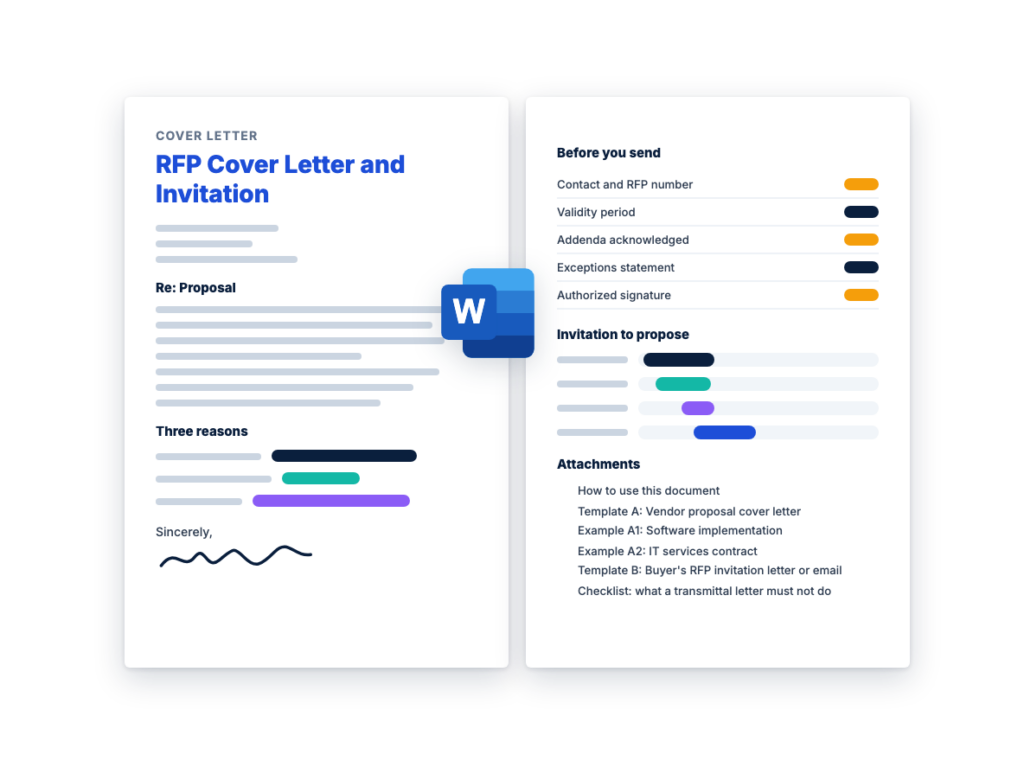
See the structure before you download. The Word file has every section listed below, ready to fill in.
The sections in the document, in order.
An RFP cover letter is the one-page letter a vendor puts on top of its proposal. It names the RFP, sums up the offer in two or three sentences, confirms the commitments the buyer asked for, such as how long the proposal stays valid, and carries the signature of someone who can commit the company. Some solicitations call it a transmittal letter.
Template A in the Word document is that letter, ready to fill in, followed by two short examples: one for a software implementation and one for an IT services contract. A checklist covers what the letter must not do, such as introduce new pricing or add terms. For the proposal itself, start from the free RFP response template.
Template B is for buyers: the letter or email that sends your RFP to vendors, with the key dates, the deadline to confirm intent to bid, how to ask questions, one point of contact and a list of attachments. If you're writing the RFP, Template A is useful too. Tell vendors what their cover letter must confirm, so every proposal opens with the same commitments.
Download the editable Microsoft Word version below. The full text is on this page, so you can read it before you download.
Template A is for vendors answering an RFP, and Template B is for buyers sending one. The first five steps follow Template A in the order you’d work through it. Step six covers Template B.
Start with the RFP. If its submission instructions say what the letter must contain or who must sign it, those instructions come first. Public-sector solicitations can be specific here. Some list the items a transmittal letter must cover, such as an acknowledgment of each addendum and the signature of someone authorized to bind the company, and some require a prescribed transmittal form or signed certifications instead of, or as well as, a letter. Requirements vary by agency and by solicitation, so follow the solicitation’s instructions and ask its named contact if anything is unclear.
Where the RFP leaves it to you, a complete cover letter includes the following, in this order. Everything else belongs in the proposal.
Both come first and both summarize, so they’re easy to mix up. The cover letter is a short, signed letter to the buyer’s contact that hands over the proposal and confirms your commitments. The executive summary is the first section of the proposal itself. It makes the case for your solution, and evaluators read it as part of your answer.
Keep them from repeating each other. If the RFP asks for an executive summary, put the detail there and hold the letter’s summary to two or three sentences. If it doesn’t ask for one, the letter still shouldn’t try to do that job. For the structure of the proposal itself, start from the free RFP response template.
Cover letters tend to be written last, under deadline pressure, which is when these mistakes creep in.
This is the complete text of the Word document. Fill in the [bracketed] placeholders and delete the italic guidance before you send it.
This document has two templates, two filled-in examples and a
checklist. Template A (Section 2) is the cover letter a vendor puts on
top of its proposal. Sections 3 and 4 show it filled in for a software
implementation and an IT services contract. Template B (Section 5) is
for buyers: the letter or email that invites vendors to respond to an
RFP. Section 6 is the checklist to run before any cover letter is
signed.
Replace every [bracketed placeholder], delete any sentence that
doesn’t apply, and delete all italic guidance before you send.
Read the RFP’s submission instructions first. If the RFP says
what the cover letter or transmittal letter must contain, who must sign
it, or whether it counts toward a page limit, follow the RFP over this
template. Some public-sector solicitations list what the transmittal
letter must say, such as an acknowledgment of each addendum, and some
require a prescribed transmittal form or signed certifications instead
of, or as well as, a letter. Requirements vary by agency and by
solicitation, so ask the RFP’s named contact if anything is
unclear.
Length: one page. Write the letter last, once the proposal is
final, so every date, figure, name and commitment in it matches the
proposal. If it runs over a page, shorten the summary and the three
reasons. Keep the commitments, the contact details and the
signature.
[Your company letterhead: logo, legal name, street address, phone,
website]
[Date of submission]
[Buyer contact’s full name, as named in the RFP’s submission
instructions]
[Title]
[Buyer organization’s legal name]
[Street address]
[City, state or region, postal code]
Re: Proposal for [RFP title], RFP no. [number]
Dear [Title and last name of the buyer contact]:
Opening: name the RFP and say what you’re submitting.
[Vendor legal name] submits the enclosed proposal in response to
[buyer organization]’s [RFP title], RFP no. [number][, issued (date)].
Our proposal is in [number] parts: [e.g. a technical proposal, a price
proposal and the required forms], submitted [through your procurement
portal / by email to (address) / in (number) hard copies] as the RFP
instructs.
Summary: two or three sentences. Restate the buyer’s goals in the
RFP’s own words, then say what you propose and how it meets them. Leave
the detail to the executive summary in your proposal.
Your RFP asks for [the buyer’s main goal, in the RFP’s words] and [a
second goal or constraint, e.g. a go-live date or a budget limit]. We
propose [the solution: product, services and delivery model], which [how
it meets the first goal] and [how it meets the second]. [Optional third
sentence: the timeline or approach, and the proposal section that covers
it.]
Why us: three reasons that matter for this RFP. Make each one a
fact the evaluators can check, and point to the section of the proposal
that proves it. Leave out claims any bidder could make, such as “trusted
partner” or “committed to quality”.
Three points set our proposal apart:
Commitments: keep the statements the RFP asks for and use its
wording where you can. The validity period must be at least as long as
the RFP requires.
This proposal remains valid for [90] days after the proposal due
date[, as Section (x) of the RFP requires]. We acknowledge receipt of
Addenda [numbers, or delete this sentence if none were issued]. Our
proposal complies with the RFP’s requirements and accepts its terms and
conditions[, except as stated below]. I am authorized to commit [vendor
legal name] to this proposal.
Exceptions: keep one option and delete the other. Never raise an
exception for the first time in this letter. List every exception in the
section of the proposal the RFP specifies, and use the letter only to
point to it.
[Option 1] We take no exceptions to the RFP’s requirements or to its
terms and conditions.
[Option 2] We take exception to [number] items, each listed with our
proposed alternative in Section [x] of our proposal. Our proposal
contains no other exceptions.
Point of contact: one person who can answer questions about the
proposal quickly. It doesn’t have to be the person who signs.
Our point of contact is [contact name], [title]: [email],
[phone].
[Optional closing sentence, e.g. We would welcome the chance to show
(the solution) at the finalist demonstrations in (month).]
Signature: someone authorized to commit the company to the
proposal, its prices and its terms. If the RFP asks for evidence of
signing authority, enclose it.
Sincerely,
[Signature]
[Signatory’s full name]
[Title]
[Vendor legal name]
[Email], [phone]
Enclosures: [List what you’re submitting, e.g. Technical proposal;
Price proposal; Required forms]
A filled-in example of Template A for a CRM software and
implementation RFP. The companies, people and details are
fictional.
[Example CRM Partners LLC letterhead]
November 13, 2026
[Dana Whitfield]
Procurement Manager
[Example Manufacturing Co.]
[Street address, city, state, postal code]
Re: Proposal for CRM Software and Implementation, RFP no.
[EMC-2026-07]
Dear Ms. [Whitfield]:
[Example CRM Partners LLC] submits the enclosed proposal in response
to your RFP for CRM Software and Implementation. The technical proposal,
price proposal and signed Appendix C forms are uploaded to your supplier
portal.
Your RFP asks for one CRM system for sales and customer service,
connected to your ERP system and live before April 1, 2027. We propose a
cloud CRM for 85 users with a fixed-fee implementation, including the
ERP integration and data migration, and go-live on March 15, 2027
(Section 5). Three points set our proposal apart:
This proposal remains valid for 120 days after the proposal due date,
as Section 2.6 of the RFP requires. We acknowledge receipt of Addenda 1
and 2. Our proposal complies with the RFP’s requirements and accepts its
terms and conditions, except for two items listed with our proposed
alternatives in Section 9: the limitation of liability clause and the
data return period after termination. Our proposal contains no other
exceptions. I am authorized to commit [Example CRM Partners LLC] to this
proposal.
Our point of contact is [Sam Okafor], Proposal Manager: [sam.okafor@example.com],
[phone].
Sincerely,
[Signature]
[Jordan Ellis]
Chief Operating Officer
[Example CRM Partners LLC]
Enclosures: Technical proposal; Price proposal; Appendix C signed
forms
A filled-in example of Template A for a managed IT services RFP
from a public body. The organizations, people and details are fictional.
If a public-sector RFP prescribes its own transmittal form, use that
form as the RFP instructs.
[Sample Managed IT Services, Inc. letterhead]
February 2, 2027
[Chris Moreno]
Procurement Officer
[Sample County] Purchasing Division
[Street address, city, state, postal code]
Re: Proposal for Managed IT Services, RFP no.
[SC-27-004]
Dear Mr. [Moreno]:
[Sample Managed IT Services, Inc.] submits the enclosed proposal in
response to the County’s RFP for Managed IT Services, in three volumes
(technical, price and required forms) as Section 3 of the RFP
specifies.
The County wants one provider for its service desk, endpoint
management and network monitoring, with measurable service levels and a
handover completed before its current contract ends on June 30, 2027. We
propose a managed service covering all three from our [city] service
center, measured against the Appendix D service levels, with a
transition that runs alongside your current provider until cutover.
Three points set our proposal apart:
This proposal remains valid for 180 days after the proposal due date,
as Section 3.4 of the RFP requires. We acknowledge receipt of Addenda 1,
2 and 3. Our proposal complies with the RFP’s requirements and accepts
its terms and conditions without exception. The signed forms required by
Section 3.7 are in Volume 3. I am authorized to commit [Sample Managed
IT Services, Inc.] to this proposal.
Our point of contact is [Alex Rivera], Bid Manager: [alex.rivera@example.com],
[phone].
Sincerely,
[Signature]
[Morgan Lee]
President
[Sample Managed IT Services, Inc.]
Enclosures: Volume 1, Technical; Volume 2, Price; Volume 3, Required
forms
For buyers. Send this to each vendor on your shortlist when you
issue the RFP, as an email with the RFP attached or linked, or as a
letter on letterhead if your policy calls for one. Send the same
invitation to every vendor on the same day. If your rules require you to
advertise the RFP publicly, use your procurement office’s format for the
public notice.
Subject: Invitation to propose: [RFP title], RFP no.
[number], proposals due [date]
Dear [Vendor contact name]:
[Organization legal name] invites [vendor company name] to submit a
proposal for [what you’re buying, in one sentence, e.g. a cloud CRM
system and its implementation for about (number) users in sales and
customer service]. [Optional: We’re inviting you based on (reason, e.g.
your response to our RFI in (month)).]
The RFP and its attachments are [attached / available at (portal
link)]. Please read the submission instructions in Section [x] of the
RFP before you start.
Key dates
All times are [time zone]. RFPhub’s RFP process guide uses three
to four weeks as an example response window for a mid-sized software
RFP. Allow more if you want detailed implementation plans.
| Step | Date |
|---|---|
| RFP issued | [Date] |
| Tell us whether you intend to bid | [Date] |
| Written questions due | [Date and time] |
| Answers sent to all invited vendors | [Date] |
| Proposals due | [Date and time] |
| Finalist demonstrations (expected) | [Dates] |
| Expected award | [Month] |
Confirming your intent to bid
Please reply to this email by [date] to tell us whether you intend to
submit a proposal. If you decide not to bid, a short reason would help
us. Answers to questions and any addenda will go to every invited
vendor.
Questions
Send all questions in writing to [email] by [date and time], quoting
the RFP section each question refers to. We’ll answer them in a single
document sent to every invited vendor, without saying who asked.
[Optional: We’ll hold a bidders’ call on (date and time). Anything said
on the call will be confirmed in writing.] If an answer changes the RFP,
we’ll issue it as a numbered addendum.
Point of contact
[Name], [title], is the only point of contact for this RFP from today
until we announce the award. Please send every question and message
about the RFP to [email], and don’t discuss it with other [organization]
staff while the RFP is open.
Attachments
List every file by its exact name, so vendors can confirm they
have the full set.
This invitation doesn’t commit [organization] to award a contract.
The terms that apply to the RFP are in Section [x] of the RFP.
Have your legal or procurement team check the paragraph above
against the RFP’s own terms.
Thank you. We look forward to your response.
[Name]
[Title]
[Organization]
[Email], [phone]
Run this check on any cover letter or transmittal letter before
it’s signed. The letter introduces the proposal. It must not change
it.
| The letter must not | Why |
|---|---|
| Introduce new pricing, discounts or price conditions | Prices belong in the price proposal, in the format the RFP asks for. A price that appears only in the letter can conflict with the price proposal and leave the buyer unsure which one you mean. |
| Contradict the proposal | Dates, figures, team names, scope and the validity period must match the proposal exactly. If evaluators find two versions, they have to ask which one you stand behind, and some may score the discrepancy against you. |
| Add terms, conditions or assumptions | A line such as “subject to our standard terms” or “assuming the project starts by (date)” may be read as qualifying your whole proposal. Put every exception and assumption in the section the RFP specifies. |
| Raise an exception for the first time | The exceptions statement only points to exceptions already listed in the proposal. |
| Promise anything the proposal doesn’t contain | Free training, extra users or a faster go-live that appear only in the letter are new scope or new pricing. Add them to the proposal or leave them out. |
| Replace a required form | If the RFP prescribes a transmittal form, a certification or a signature page, submit it as instructed. A letter doesn’t stand in for it. |
| Mention or criticize competitors | It takes attention away from your own proposal, and any claim you make about a competitor is one you may have to back up. |
Before you send
| Check | Done |
|---|---|
| The buyer contact’s name and title, the organization’s legal name, and the RFP title and number are correct |
|
| No name, figure or detail is left over from another bid | |
| The validity period is at least as long as the RFP requires | |
| Every addendum issued is acknowledged | |
| The exceptions statement matches the exceptions section of the proposal |
|
| The point of contact’s email and phone are correct and monitored |
|
| The signatory is authorized to commit the company, and the letter is signed |
|
| The letter fits on one page, or within any limit the RFP sets | |
| The enclosures list matches what you’re submitting |
It’s the short letter that goes on top of a vendor’s proposal, addressed to the contact named in the RFP. It identifies the RFP, summarizes the offer, confirms commitments such as the validity period and acceptance of the RFP’s terms, names a point of contact and carries an authorized signature. It introduces the proposal and shouldn’t change anything in it.
One page, unless the RFP says otherwise. If the RFP sets a page limit, check whether the cover letter counts toward it. If the letter runs long, shorten the summary and the reasons to choose you, and keep the commitments, contact details and signature.
In RFP responses, the two names are often used for the same document. Where a solicitation asks for a transmittal letter, read its instructions for what the letter must contain. Public-sector RFPs in particular may list required items, such as an acknowledgment of each addendum and the signature of someone authorized to bind the company, or may prescribe a transmittal form.
Someone with authority to commit your company to the proposal, its prices and its terms, such as an officer or a person with delegated signing authority. If the RFP says who must sign, or asks for evidence of signing authority, follow it. The point of contact named in the letter doesn’t have to be the person who signs it.
Send each shortlisted vendor the same invitation on the same day, with the RFP attached or linked. Say what you’re buying, list the key dates, ask vendors to confirm by a set date whether they’ll bid, explain how to submit written questions, and name one point of contact. Template B in the download covers all of these.
A free, vendor-neutral POC template for testing finalists' software with your own data before you choose, with success criteria, test scenarios, data…
A free, vendor-neutral RFP response template for suppliers answering a request for proposal, with an executive summary outline, a requirements compliance matrix,…
A free, vendor-neutral scorecard template for rating an existing supplier's performance every quarter, with KPIs and targets, a defined 1-to-5 scale, weights,…
Please provide your feedback below.
"*" indicates required fields