Capability Statement Template (Free, Word)
A free, one-page capability statement template for IT and security firms selling to government, with company data, past performance, a tailoring checklist…
Word · FreeDownload Template →
A free sources sought response template for IT and security firms answering federal market research notices, with a notice checklist, cover letter, capability table and pre-submit checklist.
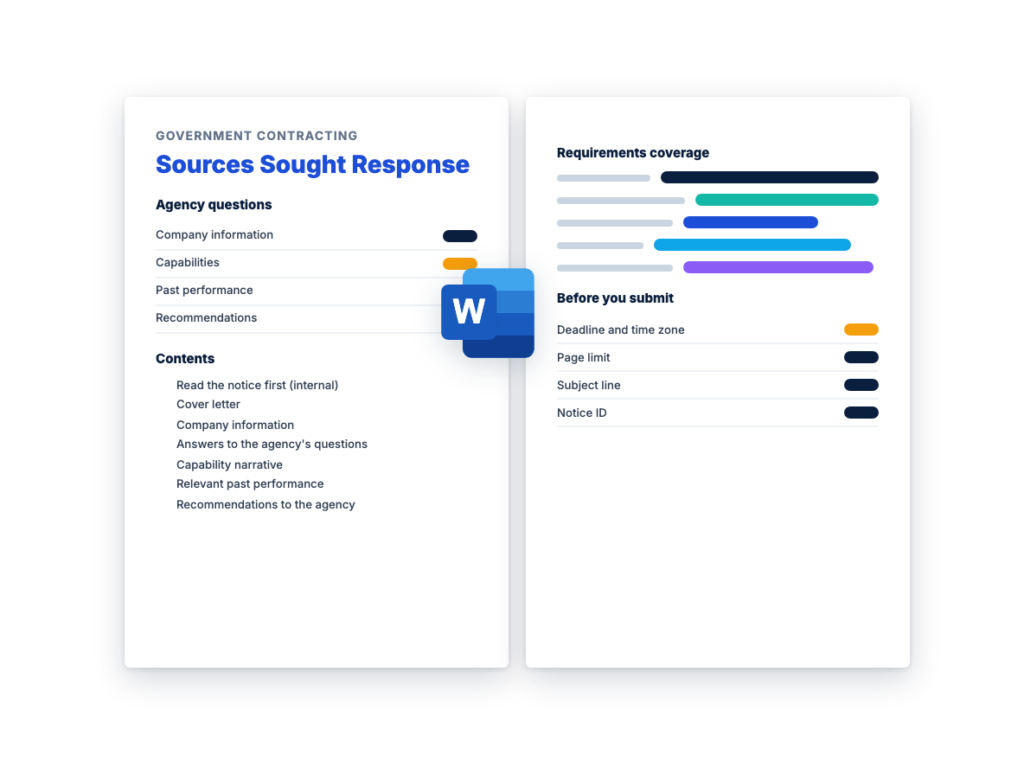
See the structure before you download. The Word file has every section listed below, ready to fill in.
The sections in the document, in order.
A sources sought notice is market research. A federal agency describes work it expects to buy, sometimes with a draft statement of work, and asks which businesses could do it before it decides how to buy. It isn't a solicitation: no contract is awarded from it, and your response isn't an offer. Sources sought notices are often the most common notice type on RFPhub's list of open federal IT and cybersecurity RFPs.
Answering one matters more than it looks. Contracting officers use the responses to decide whether to set the contract aside for small businesses, which in general happens when the contracting officer expects offers from at least two small businesses at fair market prices. If capable small businesses don't respond, the set-aside can be lost and the work may be opened to every business, large or small. A response also lets you comment on the draft requirements and puts your company in front of the agency before the solicitation is written.
This Word template is a complete response for IT and security firms, from cloud migration and managed security services to help desk and application development. It answers the agency's questions in its own order and maps your capabilities to each requirement in the draft work statement. The notice checklist, the pre-submit checklist and the after-you-submit plan stay with your team. Keep your company data the same as in your capability statement, and attach that too if the notice allows it.
Download the editable Microsoft Word version below. The full text is on this page, so you can read it before you download.
Work through Section 1 before you write anything, and follow the notice wherever it differs from this template. Send Sections 2 to 9, and keep Sections 1, 10 and 11 for your team.
On SAM.gov, one requirement can pass through all three: an RFI or a sources sought notice while the agency researches the market, then an RFP when it’s ready to buy. RFP vs RFQ vs RFI explains the RFI and the RFP from the buyer’s side. For a federal IT or security firm, the differences are these:
This is the complete text of the Word document. Fill in the [bracketed] placeholders and delete the italic guidance before you use or send it.
Instructions: replace every [bracketed placeholder], delete
anything that doesn’t apply, and delete all italic guidance before you
send. Sections 1, 10 and 11 are for your team, so delete them from the
copy you send. Sections 2 to 9 are the response. Wherever the notice
asks for a different order, format or set of sections, follow the
notice, not this template.
Fill this in from the notice on SAM.gov and every attachment
before anyone starts writing.
| Item | What the notice says | Where in the notice |
|---|---|---|
| Notice ID and title | [Notice ID]; [title, exactly as posted] | |
| Agency and office | [Agency, office, location] | |
| Contracting officer or specialist named | [Name, title, email] | |
| Response deadline and time zone | [Date, time, time zone] | |
| How to submit | [Email address / portal / other method] | |
| Email subject line format | [The exact format the notice gives] | |
| File format and file name rules | [PDF or Word; naming rules] | |
| Page limit, and what counts toward it | [Pages; whether the cover letter and attachments count] | |
| Font, size and margin rules | [Rules] | |
| Questions the agency asks | [How many, and how they’re numbered] | |
| Draft statement of work (SOW) or performance work statement (PWS) |
[Attachment name and date, or none] | |
| NAICS code and size standard | [NAICS code; size standard as stated] | |
| Product or service code (PSC), if given | [PSC] | |
| Set-aside the agency is considering | [Total small business / 8(a) / HUBZone / WOSB or EDWOSB / SDVOSB / Not stated] |
|
| Company information requested | [UEI, CAGE code, size, certifications, contract vehicles, other] |
|
| Pricing information requested | [None / rough estimate / price list / other] | |
| Rules for questions and contact | [Who to ask, how and by when] | |
| How to mark proprietary information | [Instructions, or none given] | |
| Amendments checked on SAM.gov | [Amendment numbers and dates] |
The agency uses the responses to judge which firms could do the
work and how many would compete. Answer the notices you could actually
bid on.
| Question | Answer |
|---|---|
| Does the work fit what we do, alone or with a partner we can name? |
☐ Yes ☐ No |
| Would we consider bidding if a solicitation follows? | ☐ Yes ☐ No |
| Can we show relevant past performance, government or commercial? |
☐ Yes ☐ No |
| Are we small under the notice’s NAICS code? | ☐ Yes ☐ No |
| Can we meet the deadline with a response we’d be glad for the contracting officer to read? |
☐ Yes ☐ No |
| Decision | ☐ Respond ☐ Pass. Reason: [reason] |
| Response owner, internal review date and send date | [Name]; [date]; [date, ahead of the deadline] |
Address the letter to the contracting officer or specialist named
in the notice, quote the notice ID and title exactly, and keep it to one
page. If the page limit counts the cover letter, shorten it, or leave it
out if the notice allows.
| Item | Details |
|---|---|
| Response to | Sources Sought Notice [notice ID]: [notice title] |
| Agency | [Agency and office] |
| Submitted by | [Company legal name], UEI [12-character UEI] |
| Date | [Date] |
[Company letterhead]
[Date]
[Name]
[Contracting Officer / Contract Specialist]
[Agency and office]
[Email address from the notice]
Subject: [The subject line in the format the notice requires, or:
Response to Sources Sought Notice [notice ID], [notice title]]
Dear [Name]:
[Company name] submits this response to Sources Sought Notice [notice
ID], [notice title], posted on SAM.gov on [date]. We are a [small /
other than small] business under NAICS code [code], the code in the
notice[, and SBA has certified us as a [8(a) / HUBZone / WOSB / EDWOSB /
SDVOSB / VOSB] business].
We can perform [all of the requirement / these parts of the
requirement: [SOW or PWS sections]] in the [draft SOW / draft PWS] dated
[date]. [For [part of the work], we would team with [partner name], a
[size and status] business.] Section 5 maps our capabilities to each
requirement, and Section 6 describes [two / three] similar contracts,
including [one line on the most relevant project].
[We intend to submit an offer if the agency issues a solicitation for
this requirement.] [Section 7 sets out our recommendations on [the NAICS
code / the set-aside / other topic].]
This response is market research information, not an offer. [We have
marked proprietary information as the notice instructs.] Our point of
contact for this notice is [name, title, email, phone].
Sincerely,
[Name]
[Title]
[Company name]
Copy every entry exactly as it appears in your SAM.gov
registration, so the contracting officer can match your response to your
registration. Use the same data as your capability statement.
| Item | Details |
|---|---|
| Legal business name, as registered in SAM.gov | [Legal name] |
| Doing business as (DBA), if any | [DBA name] |
| Physical address | [Street, city, state, ZIP code] |
| Website | [Web address] |
| Unique Entity ID (UEI) | [12-character UEI] |
| CAGE code | [CAGE code] |
| SAM.gov registration | [Active, expires [date] / In progress / Not registered] |
| Primary NAICS code | [NAICS code and title] |
| Other NAICS codes | [NAICS codes and titles] |
| Size status under the notice’s NAICS code | [Small / Other than small] under NAICS [code], size standard [the size standard SBA sets for that code] |
| SBA certifications | [8(a) / HUBZone / WOSB / EDWOSB / SDVOSB / VOSB / None], certified [date] |
| PSC codes | [Product and service codes] |
| Contract vehicles held | [Vehicle name, contract number and expiration date / None] |
| Government purchase card accepted | [Yes / No] |
| Security and quality credentials the notice asks about | [For example, a FedRAMP authorization for a cloud service, CMMC status for defense work, or an ISO/IEC 27001 certificate, each with its scope and date] |
| Facility security clearance, if the work needs one | [Level / None] |
Notes on the entries:
Use the agency’s numbering and order. Copy each question word for
word, answer it in the first sentence, then give the evidence. If you
can’t do something a question asks about, say so. Replace or delete the
example rows.
| No. | Agency’s question, copied exactly | Our answer | See also |
|---|---|---|---|
| [1] | [Question] | [Direct answer, then evidence] | [Section and row] |
| [2] | [Question] | ||
| [3] | [Question] | ||
| Example | [Describe your experience providing [managed security services] to federal agencies.] |
[Example IT Services LLC has provided [security monitoring and incident response] to [customer] since 2026 under [contract number], covering [scope].] |
[Section 6, project 1] |
| Example | [Is this service commercially available, and if so, through which contract vehicles?] |
[Yes. We sell [service] commercially to [type of customer], and through [vehicle and contract number].] |
[Section 7] |
| Example | [State your business size and socioeconomic status under NAICS [code].] |
[Small under NAICS [code]; SBA-certified [program] since [date].] |
[Section 3] |
[Three to five sentences: what your company does, for whom, and why
that matches this requirement. Name the work, the customers and the
results, and leave out general claims.]
Example: Example IT Services LLC runs [service desk, endpoint
management and security monitoring] for [type of customer]. Under
[contract number], it supports [number] users at [customer] and has
[result, such as the service level achieved]. The requirements in the
draft PWS match that work in [sections].
Work through the draft SOW or PWS section by section, one
requirement per row, using its own section numbers. If the contract may
be set aside, SBA’s limitations on subcontracting can require a small
business prime to perform a minimum share of the work itself, so make
clear who would do what. Replace the example rows with the real
requirements.
| Ref | SOW or PWS section | Requirement, in short | How we meet it | Performed by | Past performance (Section 6) |
|---|---|---|---|---|---|
| R-1 | [PWS section] | [Example: tier 1 and tier 2 help desk support for [number] users] |
[Staffing, process, tools and the service levels you would meet, with evidence] |
[Us / Partner name] | [Project 1] |
| R-2 | [PWS section] | [Example: security monitoring and incident response] | |||
| R-3 | [PWS section] | [Example: migration of [number] applications to [cloud environment]] |
|||
| R-4 | [PWS section] | [Example: application development and maintenance] | |||
| R-5 | [Section] | [Requirement] |
[Requirements you can’t meet yet or would meet through a partner, and
any assumptions you made about the scope, such as the number of users or
sites.]
Choose two or three projects closest to this requirement in
scope, size and type of customer. If you have little federal work, use
state, local or commercial projects, and say which they are. Ask each
reference before you list them.
| Item | Project 1 | Project 2 | Project 3 |
|---|---|---|---|
| Customer | [Agency and office, or company] | ||
| Contract or order number | [Number] | ||
| Role | [Prime / Subcontractor to [prime]] | ||
| Period of performance | [Start date to end date, or ongoing] | ||
| Value, only if the notice asks | [Value] | ||
| Scope | [Work performed; users, sites or systems supported] | ||
| Relevance to this requirement | [Rows in Section 5.2, such as R-1 and R-2] | ||
| Results | [Measured outcomes, such as service levels met or migrations completed] |
||
| Reference | [Name, title, email, phone] |
Include this section only where the notice invites comments or
questions on the requirement. Give a reason and an alternative for each
point. Useful comments let more qualified firms compete, lower the risk
of the work, or match how the market sells the service.
| Topic | Our recommendation | Reason |
|---|---|---|
| NAICS code | [The notice’s NAICS code fits / NAICS [code] fits better] | [What the work mainly is] |
| Set-aside | [For example, a [total small business / 8(a) / HUBZone / WOSB / SDVOSB] set-aside] |
[Why small businesses can do this work, and your own interest in bidding] |
| Contract type | [For example, firm-fixed-price for defined tasks, with [another type] for less predictable work] |
[How the risk and predictability of the work fit that type] |
| Requirements that limit competition | [A requirement such as a brand name, a certification, an experience minimum or a start date] |
[Why it narrows the field, and an alternative that still meets the need] |
| Commercial availability | [Whether the service or product is sold commercially, and on which existing contract vehicles] |
[Evidence, such as commercial customers or a vehicle that already offers it] |
| Other | [Period of performance, transition, security requirements, data rights or anything else] |
[Reason] |
Delete this section if you would do all the work yourself, and
list only partners who have agreed to be named. Joint ventures,
including those formed under SBA’s Mentor-Protégé program, follow SBA
rules of their own, so check them before you rely on one.
| Partner | UEI | Size and SBA certifications | Role, with SOW or PWS sections | Relationship | Status |
|---|---|---|---|---|---|
| [Partner legal name] | [12-character UEI] | [Small / Other than small; certifications] | [Work, and rows in Section 5.2] | [Subcontractor / Joint venture / Mentor-protégé joint venture] | [Teaming agreement signed / Planned] |
| [Partner legal name] |
| Item | Primary contact | Alternate contact |
|---|---|---|
| Name | [Name] | [Name] |
| Title | [Title] | [Title] |
| [Email] | [Email] | |
| Phone | [Phone] | [Phone] |
| Mailing address | [Address] | [Address] |
Delete Sections 10 and 11 before you send the response.
| Check | Done |
|---|---|
| The response will arrive before the deadline, in the notice’s time zone, by the method the notice names |
☐ |
| The email subject line, file format and file name follow the notice exactly. File name: [Company]_[Notice ID]_Sources_Sought_Response |
☐ |
| The page limit, font and margin rules are met, counting everything the notice counts |
☐ |
| Every question is answered, in the agency’s order and numbering | ☐ |
| The notice ID and title are correct in the cover letter, the header table and the file name |
☐ |
| Legal name, UEI, CAGE code, NAICS codes and certifications match your SAM.gov registration |
☐ |
| Size status is stated under the notice’s NAICS code | ☐ |
| Every SBA certification listed is current | ☐ |
| Every reference has agreed to be contacted, and their details are current |
☐ |
| Every teaming partner has agreed to be named | ☐ |
| Proprietary information is marked as the notice instructs, and nothing confidential to another customer is included |
☐ |
| Pricing appears only where the notice asks for it | ☐ |
| SAM.gov has been checked for amendments, and the response answers the latest version |
☐ |
| Every claim can be backed up with evidence if the agency asks | ☐ |
| Someone who didn’t write the response has read it against the notice |
☐ |
It’s a federal agency’s market research: the agency describes work it expects to buy and asks which businesses could do it. Agencies use the responses to find capable firms, especially small businesses, and to decide how to buy, including whether to set the contract aside. It isn’t a solicitation, so no contract is awarded from it and a response isn’t an offer.
No, it’s your choice. But it’s the stage where your company can still influence how the work is bought. If capable small businesses don’t respond, the agency may not set the contract aside, and you lose the chance to comment on the draft requirements before the solicitation is written.
No. A response is market research information, not an offer, so the agency can’t accept it to form a contract. If a solicitation follows, you decide then whether to bid, and you respond to the solicitation in full. Say honestly whether you expect to bid, because the agency uses the responses to judge how many capable firms would compete.
Federal rules require an active SAM.gov registration, with some exceptions, when you submit an offer or quotation, and a sources sought response is neither. Read the notice, though: it may ask for your UEI, CAGE code or other registration details, and you can get a UEI without a full registration by giving your legal business name and physical address. If you’d bid on the solicitation, start registering now, because you’ll need an active registration when you submit an offer.
As long as the notice allows and no longer. Follow its page limit, font and file rules exactly, because agencies are told to ask only for the information they need. If the notice sets no limit, answer every question directly, keep it short enough that the reader finds your size status, capabilities and past performance quickly, and cut anything the agency didn’t ask for.
A free, one-page capability statement template for IT and security firms selling to government, with company data, past performance, a tailoring checklist…
A free, vendor-neutral vendor risk assessment template for IT suppliers: inherent risk tiering, due diligence by tier, a risk register, contract controls,…
A free, vendor-neutral software request form for IT intake, with the business need, an already-owned check, data and access, cost and renewal…
Please provide your feedback below.
"*" indicates required fields