Capability Statement Template (Free, Word)
A free, one-page capability statement template for IT and security firms selling to government, with company data, past performance, a tailoring checklist…
Word · FreeDownload Template →
A free, vendor-neutral security questionnaire for software and SaaS vendors, tiered by risk, with an evidence checklist, questions in eight sections, a findings log, contract terms and sign-off.
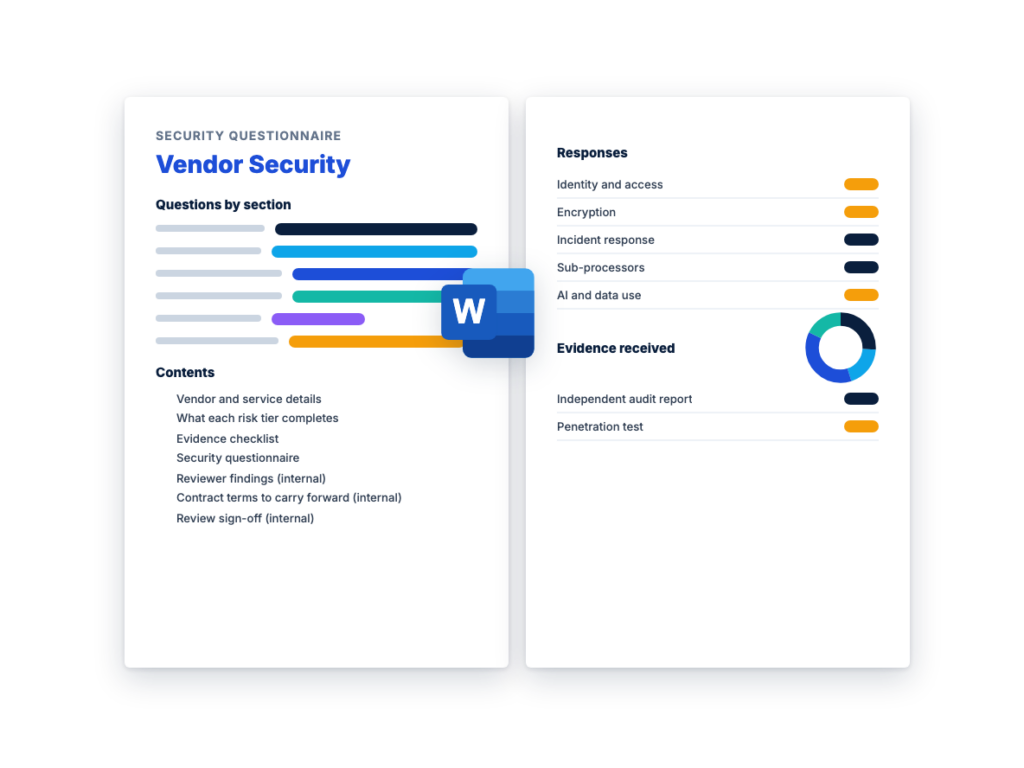
See the structure before you download. The Word file has every section listed below, ready to fill in.
The sections in the document, in order.
Use this vendor security questionnaire when a supplier will hold your data or connect to your systems, and you need to know whether it can protect them. It follows the vendor security assessment guide: tier the vendor by risk, ask for independent evidence first, use the questions for the gaps, then record what you found and what happens next. Some teams call it a vendor risk assessment questionnaire or a third-party risk assessment questionnaire.
It's written for whoever reviews vendor security, such as a security lead, an IT manager or a third-party risk team, working with procurement and the business owner who will use the service. Send it before the contract, while findings can still change the deal, and again at renewal or after a significant change at the vendor. If you're buying through an RFP, put a short list of security Must-haves in the RFP, such as those in the free RFP template, and send this questionnaire to your two or three finalists.
The Word file is a complete questionnaire you can use as it stands. Sections 1 to 4 go to the vendor: the service and its scope, which questions and evidence each risk tier provides, the evidence checklist and the questions themselves. Sections 5 to 7 stay with your review team: findings and red flags, the contract terms to carry forward, and sign-off.
Download the editable Microsoft Word version below. The full text is on this page, so you can read it before you download.
Fill in Section 1 and set the tier in Section 2 before you send anything. Send Sections 1 to 4 to the vendor, and keep Sections 5 to 7 for your review team.
A question a vendor can answer with “yes” usually gets a “yes”. Ask how a control works, when it was last tested and who is accountable for it, and say which answers need evidence.
Some rewrites, using questions from this template:
This is the complete text of the Word document. Fill in the [bracketed] placeholders and delete the italic guidance before you use or send it.
Buyer instructions: replace every [bracketed placeholder], delete
anything that doesn’t apply, and delete all italic guidance before you
send this questionnaire. Fill in Section 1 and set the tier in Section 2
first. Sections 1 to 4 go to the vendor, and your reviewer completes the
checks in Sections 3.2 to 3.4 when the evidence arrives. Sections 5 to 7
are for your review team, so delete them from the vendor’s
copy.
| Item | Details |
|---|---|
| Buyer | [Organization legal name] |
| Vendor | [Vendor legal name] |
| Service assessed | [Product or service, edition and modules] |
| Business owner | [Name, title, email] |
| Security reviewer | [Name, title, email] |
| Vendor security contact | [Name, title, email] |
| Related RFP or contract | [RFP or contract number, or new purchase] |
| Reason for this assessment | [New vendor / Renewal / Significant change at the vendor / Incident] |
| Risk tier (Section 2) | [High / Medium / Low] |
| Sent on / Return by | [Date] / [Date] |
Complete this before you send the questionnaire, and ask the
vendor to correct anything that’s wrong. The answers set the tier in
Section 2.
| Scope question | Answer |
|---|---|
| Data the vendor will store, process or see | [For example: customer records, employee data, financial data, internal documents] |
| Personal or regulated data | [None / Personal data: categories / Regulated data: type] |
| Access to our systems | [None / User accounts / Administrator rights / API or integration access / Software installed on our devices or servers] |
| Systems it will connect to | [Identity provider, ERP, CRM, others] |
| How critical the service is | [What stops, and for whom, if it’s unavailable] |
| How hard it would be to replace | [Easy / Needs a planned migration / Very hard] |
| AI features we expect to use | [None / Names of features] |
| Out of scope | [Other products or services from this vendor] |
In this questionnaire, “we” and “our” mean [Organization name], and
“you” means [Vendor name].
The tiers below are an example to adjust to your policy. Choose
the highest tier any answer in Section 1.1 points to, or use the tier
from your vendor risk assessment, and re-tier if the vendor’s data or
access changes. Apply the same rules to every vendor, including SaaS
bought on a credit card. Before sending, delete what the tier doesn’t
need.
| Example tier | What puts a vendor here | Questions to answer (Section 4) | Evidence to provide (Section 3) |
|---|---|---|---|
| High | Sensitive or regulated data, privileged access, or a service we can’t run without, such as payroll or our identity provider |
All questions | E-1 or E-2, plus E-3, E-5 and E-6 |
| Medium | Internal business data, or a connection to some of our systems | The first three questions in each part of Section 4 | E-1 or E-2, plus E-5 if the vendor will process personal data |
| Low | No sensitive data, no access to our systems, and easy to replace |
IA-1, DP-1, DP-3 and LI-2 only | None required |
If you know the product has no AI features, keep only AI-1 and
AI-2 from Section 4.8, so the vendor’s answer is on record.
Ask for independent evidence first, use Section 4 for the gaps,
and read what you get. A SOC 3 report is a general-use version without
the system description or the auditor’s tests and results, so it can’t
stand in for E-1.
| ID | Evidence | Required for | Provided | What the reviewer checks |
|---|---|---|---|---|
| E-1 | SOC 2 Type II report covering the service | High and Medium: E-1 or E-2 | Section 3.2 | |
| E-2 | ISO/IEC 27001 certificate and statement of applicability | High and Medium: E-1 or E-2 | Section 3.3 | |
| E-3 | Penetration test summary or letter from an independent tester | High | The date, what was tested, and whether serious findings were fixed and retested |
|
| E-4 | Policies for security, incident response, business continuity and secure development |
Where a question asks for one | An owner and a recent review date on each | |
| E-5 | Data processing agreement | High; Medium if personal data is involved | Reviewed by [privacy or legal] | |
| E-6 | Sub-processor list | High | Each company that processes our data for the vendor, what it does and where |
Use of a SOC 2 report is restricted, so the vendor may ask for a
nondisclosure agreement first. If the vendor has neither E-1 nor E-2 and
no plan to get one, record a finding, and decide in advance what other
evidence, if any, you will accept.
A Type I report covers the design of controls at a point in time.
A Type II report also covers whether they operated effectively
throughout a period, with the auditor’s tests and results, so ask for
Type II.
| Check | What to look for | Result and notes |
|---|---|---|
| Report type and issuer | A Type II report from an independent CPA firm, under AICPA standards |
[Type; CPA firm] |
| Scope | The system description covers the service in Section 1. Note which trust services categories are included: security, availability, processing integrity, confidentiality, privacy. |
[Covered / Partly / Not covered; categories] |
| Period | When it ended. If long ago, ask when the next report is due. | [Dates; next report due] |
| Exceptions | Read the test results, not only the opinion, for controls that didn’t work as described. Ask what the vendor did about each. |
[Exceptions, responses, finding numbers] |
| Subservice organizations | Whether the report includes each one’s controls (the inclusive method) or excludes them (the carve-out method). For a carved-out provider, get evidence about it too. |
[Name, method, evidence received] |
| Complementary user entity controls | Controls the vendor’s design assumes we will run | [Listed in Section 3.4] |
ISO/IEC 27001 sets requirements for an information security
management system (ISMS). ISO doesn’t certify organizations: an
independent certification body audits the ISMS and issues a certificate
with a defined scope.
| Check | What to look for | Result and notes |
|---|---|---|
| Scope | Includes the service in Section 1 and the teams and locations that run it |
[Covered / Partly / Not covered] |
| Validity | The certificate’s dates. Confirm with the certification body that it’s current. |
[Dates; how confirmed] |
| Issuer | The certification body, and whether a national accreditation body has accredited it |
[Certification body; accreditation body] |
| Statement of applicability | The controls the organization decided it needs, why, whether each is implemented, and why it excluded any reference controls in Annex A. Excluded or unimplemented controls are ones we can’t count on. |
[Controls that matter here and are excluded or not implemented; finding numbers] |
Give each complementary user entity control from the SOC 2 report
an owner on your side.
| Complementary user entity control | Our owner | How we will carry it out |
|---|---|---|
| [Example: removing users’ access when our staff leave] | [IT service desk] | [Deprovisioning through our identity provider] |
| [Control] | [Owner] | [How] |
In the Evidence requested column, an E number means attach that
document from Section 3 or point to the page and section that answers
the question. Leave the Reviewer notes column blank.
| ID | Question | Evidence requested | Vendor response | Reviewer notes |
|---|---|---|---|---|
| GP-1 | Who is accountable for information security, and who do they report to? |
Name or role | ||
| GP-2 | When were your security policies last reviewed and approved, and by whom? |
E-4 | ||
| GP-3 | Do staff with access to customer data get security training and, where the law allows, background checks? |
Written answer | ||
| GP-4 | Which independent reports or certifications cover the service in Section 1, and what scope and period does each cover? |
E-1 or E-2 | ||
| GP-5 | How do you assess and treat risks to your own information security, and when did you last do it? |
Written answer | ||
| GP-6 | Have you had a security incident affecting customer data in [period]? If so, what happened and what did you change? |
Written answer |
| ID | Question | Evidence requested | Vendor response | Reviewer notes |
|---|---|---|---|---|
| IA-1 | Can we enforce single sign-on through our identity provider (SAML or OIDC) and provision users through SCIM? If single sign-on isn’t available, can we require multi-factor authentication for every user? Is either limited to a higher edition or an extra fee? |
Product documentation | ||
| IA-2 | Do all your staff who can reach production systems use multi-factor authentication? |
E-1 or E-2 | ||
| IA-3 | How is privileged access to production systems and customer data granted, reviewed and removed? |
E-4 or E-1 | ||
| IA-4 | When someone leaves your company or changes role, how quickly is their access removed? |
E-1 or E-2 | ||
| IA-5 | Can your support staff see our data? If so, how is that access approved, limited and logged? |
Written answer | ||
| IA-6 | How are the API keys, tokens and service accounts that connect to our systems scoped, rotated and revoked? |
Product documentation |
| ID | Question | Evidence requested | Vendor response | Reviewer notes |
|---|---|---|---|---|
| DP-1 | Where are our data and backups stored, and can we choose the region? Name the countries. |
Hosting description; E-6 | ||
| DP-2 | How is our data encrypted in transit and at rest, and who manages the keys? Can we manage our own keys? |
Written answer or E-1 | ||
| DP-3 | How do we export our data, and in what format? How will you confirm its deletion at exit, including from backups? |
Product documentation; proposed contract wording | ||
| DP-4 | How is our data kept separate from other customers’ data? | Architecture description | ||
| DP-5 | What data do you collect about our use of the service, such as usage data and logs, and what do you use it for? |
E-5; privacy notice | ||
| DP-6 | Is our data ever copied into test or development environments? If so, how is it protected or masked? |
Written answer |
| ID | Question | Evidence requested | Vendor response | Reviewer notes |
|---|---|---|---|---|
| AS-1 | How do you check your code and open-source components for vulnerabilities before release? |
E-4 (secure development) | ||
| AS-2 | What are your target times to fix vulnerabilities, by severity, and how do you track whether you meet them? |
Vulnerability management procedure | ||
| AS-3 | Do you publish a vulnerability disclosure policy? Where? | Link to the policy | ||
| AS-4 | When did an independent tester last test the service, what was in scope, and were serious findings fixed and retested? |
E-3 | ||
| AS-5 | How are changes to production reviewed, approved and tested before release? |
E-1 or E-2 | ||
| AS-6 | How do you protect your source code, build systems and software updates from tampering? For any software we install, such as an agent, can you provide a software bill of materials (SBOM)? |
Written answer; SBOM if available |
| ID | Question | Evidence requested | Vendor response | Reviewer notes |
|---|---|---|---|---|
| LI-1 | Which security events do you log, for how long, and can we get the logs for our account? |
Product documentation | ||
| LI-2 | How soon after confirming an incident affecting our data will you tell us, and what will you include? Will you put that time in the contract? |
E-4 (incident response); proposed contract wording | ||
| LI-3 | When did you last test your incident response plan, and how? | Date and type of test | ||
| LI-4 | Can we send the audit log of user and administrator actions to our own security monitoring tools? |
Product documentation | ||
| LI-5 | How do you monitor the service for attacks and suspicious activity, and who responds outside business hours? |
Written answer | ||
| LI-6 | How do we report a suspected incident to you, and who will be our contact during one? |
Contact details |
| ID | Question | Evidence requested | Vendor response | Reviewer notes |
|---|---|---|---|---|
| BC-1 | When did you last test restoring the service from backup, and what did the test show? |
Date and summary of the test | ||
| BC-2 | What are your recovery time and recovery point objectives, and will you put them in the contract? |
E-4 (business continuity) | ||
| BC-3 | What happens if your hosting provider’s region fails? | Architecture description | ||
| BC-4 | How often are backups taken, where are they kept, and how are they protected from deletion or tampering? |
Written answer | ||
| BC-5 | What availability do you commit to, how is it measured, and where do you publish service status? |
Service-level agreement | ||
| BC-6 | When did you last test your business continuity plan, and did the test include losing a key supplier? |
Date and type of test |
| ID | Question | Evidence requested | Vendor response | Reviewer notes |
|---|---|---|---|---|
| SP-1 | Which sub-processors handle our data, for what, and in which countries? |
E-6 | ||
| SP-2 | How do you assess your own critical suppliers’ security? | Supplier security procedure | ||
| SP-3 | How much notice will you give before adding a sub-processor, and can we object or leave? |
E-5; proposed contract wording | ||
| SP-4 | Which hosting provider runs the service? Does your SOC 2 report include it or carve it out? |
E-1 | ||
| SP-5 | Do you pass your security and data protection terms down to sub-processors, and what evidence do you get from them? |
Written answer | ||
| SP-6 | Do contractors or outsourced teams have access to our data or production systems? Where are they based? |
Written answer |
| ID | Question | Evidence requested | Vendor response | Reviewer notes |
|---|---|---|---|---|
| AI-1 | Which features use AI, and can our administrators switch them off? |
Product documentation | ||
| AI-2 | Are our data, prompts or outputs used to train models that serve other customers, and can we opt out? |
Contract or terms wording | ||
| AI-3 | Which outside model providers process our data, and how long are prompts and outputs kept? |
E-6 | ||
| AI-4 | Are new AI features switched on by default, and how will you tell us before adding one that uses our data? |
Written answer | ||
| AI-5 | Can an AI feature show a user data that the user couldn’t open directly? |
Product documentation | ||
| AI-6 | Can an AI feature take actions, such as sending messages or changing records? If so, what approvals and logs apply? |
Product documentation |
[Vendor legal name] confirms that its answers in Section 4 and its
documents under Section 3 are accurate and complete as of the date
below, and will tell [Organization name] in writing of any significant
change that affects them, such as a new hosting provider or
sub-processor, a change of ownership, or a new AI feature that uses
customer data.
| Name | Title | Signature | Date |
|---|---|---|---|
| [Name] | [Title] |
Internal: delete Sections 5 to 7 from the vendor’s copy. Check
each answer against the evidence, record each gap as a finding, rate it
by the harm it could do, and decide the action.
| No. | Finding | Source | Rating | Action | Owner | Due date |
|---|---|---|---|---|---|---|
| 1 | [Example: incident notification promised “promptly”, with no defined time] |
LI-2 | [High] | [Fix before signing: a defined time in the contract] | [Procurement lead] | [Date] |
| 2 | [Example: hosting provider carved out of the SOC 2 report, with no other evidence] |
E-1, SP-4 | [Medium] | [Fix before signing: evidence about the hosting provider] | [Security reviewer] | [Date] |
| 3 | [Finding] | [Question or evidence ID] | [High / Medium / Low] | [Action] | [Owner] | [Date] |
Example ratings, to adjust to your policy. High: could expose
sensitive data, give someone unauthorized access to our systems, or stop
a service we can’t run without. Medium: weakens a control, but other
controls limit the harm. Low: a minor gap, or missing documentation for
a control that otherwise appears to work.
Actions:
Ask the vendor about each one that applies, and record the
answer.
| Red flag | Present? | Vendor’s explanation and finding number |
|---|---|---|
| No independent report or certificate, and no plan to get one | [Yes / No] | |
| A report or certificate whose scope leaves out the service we’re buying |
[Yes / No] | |
| Unexplained SOC 2 exceptions, or an old report period with no newer report due |
[Yes / No] | |
| Refusal to name sub-processors | [Yes / No] | |
| Vague incident notification, such as “promptly”, with no defined time |
[Yes / No] | |
| Answers that contradict the report, or “yes” to everything with no evidence |
[Yes / No] | |
| No clear answer on whether our data trains models for other customers |
[Yes / No] |
If you’re running an RFP, put these terms in it so bidders price
and accept them before award. Have counsel review the wording.
| Term | Source | What the contract should say | Clause |
|---|---|---|---|
| Incident notification | LI-2 | Notice within [time] of the vendor confirming an incident affecting our data, what it contains, and how the vendor will cooperate |
[Clause] |
| Sub-processor changes | SP-3 | [Period] of notice before a new sub-processor handles our data, and a right to object or leave |
[Clause] |
| Independent reports | GP-4 | A current report or certificate covering the service for the whole term, and copies of new ones as they’re issued |
[Clause] |
| Data location | DP-1 | Our data and backups stay in [countries or regions] | [Clause] |
| Data return and deletion | DP-3 | Our data returned in [format] within [period] after the contract ends, then deleted, including backups, with written confirmation |
[Clause] |
| Recovery and availability | BC-2, BC-5 | The recovery objectives stated in BC-2; availability, how it’s measured and the credits for a miss |
[Clause] |
| AI and data use | AI-2 | Our data, prompts and outputs aren’t used to train models that serve other customers |
[Clause] |
| Audit rights | GP-4 | Our right to receive audit reports, ask follow-up questions and, where it matters, assess the vendor |
[Clause] |
| Dated fixes | Section 5 | Each “Fix by a contract date” finding, and its date | [Clause] |
| Item | Details |
|---|---|
| Tier confirmed | [High / Medium / Low] |
| Evidence reviewed | [E numbers, with report periods or certificate dates] |
| Recommendation | [Approve / Approve with conditions / Reject] |
| Conditions | [Finding numbers, with what must be done and by when] |
| Risks accepted | [Finding numbers and review date] |
| Next reassessment | [Date, from the interval our policy sets for this tier] |
| Reassess earlier if | Renewal, a significant change at the vendor, or an incident at the vendor or one of its suppliers |
| Name | Role | Decision or comment | Signature | Date |
|---|---|---|---|---|
| [Name] | Security reviewer | |||
| [Name] | Business owner, accepting any risks marked “Accept the risk” | |||
| [Name] | Procurement | |||
| [Name] | [Privacy or legal, if personal data is involved] |
Keep this questionnaire, the evidence and this sign-off with the
vendor’s record.
It’s a set of questions a buyer sends a supplier to find out how it protects the buyer’s data and access to the buyer’s systems. It covers what independent evidence, such as a SOC 2 report or ISO/IEC 27001 certificate, doesn’t, and asks for proof behind the answers that matter. Some teams call it a vendor risk assessment questionnaire or a third-party risk assessment questionnaire.
Questions on governance and policies, identity and access, data protection and encryption, application security and vulnerability management, logging and incident response, business continuity, and the vendor’s sub-processors and own suppliers. Add AI features and data use where the product has them. This template has six questions in each of those eight sections, each with the evidence to request.
A SOC 2 Type II report is strong evidence, but not enough on its own. Check that its scope covers the service you’re buying, that the period is recent, and what the exceptions and the controls left to you mean. Then use the questionnaire for what the report may not answer, such as where your data is stored, the incident notification time the vendor will commit to, and how AI features use your data.
Match the length to the vendor’s risk. In this template’s example tiers, a low-risk vendor answers four questions, a medium-risk vendor answers the first three in each section and provides an independent report or certificate, and a high-risk vendor answers every question and provides the full evidence set. Sending the full set to every vendor gets volume instead of evidence and leaves your team too little time to review it.
Answer each question directly, say how the control works, and point to the page or section of the SOC 2 report or other evidence that supports it. Where a control isn’t in place, say so and give a date if one is planned. This template lists answers that contradict the evidence, or a yes to everything with no evidence, as red flags for the reviewer.
A free, one-page capability statement template for IT and security firms selling to government, with company data, past performance, a tailoring checklist…
A free sources sought response template for IT and security firms answering federal market research notices, with a notice checklist, cover letter,…
A free, vendor-neutral vendor risk assessment template for IT suppliers: inherent risk tiering, due diligence by tier, a risk register, contract controls,…
Please provide your feedback below.
"*" indicates required fields