Information Security Policy Template for IT (Free, Word)
A free, editable information security policy for small and mid-sized organizations, with data classification, access and password rules, AI tool use and…
Word · FreeDownload Template →
A free, vendor-neutral SLA template for IT services, managed services and SaaS, with availability targets, a downtime conversion table, a severity matrix, service credits and chronic failure terms.
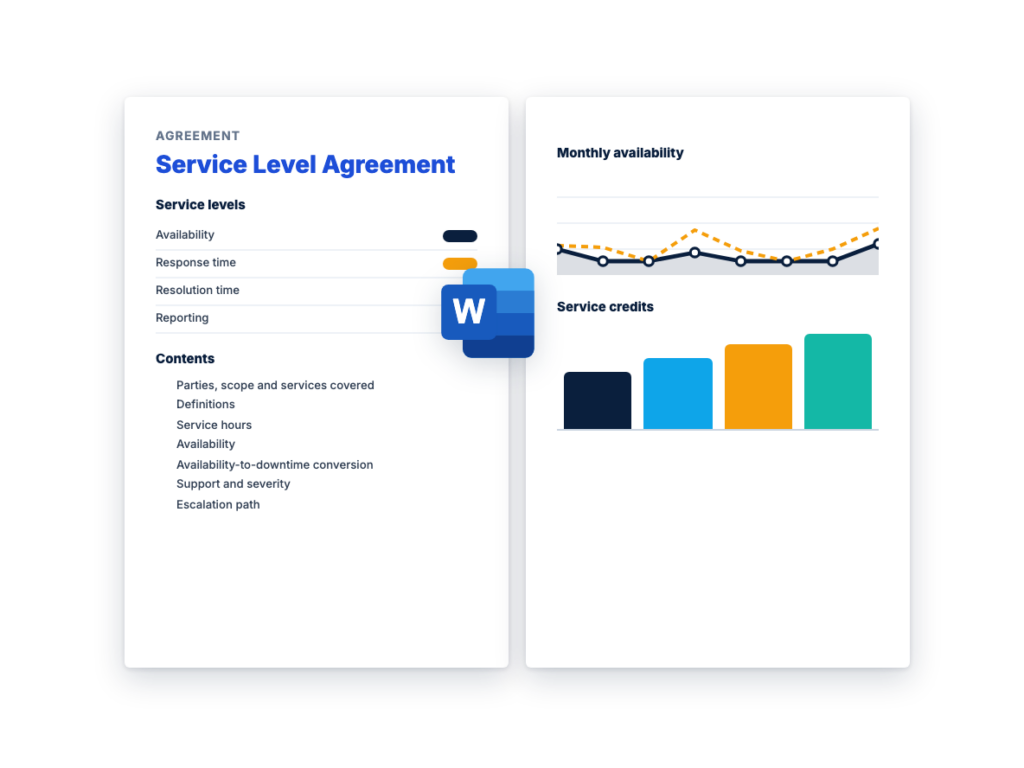
See the structure before you download. The Word file has every section listed below, ready to fill in.
The sections in the document, in order.
Use this service level agreement template to set the service levels for an IT service, a managed service or a SaaS subscription: availability, support response and resolution times, reporting, service credits and the right to leave after repeated failures. Fill it in and send it to the supplier, or attach it to an RFP and ask each supplier to propose its targets in the same format, so the commitments can be compared side by side. It sits under the main contract as a schedule, next to any statement of work for project work such as implementation.
Every target, time and percent is a [placeholder], because the right level depends on the service and on what an outage costs you. The Word file includes an availability-to-downtime conversion table, so you can see what a percentage allows in minutes before you agree to it. It isn't legal advice: legal counsel reviews the completed SLA, with the agreement it sits under, before it's signed. Clauses such as whether credits are your only remedy and the right to terminate are flagged for counsel.
Before signature, check the SLA against the service level rows of the free contract review checklist: how availability is measured, what's excluded, how credits are claimed, support response times and repeated failures. If the supplier offers its own standard SLA instead, run the same checks on that document.
Download the editable Microsoft Word version below. The full text is on this page, so you can read it before you download.
Fill in Sections 1 to 4 with the service owner, using the conversion table in Section 5, then Sections 6 to 11 on support, reporting, credits, chronic failure and security notification. Agree Sections 12 and 13 with the supplier, and delete the italic guidance and the internal checks in Section 14 before you send it.
An SLA is only as useful as what it measures and what happens when a target is missed. A high availability percentage can still allow a long outage at your busiest hour if it’s measured over a year, on a component your users never see, with broad exclusions. Before you agree to a target, check these points:
This is the complete text of the Word document. Fill in the [bracketed] placeholders and delete the italic guidance before you use or send it.
Drafting instructions: use this SLA as a schedule to the main
contract for an IT service, a managed service or a SaaS subscription.
Send it to the supplier, or attach it to an RFP and ask each supplier to
propose its own targets in the bracketed fields. Every target, time and
percent is a [placeholder] for you to set. Delete what doesn’t apply,
and the italic guidance, before you send it.
Not legal advice. This template is business guidance
for drafting service levels. It isn’t legal advice, and legal counsel
reviews the completed SLA, with the agreement it sits under, before it’s
signed. Clauses marked “(Legal)” need counsel’s wording.
Public bodies: the rules on which contract terms you can accept
vary by jurisdiction and agency, so check with your procurement office
or counsel before you negotiate.
| Item | Details |
|---|---|
| SLA reference and version | [SLA number, version and date] |
| Customer | [Customer legal name] (“Customer”) |
| Vendor | [Vendor legal name] (“Vendor”) |
| Agreement this SLA forms part of | [Master agreement or subscription agreement] dated [date] (the “Agreement”), and [order form or statement of work] |
| Effective date and term | [Date]; [the term of the Agreement / other term] |
This service level agreement (“SLA”) between Customer and Vendor
forms part of the Agreement and sets the service levels for the services
in Section 1.2. Terms defined in the Agreement have the same meaning
here. [If this SLA and the Agreement conflict on a service level, [this
SLA / the Agreement] takes precedence.] (Legal: counsel confirms the
order of precedence.)
Give a service its own row when it has its own target, and name
the core functions users depend on: availability is measured on them in
Section 4.
| Service ID | Service | Core functions measured | Users or locations covered | Criticality |
|---|---|---|---|---|
| [SVC-1] | [Service name, as on the order form] | [e.g. Sign-in, [key transaction], reporting] | [All users / named sites] | [Critical / High / Standard] |
| [SVC-2] |
| Term | Meaning in this SLA |
|---|---|
| Availability | The percentage of service hours in a measurement period, outside excluded time (Section 4.3), in which a service and its core functions are usable by Customer’s users, calculated as in Section 4.2 |
| Downtime | Time during service hours when a service, or any of its core functions, is unavailable to Customer’s users or too slow to use [e.g. [function] takes longer than [time] to respond], as measured under Section 4.2 |
| Maintenance window | The agreed times in Section 3.2 when Vendor may carry out scheduled maintenance, with notice |
| Incident | An unplanned interruption to a service, a reduction in its quality, or a fault that will affect it if it isn’t fixed |
| Severity | The level, from 1 (Critical) to 4 (Low), given to an incident by its business impact, as defined in Section 6.2 |
| Response | A qualified member of Vendor’s support staff acknowledges the incident to the person who raised it, confirms the severity and starts work on it. An automated reply isn’t a response |
| Workaround | A temporary measure, accepted by Customer, that restores the affected function to normal use until the incident is resolved |
| Resolution | The cause of the incident is fixed and the service works as specified, confirmed by Customer [or not disputed within [period] of Vendor’s notice] |
| Measurement period | The period over which availability is calculated: [each calendar month] |
| Business day | [Monday to Friday, excluding public holidays in [location]] |
| Monthly fee | The fees for the affected service for the measurement period. Where fees are billed annually, one-twelfth of the annual fee |
| Security incident | Actual or reasonably suspected unauthorized access to, or loss, change or disclosure of, Customer data, or a compromise of the systems that hold it |
| Service ID | Service hours (availability measured) | Support hours | Severity 1 support | Time zone |
|---|---|---|---|---|
| [SVC-1] | [Around the clock / [hours] on business days] | [[hours] on business days] | [Around the clock / Support hours only] | [Time zone] |
Set the windows outside the hours your users rely on the service
most.
| Service ID | Availability target | Measurement period | Service credits apply (Section 9) |
|---|---|---|---|
| [SVC-1] | [target] | [Calendar month] | [Yes / No] |
| [SVC-2] | [target] | [Calendar month] | [Yes / No] |
Before you agree to a target, convert it to minutes with Section
5 and ask whether the worst case it allows, as one outage at your
busiest time, is one the business could accept.
Availability (%) = (Service minutes − Excluded minutes − Downtime
minutes) ÷ (Service minutes − Excluded minutes) × 100
Service minutes are the minutes of service hours in the measurement
period: every minute, for a service with round-the-clock service
hours.
Time is excluded only for these reasons, and only if Vendor records
it, with the reason, in the service report (Section 8.1):
Read a supplier’s standard exclusions closely. Broad wording,
such as any cause outside the vendor’s control, can take real outages
out of the calculation.
Add other measures the service needs as rows in Section 4.1, each
with a target, a measurement method and whether credits apply: for
example, the response time of a key function, time to complete service
requests, or recovery time and recovery point objectives that match your
disaster recovery plan, such as one built from RFPhub’s free Disaster
Recovery Plan Template.
This table is arithmetic, not a recommendation. The percentages
are sample inputs to show the math: set your own target in Section 4.1.
Allowed downtime = minutes in the period × (100 − availability target) ÷
100. Times in parentheses are rounded to the nearest second.
| Availability | Downtime allowed in a 30-day month (43,200 minutes) | Downtime allowed in a 365-day year (525,600 minutes) |
|---|---|---|
| 99% | 432 minutes (7 h 12 min) | 5,256 minutes (87 h 36 min) |
| 99.5% | 216 minutes (3 h 36 min) | 2,628 minutes (43 h 48 min) |
| 99.9% | 43.2 minutes (43 min 12 s) | 525.6 minutes (8 h 45 min 36 s) |
| 99.95% | 21.6 minutes (21 min 36 s) | 262.8 minutes (4 h 22 min 48 s) |
| 99.99% | 4.32 minutes (4 min 19 s) | 52.56 minutes (52 min 34 s) |
| [target] | 43,200 × (100 − [target]) ÷ 100 | 525,600 × (100 − [target]) ÷ 100 |
Write the definitions in terms of business impact for this
service, with an example for each. Response and update times run [around
the clock for Severity 1 and during support hours for the rest / during
support hours].
| Severity | Definition | Response | Update frequency | Resolution or workaround |
|---|---|---|---|---|
| 1: Critical | A service or core function is unavailable, or Customer data is lost, corrupted or exposed, and there is no workaround. [Example] |
[time] | [Every [time]] | [time] |
| 2: High | A core function fails, gives wrong results or is too slow to use, and any workaround is difficult or temporary. [Example] |
[time] | [Every [time]] | [time] |
| 3: Medium | A function fails or performs poorly, but a reasonable workaround exists, or the impact is limited to a few users. [Example] |
[time] | [Every [time]] | [time] |
| 4: Low | A minor or cosmetic issue, or a question about using the service, with little or no business impact. [Example] |
[time] | [Every [time]] | [time or next release] |
Use escalation for missed targets, disputes about reports or
credits, and repeated problems. Contacts are in Section 12.2.
| Level | Customer | Vendor | Escalate to the next level if not resolved within |
|---|---|---|---|
| 1 | [Service owner] | [Support lead or service manager] | [time] for Severity 1; [number] business days otherwise |
| 2 | [IT manager or head of the business area] | [Head of support or delivery director] | [time] for Severity 1; [number] business days otherwise |
| 3 | [Executive sponsor] | [Executive] | Then dispute resolution under the Agreement |
A Severity 1 incident that misses its response or update target may
go straight to level 2.
Within [number] business days after each measurement period, Vendor
sends a written service report covering:
Customer may dispute a report within [period] of receiving it. A
disputed figure goes to escalation (Section 7), and undisputed credits
are applied in the meantime.
| Meeting | Frequency | Attendees | Purpose |
|---|---|---|---|
| Service review | [Monthly] | Both SLA owners and support leads | The service report, misses, open actions and upcoming changes |
| Relationship review | [Quarterly] | SLA owners and sponsors | Trends, any risk of chronic failure, improvement plans and changes to this SLA |
| Renewal review | [Before the renewal notice deadline] | Sponsors and procurement | Performance over the term, for the renewal decision |
To rate the vendor over the term, use the service reports as
evidence in a scorecard, such as RFPhub’s free Vendor
Scorecard Template.
A credit reduces the fee for a period in which the service fell
short. Credits are capped and aren’t sized to cover what an outage costs
the business, so set targets for the service you need rather than for
the credit.
| Availability of the service in the measurement period | Credit (percent of the monthly fee for that service) |
|---|---|
| Below [target] and at or above [lower level] | [percent] |
| Below [lower level] and at or above [lowest level] | [percent] |
| Below [lowest level] | [percent] |
| Missed target | Credit (percent of the monthly fee for the affected service) |
|---|---|
| Severity 1 response | [percent] for each incident |
| Severity 1 resolution or workaround | [percent] for each incident |
| Severity 2 resolution or workaround | [percent] for each incident |
Choose one option. Option A means a credit doesn’t depend on
someone filing a claim before a deadline.
Total service credits for a service in a measurement period won’t
exceed [cap] of the monthly fee for that service.
Once the cap is reached, the credit stops growing however long
the outage lasts. That’s when Section 10 matters.
[Service credits are a price adjustment for reduced service and don’t
limit Customer’s other rights and remedies under the Agreement. /
Service credits are Customer’s only financial remedy for a missed
availability target, except for the rights in Section 10 and as the
Agreement provides.]
Counsel chooses and drafts this clause. A supplier’s standard SLA
may make credits the only remedy: record what it proposes, with what an
outage would cost and how much the business depends on the
service.
A chronic failure occurs if, for a service:
After a missed availability target or a missed Severity 1 resolution
or workaround target, Vendor sends a written remediation plan within
[number] business days, with causes, actions, owners and dates, for
review at the next service review. A plan doesn’t delay or remove
Customer’s rights in Section 10.3.
After a chronic failure, Customer may terminate [the affected service
/ the Agreement] by written notice within [period]. If it does:
Counsel drafts the final wording against the Agreement’s
termination clauses. Without this right, a service that keeps failing
earns only capped credits, and Customer stays committed for the rest of
the term.
Set the time with your own legal deadlines in mind, and match the
data processing agreement. Some sectors have their own rules: for
example, the US federal banking agencies require bank service providers
to notify affected bank customers as soon as possible of certain
computer-security incidents that materially disrupt or degrade the
services they provide (for national banks, see 12 CFR
part 53). Check with your compliance team or counsel which rules
apply.
| Area | Vendor | Customer |
|---|---|---|
| The service | Delivers the services to these service levels, and is responsible for its hosting providers and subcontractors |
Uses the services as the Agreement allows |
| Monitoring and reports | Monitors, sends the service report and calculates credits | Reads each report and raises disputes in time [and runs its own monitoring] |
| Incidents | Meets the targets and sends root cause reports | Raises incidents as in Section 6.1 and gives the access Vendor asks for |
| Changes | Gives maintenance notice and warns of changes that affect users | Shares business-critical dates and keeps its connected systems on supported versions |
| Security | Meets the Agreement’s security terms and notifies under Section 11 |
Manages its users’ access and reports suspected misuse |
| Reviews | Presents the report and owns its actions | Sends a decision maker and owns its actions |
A Customer failure excuses a missed service level only to the extent
it caused the miss, and only if Vendor told Customer in writing at the
time.
| Role | Customer | Vendor |
|---|---|---|
| SLA owner | [Name, title, email, phone] | [Service manager: name, title, email, phone] |
| Support and Severity 1 line | [Team, email] | [Portal, email, phone, hours] |
| Security contact | [Name, email, phone] | [Name, email, phone] |
| Escalation levels 2 and 3 | [Names, titles] | [Names, titles] |
| Invoices and credits | [Name, email] | [Name, email] |
| Version | Date | Change and reason | Approved for Customer | Approved for Vendor |
|---|---|---|---|---|
| [Version number] | [Date] | [First version] | [Name] | [Name] |
This SLA forms part of the Agreement. This template isn’t legal
advice: legal counsel reviews the completed SLA and the Agreement
together before either party signs.
| Detail | Customer | Vendor |
|---|---|---|
| Name | ||
| Title | ||
| Signature | ||
| Date |
Customer’s internal checks before signature (delete before
sending):
The services covered and their service hours, definitions of availability, downtime, incidents and severity, an availability target with how it’s measured and what’s excluded, and support response and resolution times for each severity. It should also cover escalation, reporting and review meetings, service credits with a claim process and a cap, the right to terminate after chronic failure, security incident notification, each side’s responsibilities and how the SLA can change. This template has all of them, with placeholders for your own targets.
The contract, often a master agreement or a subscription agreement, sets the legal terms for the whole relationship, such as liability, data protection and termination. A statement of work describes one piece of project work: its scope, deliverables, schedule and acceptance. An SLA sets the ongoing service levels for a running service, such as availability, support response times and credits, and forms part of the contract, often as a schedule to it.
Start from the business: when the service is used, what an hour of downtime would cost at the busiest time, and what workaround users have. Convert any proposed percentage into minutes of downtime for the measurement period, and check that the worst case it allows is one the business could live with. Then compare it with what each supplier will commit to in writing, and pay for a higher target only where the service needs it.
When the vendor misses a service level in a measurement period, the customer gets a credit, set as a percentage of that period’s fee for the affected service, against a future invoice. The SLA sets the credit for each level of miss, how credits are claimed and by when, and a cap on the total. A credit lowers the price of a period of poor service and is capped, so it isn’t sized to cover what an outage costs the business. Pair credits with a right to terminate after chronic failure.
In this template, the vendor measures availability and support performance and sends a service report after each measurement period, with any credits due. The customer names an SLA owner who reads each report, checks it against its own monitoring and incident records, raises disputes in time and runs the review meetings. Where you can, run your own monitoring of the service as your users reach it, so the vendor’s figures aren’t the only record.
A free, editable information security policy for small and mid-sized organizations, with data classification, access and password rules, AI tool use and…
A free, vendor-neutral business continuity plan template in Word, with a BIA worksheet, process priorities, continuity strategies, crisis management, communications and an…
A free, vendor-neutral incident response plan template in Word, with roles, a severity matrix, out-of-band contacts, containment approvals, playbooks, evidence and notification…
Please provide your feedback below.
"*" indicates required fields