Information Security Policy Template for IT (Free, Word)
A free, editable information security policy for small and mid-sized organizations, with data classification, access and password rules, AI tool use and…
Word · FreeDownload Template →
A free, editable procurement policy for private organizations, with roles, sourcing by value tier, a purchase approval workflow, rules for software and SaaS, three-way match and exceptions.
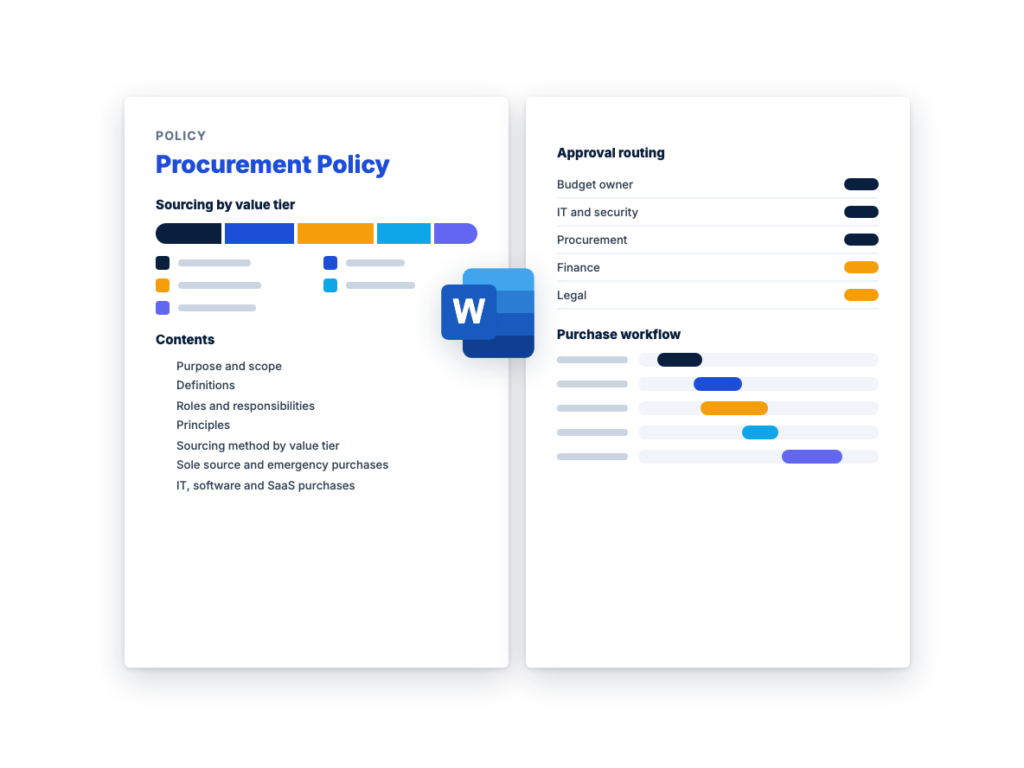
See the structure before you download. The Word file has every section listed below, ready to fill in.
The sections in the document, in order.
Use this procurement policy template to set the rules for how your organization buys goods, services, software and SaaS: who can ask, who approves, how much competition each purchase needs and what has to happen before an invoice is paid. It turns the steps in the procurement process guide into rules, from a request with budget approval through sourcing, the contract and purchase order, and receiving, to a three-way match before payment.
It's written for a private company or nonprofit adopting its first purchasing policy, or replacing one nobody follows. Every value tier has a [threshold] placeholder, because the right levels depend on your size, your spending and your controls, so you set them with finance. The purchase approval workflow is a section of the policy, with numbered steps and an approval routing table, so you can start with one document instead of a policy and a separate procedure.
Software and SaaS get their own section, because a card purchase or a free trial can put company data in a supplier's hands before anyone has read the terms. The policy requires IT and security review before purchase, at any value, and starts every request with the free software request form. Public bodies follow their own procurement laws, so check those rules first. The template isn't legal advice: have legal counsel review it before you adopt it.
Download the editable Microsoft Word version below. The full text is on this page, so you can read it before you download.
Fill in the placeholders with finance and the people who will approve purchases, have legal counsel review the draft, and have your board or leadership adopt it. Delete the italic guidance before you publish the policy to staff.
A purchase approval process sets who has to say yes before the organization commits money, and what each approver needs to see first. In this template it’s Section 8 of the policy: a numbered workflow from request to payment, an approval routing table by value tier, and a list of approvals any purchase needs whatever its value.
The workflow runs in this order: raise the request, get budget approval, confirm the tier and sourcing method, run the reviews and the sourcing, approve the award, sign the contract, set up the supplier, issue the purchase order, receive, match the invoice and pay. Who approves depends on the value and the risk:
This is the complete text of the Word document. Fill in the [bracketed] placeholders and delete the italic guidance before you use or send it.
Setting up this policy: replace each [bracketed placeholder], set
every [threshold] with finance, and delete anything that doesn’t apply
and all italic guidance before adoption. This template is for a private
company or nonprofit. It isn’t legal advice, so have legal counsel
review the policy before it’s adopted. Public bodies: read Section 1.3
first.
| Item | Details |
|---|---|
| Organization | [Organization legal name] |
| Policy owner | [Role, such as head of procurement or finance director] |
| Approved by and date | [Board / Chief executive / Leadership team], [date] |
| Effective date and version | [Date], [version number] |
| Next review due | [Date] |
This policy sets how [Organization name] (“the organization”) buys
goods, services, software and SaaS, so that it gets value over the life
of each purchase, treats suppliers fairly, approves each commitment
before it’s made, protects its data and systems, and keeps a record of
why each purchase was made the way it was.
It applies to every employee, [board member, volunteer] and
contractor who buys anything for the organization or commits it to buy,
from any budget and by any payment method, including cards and expense
claims. It covers renewals and contract changes, and free tools and
trials that hold company data or need someone to accept the supplier’s
terms. It doesn’t cover [payroll and benefits, taxes, or grants the
organization awards].
Public bodies follow procurement rules set by law, regulation and
policy, which vary by jurisdiction and purchase value. If yours is a
public body, check those rules first: they take priority, and parts of
this template may not apply or may need to be stricter.
Federal grant money can bring federal procurement standards.
Under 2
CFR 200.317, recipients and subrecipients other than states and
Indian Tribes follow 2 CFR 200.318 to 200.327. Among other things, 2 CFR
200.318 requires documented procurement procedures, written
standards of conduct covering conflicts of interest and records of each
procurement, and 2 CFR
200.320 sets procurement methods by value. Check the current text
and your award terms with counsel or the awarding agency.
Where grant or other restricted funds pay for a purchase, the
funder’s procurement rules also apply, and where they’re stricter, they
take priority. [Finance] confirms those rules before the first purchase
under each award.
| Term | Meaning in this policy |
|---|---|
| Purchase value | The total expected cost over the full term: every contract year, expected renewals and options, one-time fees and expected usage charges, [including / excluding] tax. Value tiers and approvals use this figure. |
| Supplier | Any business or person the organization buys from. “Vendor” means the same. |
| Sole source | A purchase from one supplier without competition because only that supplier can meet the need. A single source purchase, where others could supply but one is chosen for a documented reason, follows the same rules. |
| Emergency purchase | A purchase needed at once to protect people’s health or safety, prevent serious damage to property or keep critical operations running, where normal sourcing would make the harm worse. A deadline caused by poor planning isn’t an emergency. |
| Contract | Any agreement that commits the organization, including order forms, statements of work, purchase order terms and online terms accepted by clicking “I agree”. |
| Purchase order (PO) | The organization’s formal order to a supplier: items or services, quantities, prices, delivery dates, payment terms and a PO number to quote on the invoice. |
| Receiving record | The record of goods accepted or, for services, written confirmation that the work was delivered or a milestone met its acceptance criteria. |
| Conflict of interest | A personal, financial or family interest, or a relationship, that could influence, or appear to influence, someone’s part in a purchase. |
One person can hold several roles in a small organization. Keep
the separation of duties in Section 4.5 even then.
| Role | Responsibilities |
|---|---|
| Requester | Checks what’s already available, raises the request and confirms receipt. Doesn’t commit the organization to a supplier, accept its terms or give it company data before approval. |
| Budget owner | Confirms the need and the budget, and approves the spend. Never approves their own request. |
| Procurement | Confirms the tier and sourcing method, runs or supports sourcing, negotiates, issues purchase orders, and keeps the contract record and renewal calendar. [Without a procurement team: [role].] |
| IT and security | Review every request covered by Section 7 before purchase, grant and remove supplier access, and keep the IT asset records. |
| Legal | Reviews contracts and online terms under Section 9, with [privacy lead] for data processing terms. |
| Finance | Sets up and changes supplier records, runs the three-way match, pays invoices and sets card limits. |
| Policy owner | [Role]. Keeps this policy current, decides how it applies and keeps the exception register. |
Choose on value over the full term, not on the lowest first-year
price. Weigh the price with quality, fit, service, security, the
supplier’s ability to perform and the cost of leaving. For software and
SaaS, include renewal increases, usage growth, implementation and exit
costs.
No one person controls a purchase from request to payment. The
requester doesn’t approve their own request, and whoever sets up or
changes a supplier record doesn’t approve payments to that supplier.
Set each [threshold] with finance, from your own spending, risks
and controls. Public bodies and grant recipients must stay within
thresholds set by law or by the award.
Procurement confirms the tier before anyone asks a supplier for a
price. The tier depends on the purchase value of the whole purchase, not
of one order or one year.
| Tier | Purchase value | Minimum sourcing method | Records to keep |
|---|---|---|---|
| Tier 1 | Up to [threshold A] | One written quote or a published price, checked as reasonable | The quote or price, and the PO or card receipt |
| Tier 2 | Above [threshold A], up to [threshold B] | At least [number] written quotes for the same defined requirement, or a request for quotation (RFQ) |
The quotes, a comparison and the reason for the choice |
| Tier 3 | Above [threshold B] | A formal request for proposal (RFP), scored against weighted criteria set before responses arrive. Where the requirement is fully specified and price decides, an RFQ or invitation to bid |
The RFP, every response, the scores, the evaluation report and the award approval |
RFPhub’s RFP vs
RFQ vs RFI compares the methods.
Above [threshold A], a purchase may skip the competition in Section 5
only with a written justification, approved before the organization
commits, on one of these grounds:
The justification covers the need and its value, why only this
supplier can meet it and competition isn’t practical, the market
research done and alternatives considered, why the price is reasonable
and how long the arrangement lasts. Preference, familiarity and a
deadline caused by poor planning aren’t grounds. Where several resellers
sell a required brand, compete the price among them.
RFPhub’s sole source
justification guide explains what a strong justification
contains.
Hardware, software, SaaS, cloud services, IT and managed services,
including renewals and upgrades, AI tools and features that will process
company data, and free tools and trials that will hold company data,
connect to company systems or need someone to accept the supplier’s
terms.
Every request starts with the Software
Request Form, sent to [intake address], before anyone commits to a
supplier, accepts its terms or gives it company data. IT first checks
whether the organization already owns something that meets the need.
IT records each tool’s owner, license metric and quantity, renewal
date and notice deadline, and procurement puts the notice deadline in
the renewal calendar. The owner reviews usage and need before that
deadline.
This section is the purchase approval procedure. If you later
write detailed steps for your purchasing system, keep the two
consistent.
Use the same thresholds as Section 5.
| Tier (purchase value) | Approvers | Documents required |
|---|---|---|
| Tier 1: up to [threshold A] | Budget owner | Purchase requisition or card receipt; the quote or published price; the Software Request Form for anything covered by Section 7 |
| Tier 2: above [threshold A], up to [threshold B] | Budget owner; procurement; [department head] | Purchase requisition; [number] written quotes or RFQ responses, compared, with the reason for the choice |
| Tier 3: above [threshold B], up to [threshold C] | Budget owner; procurement; [finance director or CFO]; [executive sponsor] |
Purchase requisition or business case; the RFP, responses, scores and evaluation report; contract review notes |
| Tier 3: above [threshold C] | Every approver above, plus [chief executive / board] | As above, plus [a board summary: need, options, recommendation, full-term cost and risks] |
| When the purchase involves | Also approved by | Document |
|---|---|---|
| Software, SaaS, a cloud service or an IT service | IT and security | The completed Software Request Form |
| Personal or regulated data | [Privacy lead] or legal | A data processing agreement, where the supplier processes personal data |
| The supplier’s own terms, or nonstandard terms | Legal | Legal review notes |
| A sole source or single source | Procurement and [role] | Sole source justification (Section 6.1) |
| A related party or a declared conflict of interest | [Policy owner] | The declaration and how the conflict is managed |
| Grant or restricted funds | [Grants manager or finance] | Confirmation that the funder’s rules were followed |
| Contract (purchase value) or type | Authorized signatory |
|---|---|
| Up to [threshold A] | [Role] |
| Above [threshold A], up to [threshold B] | [Role] |
| Above [threshold B] | [Role, after board approval above [threshold C]] |
| Nondisclosure agreements, data processing agreements and online terms for an approved request |
[Role or named delegate] |
Before the first PO or payment, finance sets up each new supplier
using the Vendor
Onboarding Checklist [or your own]:
When a contract ends, IT removes the supplier’s access, and
procurement gets written confirmation that the organization’s data has
been returned or deleted.
Procurement keeps a file for each purchase in [location]: the request
and approvals; the quotes or RFP documents, responses and scores; any
justification, emergency record or exception; conflict declarations; the
contract and POs; and the receiving records, invoices and payments. The
file shows why the method, supplier and price were chosen.
Files are kept for [period] after the contract ends or the final
payment, whichever is later, or longer where a law, tax rule, grant
award or legal hold requires it.
Set [period] with finance and legal counsel.
Anyone who needs to depart from a rule in this policy asks [policy
owner] in writing, before the organization commits, with the details
below. An exception covers one purchase or a stated period, and can’t
set aside a law, a funder’s rules or Section 4.3.
| Item | Details |
|---|---|
| Requester and date | |
| Purchase, supplier and purchase value | |
| The rule to set aside (section) and why it can’t be followed | |
| Risks, and how they’ll be controlled | |
| Purchases or period covered | |
| Decision | ☐ Approved ☐ Approved with conditions ☐ Not approved |
| Decided by, role and date |
[Policy owner] approves exceptions up to [threshold B], and [finance
director or CFO] above it, with IT and security for any exception to
Section 7. [Policy owner] keeps an exception register and reports it to
[leadership] every [interval].
A commitment made without the approvals this policy requires, such as
a contract signed without authority, is reported to [policy owner].
[Role] decides whether to approve it after the fact, cancel it or
renegotiate it, and breaches can lead to action under [disciplinary
policy]. Anyone can report a suspected breach or fraud to [contact or
reporting line].
| Version | Date | Changes | Approved by |
|---|---|---|---|
| [Version number] | [Date] | [Summary of changes] | [Name and role] |
Its purpose and scope, definitions, the roles of requesters, budget owners, procurement, IT and security, legal and finance, and principles such as fair competition and conflicts of interest. Then the sourcing method for each value tier, rules for sole source, emergency and software purchases, an approval workflow, signature authority, receiving and invoice matching, records retention, exceptions and a review date. This template includes all of them, with placeholders for your own thresholds and roles.
A policy sets the rules: what must happen, who approves and which sourcing method each purchase needs. A procedure sets out the steps people follow to meet those rules, such as how to raise a requisition in your purchasing system. This template puts a short purchase approval workflow inside the policy, so you can start with one document and write detailed procedures later.
Start from your own spending: the usual size of your purchases, who is available to approve them and how much risk leadership will accept at each level. Set the tiers so routine purchases move quickly and larger or riskier ones get competition and senior review, and agree them with finance and, where your governance requires it, the board. Measure value over the full contract term, including renewals, and ban splitting a purchase to stay under a tier. Public bodies and grant recipients also have to work within thresholds set by law or by the award.
On a regular cycle that the policy owner sets and the policy records, and also whenever something changes: new laws or funding rules, an audit finding, a new purchasing system, a reorganization or repeated exceptions to the same rule. Each review checks that the thresholds, approvers and signatories still fit and that the workflow matches how people actually buy. Record every change in the version history.
It should cover software, SaaS and cloud services explicitly, including free trials, because clicking “I agree” can accept a vendor’s terms and put company data in the tool before anyone has reviewed it. The policy should require a request through IT, a security and privacy review before purchase at any value, and no card or expense purchases of software that hasn’t been reviewed. It should also make someone record each renewal’s notice deadline, so the organization can cancel or renegotiate in time.
A free, editable information security policy for small and mid-sized organizations, with data classification, access and password rules, AI tool use and…
A free, vendor-neutral business continuity plan template in Word, with a BIA worksheet, process priorities, continuity strategies, crisis management, communications and an…
A free, vendor-neutral incident response plan template in Word, with roles, a severity matrix, out-of-band contacts, containment approvals, playbooks, evidence and notification…
Please provide your feedback below.
"*" indicates required fields