Information Security Policy Template for IT (Free, Word)
A free, editable information security policy for small and mid-sized organizations, with data classification, access and password rules, AI tool use and…
Word · FreeDownload Template →
A free, editable third-party risk management (TPRM) policy for private organizations: roles, a vendor inventory, risk tiers, due diligence, contract terms and monitoring by tier, and offboarding.
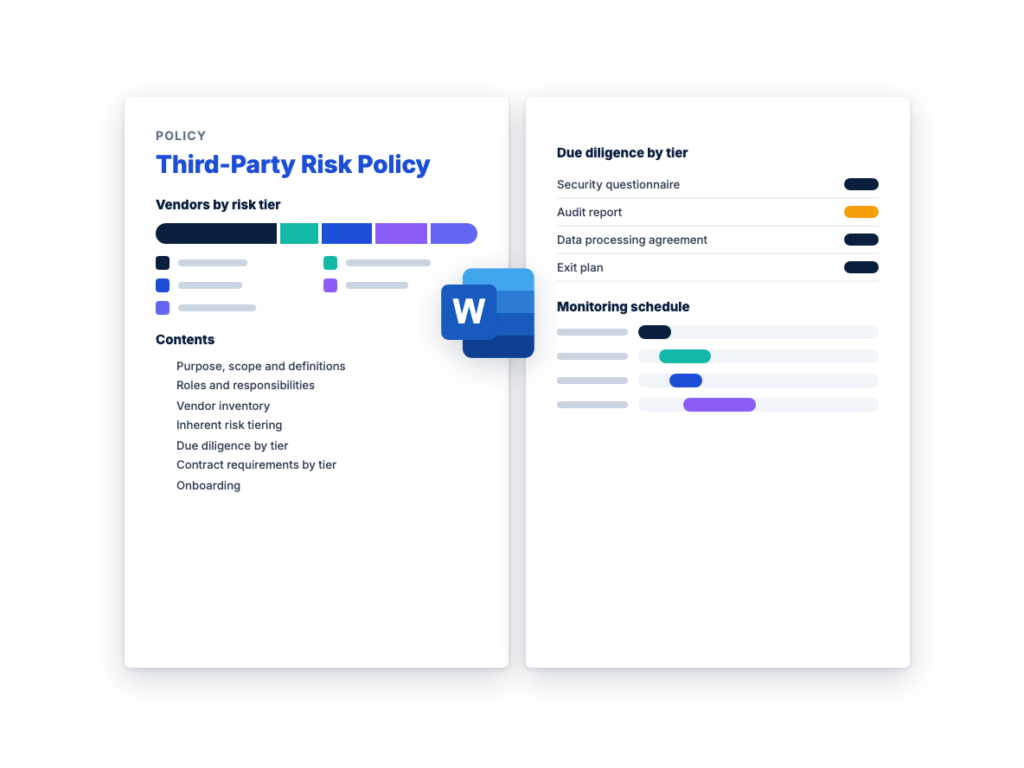
See the structure before you download. The Word file has every section listed below, ready to fill in.
The sections in the document, in order.
Use this third-party risk management policy template to set the rules for how your organization finds, rates and controls the risks its vendors, suppliers and service providers bring, from the request to use one until the relationship ends. It turns the program in the vendor risk management guide into policy: keep an inventory, tier every vendor by risk, scale due diligence, contract terms and monitoring to the tier, follow every finding to closure, and exit cleanly.
It's written for a private company or nonprofit, and it sits beside a purchasing policy such as the free procurement policy template. The procurement policy decides how you buy. This TPRM policy decides how much oversight each third party gets, who owns each relationship, and who can accept the risks that remain. The roles run from the vendor owner and the TPRM lead to security, IT, privacy, legal, procurement, finance and an executive risk owner.
The tiers, the seven risk types and the due diligence match the free vendor risk assessment template, which holds the scoring and the risk register for each vendor. Every review cadence is an [interval] placeholder, because the right one depends on your vendors and your team. The template isn't legal advice: have legal counsel review it before you adopt it, and if you're a bank, credit union or other regulated organization, check your regulator's guidance first.
Download the editable Microsoft Word version below. The full text is on this page, so you can read it before you download.
Fill in the placeholders with the people who will run the reviews, have legal counsel review the draft, and have your board or leadership adopt it. Delete the italic guidance before you publish the policy to staff.
A vendor management policy covers the whole supplier relationship: how vendors are chosen and contracted, how spend is controlled, how performance is reviewed against the contract and how renewals are decided. A third-party risk management policy covers the part focused on what could go wrong, such as a breach, an outage or a vendor failing, and the controls that reduce it.
Some organizations write one document that does both, and others keep two. Either works if the scope is clear and both use the same inventory, vendor owners and renewal calendar. If you keep two, one way to divide the work:
This is the complete text of the Word document. Fill in the [bracketed] placeholders and delete the italic guidance before you use or send it.
Setting up this policy: replace each [bracketed placeholder], set
every [interval] and [period] with the people who will run the reviews,
and delete anything that doesn’t apply and all italic guidance before
adoption. This template is for a private company or nonprofit. It isn’t
legal advice, so have legal counsel review the policy before it’s
adopted. Banks, credit unions and other regulated organizations: read
Section 1.4 first.
| Item | Details |
|---|---|
| Organization | [Organization legal name] |
| Policy owner | [Role, such as TPRM lead, head of security or head of procurement] |
| Approved by and date | [Board / Chief executive / Risk committee], [date] |
| Effective date and version | [Date], [version number] |
| Next review due | [Date] |
This policy sets how [Organization name] (“the organization”) finds,
rates and controls the risks that come with its third parties, from the
request to use one until the relationship ends, so that each gets
oversight in proportion to its risk and every open risk has an owner. It
works alongside the [procurement policy], which sets how purchases are
requested, competed and approved.
No procurement policy yet: RFPhub’s free Procurement
Policy Template is one starting point.
This policy applies to every third party that provides goods,
services or software to the organization, or acts for it:
It covers new relationships, renewals and changes in scope, at any
value and by any payment method, and free tools and trials once they
hold company data, connect to company systems or need someone to accept
the supplier’s terms. It doesn’t cover [employees, or payments such as
taxes that aren’t supplier relationships].
| Term | Meaning in this policy |
|---|---|
| Third party | Any business or person outside the organization that provides goods, services or software to it, or acts for it. Vendors, suppliers and service providers are all third parties. |
| Fourth party | A supplier of a third party, such as the hosting provider a SaaS vendor runs on or a sub-processor that receives the organization’s data. The organization usually has no contract with it. |
| Vendor owner | The person who requested the third party and owns the relationship. Also called the business owner. |
| Inherent risk | The risk a third party brings before any controls are taken into account: the data it will hold, what it can reach in company systems and how much the organization depends on it. |
| Residual risk | The risk that remains after the third party’s controls and the organization’s own are applied. |
| Tier | High, medium or low, set from inherent risk under Section 4. |
| Finding | A gap or concern from due diligence, monitoring, an audit or an incident, logged in the risk register. |
| Concentration risk | Relying on one third party, or one fourth party, for several critical services, or holding data in a format only one vendor reads. |
Some sectors have regulator guidance or rules on third-party
risk, and where they apply they take priority over this template. In US
banking, the Federal Reserve, the FDIC and the OCC issued the Interagency
Guidance on Third-Party Relationships: Risk Management in June 2023,
covering each stage of the relationship: planning, due diligence and
third-party selection, contract negotiation, ongoing monitoring and
termination. In September 2026 those agencies and the NCUA published proposed
guidance that, if finalized, would replace it. Regulated
organizations should confirm which guidance is current, and any other
rules for their sector, with their compliance team and legal
counsel.
For cybersecurity, the NIST
Cybersecurity Framework (CSF) 2.0, which any organization can use,
has a Cybersecurity Supply Chain Risk Management category (GV.SC). Its
outcomes follow the same path as this policy, from knowing suppliers and
prioritizing them by criticality to planning for what happens after an
agreement ends.
One person can hold several roles in a small organization, but a
vendor owner can’t also act as the TPRM lead or executive risk owner for
their own third party, so every exception and every medium- or
high-rated risk acceptance has a second, independent approver.
| Role | Responsibilities |
|---|---|
| Vendor owner | Owns the relationship. Gives the facts the tier needs, gets findings fixed by their due dates, accepts low-rated risk (Section 12), keeps the performance record and starts the renewal or exit decision before the notice deadline. |
| TPRM lead | [Role]. Runs the program: keeps the inventory, confirms tiers, keeps the risk and exception registers, and reports to leadership. |
| Security | Sets security assessment requirements by tier, reviews evidence, rates security findings and leads the response to incidents at third parties. |
| IT | Grants and removes third-party access, reviews architecture and integrations, and records the accounts, keys and connections each third party holds. |
| Privacy | Reviews third parties that will process personal data, the data processing agreement, data locations and sub-processors. |
| Legal | Reviews contract terms (Section 6) and advises on the laws that apply. |
| Procurement | Routes every new third party through intake, puts the Section 6 requirements in solicitations and negotiations, and keeps the contract record and renewal calendar. |
| Finance | Provides payment, card and expense data that reveals third parties missing from the inventory, runs financial reviews, and sets up supplier records only for third parties that have a tier. |
| Executive risk owner | [Role, such as chief risk officer or chief financial officer]. Sets the organization’s tolerance for third-party risk, accepts high-rated risks, approves exceptions for high-tier third parties and receives the reports in Section 13. |
The TPRM lead keeps one inventory of every third party in scope, in
[system or spreadsheet]. No one engages a third party that isn’t in it.
For each one it records:
Every new third party enters through intake under the [procurement
policy]. Every [interval], the TPRM lead checks the inventory against
accounts payable records, the contract repository, the applications
connected to the identity provider, and card and expense reports, which
is where software bought outside IT tends to show up. A third party
found in use without a tier is tiered at once and its due diligence
finished within [period], or its use stops and its access is
removed.
RFPhub’s free Vendor
Risk Assessment Template scores these four factors on defined levels
and maps the total to high, medium or low. Use it, or your own method,
the same way for every third party.
Each third party is tiered on its inherent risk, from four factors:
data sensitivity (the data it will hold),
system access (what it can reach in company systems),
criticality (what stops if the service fails) and
replaceability (how hard it would be to leave).
| Tier | Meaning | Example |
|---|---|---|
| High | Holds personal, financial, health or payment data, credentials or other protected data; has administrator rights, remote access, an installed agent or API access that can change core systems; or supports a core process with no practical workaround |
A payroll SaaS; a managed service provider with administrator access |
| Medium | Not high, but holds internal business data, has a limited integration or user-level accounts, or has so few alternatives that leaving means a major migration |
A project tool holding internal documents |
| Low | No business data beyond public information and no connection to company systems; an outage would at most slow one team that has a workaround, and it could be replaced without a major migration |
A stock image subscription |
Due diligence is completed before the contract is signed and before
the third party gets data or access. For the security questions, use
[the organization’s questionnaire / RFPhub’s free Vendor
Security Questionnaire Template].
| Check | Low | Medium | High |
|---|---|---|---|
| Security questions | A short checklist: data location, sign-in security, incident reporting, deletion at exit and AI use of the data |
A short security questionnaire | The full security questionnaire |
| Independent evidence | Not required | Evidence covering the service, such as a SOC 2 Type II report or an ISO/IEC 27001 certificate |
A SOC 2 Type II report, or an ISO/IEC 27001 certificate with its statement of applicability, covering the service |
| Penetration test summary | Not required | Not required | From an independent tester: the date, the scope, and whether serious findings were fixed |
| Sub-processor list | Not required | If personal data is involved | Required, with how changes are notified |
| References the organization chooses | Not required | Recommended | Required, including at least one the organization finds itself |
| Financial information | Not required | If the organization will depend on the third party | Required |
| Insurance certificate | If the contract requires insurance | For the coverage the contract requires | For the coverage the contract requires |
| Architecture and integration review by IT | Not required | For each connection to company systems | Required |
| Exit plan | Not required | If the third party would be hard to replace | Required |
Put these in the RFP or request for quotation, so bidders price
and accept them before award. RFPhub’s free Contract
Review Checklist checks them before signature, and the Service
Level Agreement Template covers service levels and credits.
| Requirement | What the contract includes | Required for |
|---|---|---|
| Security requirements | Controls kept for the whole term, including a current independent audit report or certification covering the service, and new reports as they’re issued |
Medium and high |
| Audit rights | The right to receive audit reports, ask follow-up questions and, where it matters, assess the third party |
High |
| Incident notification | Notice within [time] of [confirming / becoming aware of] an incident affecting the organization’s data, what the notice contains, and cooperation in the response |
All tiers |
| Sub-processor changes | [Period] of notice before a new sub-processor handles the data, a right to object or leave, and security and data protection obligations passed down to sub-processors |
Medium and high |
| Service levels | How availability and support response are measured, credits for a miss, and a right to terminate after repeated failures |
Any tier where the service is critical |
| Data return and deletion | The format and timeline for returning the data, and written confirmation of deletion, including backups |
All tiers |
| Termination assistance | Help moving to a new provider, with the service continued through the transition |
High |
| Data processing agreement | How personal data may be processed, by which sub-processors and where it’s held |
Any tier with personal data |
| Limits on data use | Stated data locations, and no use of the data to train AI models that serve other customers without the organization’s agreement |
Medium and high |
Legal counsel reviews the wording, and only the signatories in the
[procurement policy] sign. A requirement the third party won’t accept is
a finding under Section 9, decided before signature.
Procurement and the vendor owner complete onboarding with the Vendor
Onboarding Checklist [or the organization’s own]. Before
go-live:
| Tier | Sign-off before go-live |
|---|---|
| Low | Vendor owner and TPRM lead |
| Medium | Vendor owner, TPRM lead and security, plus IT, privacy or legal where their review applied |
| High | Vendor owner, TPRM lead, security, IT, procurement, legal and privacy, plus the executive risk owner if a high-rated risk is accepted |
Set the intervals with security and the vendor owners, with
high-tier third parties reviewed most often, and book each review in
[system].
| Activity | High | Medium | Low |
|---|---|---|---|
| Full reassessment: tier, due diligence, findings and contract controls |
Every [interval] | Every [interval] | Every [interval], or at renewal |
| New audit report or certificate: read the scope, period and exceptions |
As each is issued, and at least every [interval] | As each is issued | Not required |
| Access review: accounts, API keys, integrations, and data beyond what the tier assumed |
Every [interval] | Every [interval] | At renewal |
| Sub-processor list and terms check | Every [interval] | Every [interval] | At renewal |
| Financial review | At renewal, and every [interval] | At renewal, if the organization depends on the third party | Not required |
| Open findings | Every [interval] until closed | Every [interval] until closed | At renewal |
| Renewal review, using the risk and performance records | [Interval] before the notice deadline | [Interval] before the notice deadline | [Interval] before the notice deadline |
Whatever the tier, anyone who learns of one of these tells the TPRM
lead, who reviews the third party within [period]:
Risk monitoring checks whether the controls still hold. Performance
against the contract, such as service levels, is a separate record the
vendor owner keeps with a vendor
scorecard. Both feed the renewal decision.
Every finding is logged in the risk register in [system or the vendor
risk assessment] under one of seven risk types: security; privacy and
data protection; operational and availability; financial; compliance and
regulatory; concentration and lock-in; and fourth-party. It’s rated
high, medium or low from its likelihood and impact, using [the rating
grid in the vendor risk assessment], and given one treatment:
Security leads the response to an incident at a third party, or one
of its suppliers, that affects the organization’s data or services,
under the [incident response plan]. The incident is logged, the risks it
affects are re-rated, and the third party gets an early review. Legal
and privacy decide whether the organization has notification duties of
its own.
The organization usually has no contract with a fourth party, so it
manages the risk through the third party:
The TPRM lead uses the inventory to find concentration: several
critical services that depend on one third party or one hosting
provider, or data held in a format only one vendor reads. Each one is
logged as a concentration and lock-in finding and treated under Section
9, with controls such as an exit plan, data export in a documented
format, termination assistance and [where justified] a workaround or a
second provider.
When any third-party relationship ends, the vendor owner starts
offboarding well before the notice deadline, and the TPRM lead confirms
each step is done.
| Step | Owner | Done (date) |
|---|---|---|
| Decide whether to renew, renegotiate or leave, using the risk and performance records, and give notice by the deadline |
Vendor owner, procurement | |
| Move to the new provider, with termination assistance where the contract includes it |
Vendor owner, IT | |
| Get the data back in a usable format, and check that it’s complete |
Vendor owner, IT | |
| Revoke the third party’s accounts, single sign-on access, API keys and remote access, and change any shared credentials |
IT, security | |
| Remove its integrations and agents from company systems | IT | |
| Get written confirmation that the data has been deleted, including backups, on the timeline the contract sets |
Security, legal and privacy | |
| Close or hand over open findings, and remove its contacts from the incident response plan |
TPRM lead, security | |
| Stop billing and close the purchase order | Procurement, finance | |
| Update the inventory: status, end date and where the records are kept |
TPRM lead |
The relationship’s assessments, findings and acceptances are kept for
[period] after it ends.
A residual risk is accepted only in writing, by someone with the
authority below, with the reason, the compensating controls and a review
date no more than [period] away. An acceptance lapses on its review date
unless renewed, and each one is recorded in the risk register and the
inventory.
| Finding rating | Who can accept the risk |
|---|---|
| Low | Vendor owner |
| Medium | Vendor owner and TPRM lead |
| High | Executive risk owner, after review by security, and by privacy or legal where their area is affected |
Anyone who needs to depart from a rule in this policy, such as giving
a third party access before due diligence is complete, asks the TPRM
lead in writing first. An exception covers one third party for no more
than [period], and can’t set aside a law, a regulation or a contract.
The TPRM lead approves exceptions for low- and medium-tier third
parties, and the executive risk owner for high-tier ones. The TPRM lead
keeps the exception register.
| Item | Details |
|---|---|
| Requester and date | |
| Third party, service and tier | |
| The rule to set aside (section) and why it can’t be followed | |
| Risks, and how they’ll be controlled meanwhile | |
| Period covered, and the plan to comply | |
| Decision | ☐ Approved ☐ Approved with conditions ☐ Not approved |
| Decided by, role and date |
The TPRM lead reports to [executive risk owner / risk committee /
board] every [interval], and within [period] of a serious incident at a
high-tier third party. Each report covers:
| Version | Date | Changes | Approved by |
|---|---|---|---|
| [Version number] | [Date] | [Summary of changes] | [Name and role] |
Its purpose, scope and definitions, the roles involved, and a requirement to keep an inventory of every third party. Then how vendors are tiered by risk, the due diligence, contract terms and monitoring each tier needs, how findings are followed to closure, fourth parties and concentration risk, offboarding, exceptions and risk acceptance, reporting to leadership and a review date. This template includes all of them, with placeholders for your own roles and intervals.
One person runs the program and owns the policy, often a TPRM lead in procurement, security or IT risk, and the board or leadership approves it. The work is shared: the vendor owner owns each relationship and its findings, security and privacy review evidence, legal reviews contract terms, and procurement and finance keep the inventory complete. An executive risk owner accepts the largest risks and receives regular reports.
Rate each vendor on the data it will hold, its access to your systems, how critical its service is and how hard it would be to replace. Group the results into high, medium and low tiers, and treat a vendor with sensitive data, privileged access or a core service as high tier whatever its other ratings. Tier on what the vendor will hold and reach, not on its controls, and re-tier when its data or access changes.
On a cadence your policy sets for each tier, with high-risk vendors reviewed most often and low-risk vendors at renewal. Review any vendor early after a trigger, such as an incident, an acquisition, a new sub-processor, a new integration or a new AI feature that uses your data. Start each renewal review well before the notice deadline, so there’s time to renegotiate or leave.
It covers the whole supplier relationship: choosing vendors, contracting, controlling spend, reviewing performance against the contract and deciding renewals. Some organizations fold third-party risk management into it, and others keep a separate risk policy like this one. If you keep both, make sure they share the same inventory, vendor owners and renewal calendar.
A free, editable information security policy for small and mid-sized organizations, with data classification, access and password rules, AI tool use and…
A free, vendor-neutral business continuity plan template in Word, with a BIA worksheet, process priorities, continuity strategies, crisis management, communications and an…
A free, vendor-neutral incident response plan template in Word, with roles, a severity matrix, out-of-band contacts, containment approvals, playbooks, evidence and notification…
Please provide your feedback below.
"*" indicates required fields